


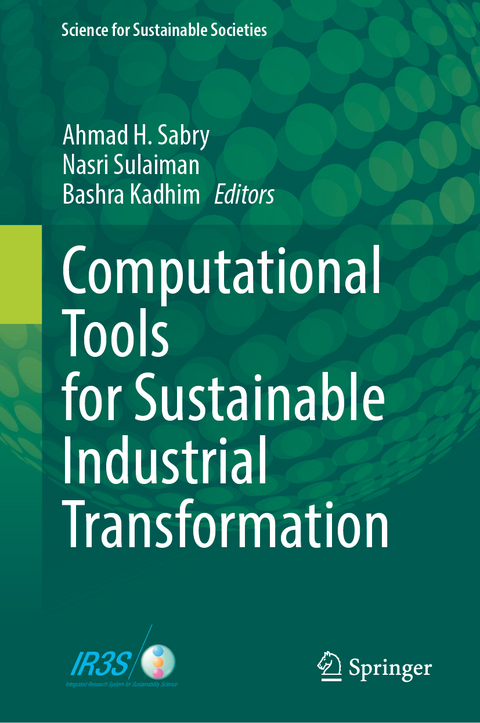
Computational Tools for Sustainable Industrial Transformation
Springer Verlag, Singapore
978-981-95-0499-2 (ISBN)
- Titel nicht im Sortiment
- Artikel merken
Designed for industrial engineers, managers, and academics across disciplines such as engineering, environmental science, and business management, this book offers practical guidance on implementing computational techniques to optimize processes and reduce environmental impact. It invites readers to think through critical questions about sustainable practices and provides actionable insights that can be directly applied within industrial settings. By bridging theoretical knowledge with practical application, this book serves as an essential resource for professionals seeking to drive sustainable change in industry.
Ahmad H. Sabry was born in Baghdad, Iraq. He received the B.Sc. and M.Sc. degrees in electrical and electronics, control and automation, engineering from the University of Technology-Baghdad, Iraq, in 1994 and 2001, respectively. He received the Ph.D. degree in DC Based PV-Powered Home Energy System from Department of Electrical and Electronic Engineering, control and automation at UPM, Malaysia in 2017. He is the author of more than 35 articles, and more than 5 inventions, and holds one patent. His research interests include Integrated Solar Powered Smart Home System Based on Voltage Matching, DC distribution, industrial robotic systems, wireless energy management systems. Nasri Sulaiman (Member, IEEE) received the bachelor’s degree in electronics and computer engineering from Universiti Putra Malaysia (UPM), Malaysia, in 1994, the master’s degree in microelectronics system design from the University of Southampton, U.K., in 1999, and the Ph.D. degree in adaptive hardware from The University of Edinburgh, U.K., in 2007. He is currently an Associate Professor at the Department of Electrical and Electronic Engineering, Faculty of Engineering, UPM. He is currently working on a variety of research projects such as “High Performance Hardware Implementation of a Multi-Objective Genetic Algorithm” which is funded through the Research University Grant Scheme (RUGS) of Universiti Putra Malaysia (UPM), as well as, “Crest Factor Reduction and Digital Pre-distortion Implementation in Orthogonal Frequency Division Multiplexing (OFDM) Systems, funded by the Ministry of Science, Technology and Innovation (MOSTI). His research interests include evolutionary algorithms, digital signal processing, digital communications, and low power VLSI designs. Bashra Kadhim was born in Baghdad. Currently, she is working as an Assistant Professor in the department of Control and System Engineering at University of Technology, Iraq. She completed her Master degree in Mechatronics Engineering at University of Technology (UOT) Bagdad-Iraq. She obtained her PhD at Control Engineering Department (RST), Siegen University, Germany. She also served as a lecturer in control and systems Engineering Department at UOT 2005. She also served as a Reviewer and Editor in many reputed journals notably IEEE Access, MTAP, Journal of Intelligent Systems and so on. She also had a proven experience in the International Journal of Intelligent Engineering Informatics as an Editor. Her research interests are mobile robot, path planning, multi objective optimization and intelligent algorithm.
Chapter 1. Advanced AI and Digital Twin Solutions: WOA, BERT, ST-GCN, PSO- Enhanced IoT Cybersecurity and Transformation.- Chapter 2. AI-Powered Blockchain and IoT Frameworks: Integrating DAG, LPWAN, SPNs, PSNR, and ECC for Smart Environmental Solutions.- Chapter 3. AI-Powered Multi-Scale Analysis of Urban Green Spaces Using OBIA, LULC Mapping, and Ecosystem Valuation for Human Settlement Sustainability.- Chapter 4. Industrial Robotics in Smart Manufacturing: Integrating PLM, AMRs, GNNs, CPS, and Energy-Efficient Systems.- Chapter 5. Revolutionizing Industrial Automation: Blockchain-IoT Convergence with Secure Data Sharing and Real-Time Monitoring for Smart Systems.- Chapter 6. Revolutionizing Urban Development in Smart Cities with Advanced Digital Twins: Integrating IoT, Multi-Model Simulations, and Geospatial Analytics.- Chapter 7. Running Industrial Workflow Applications in a Software-Defined Multi-Cloud Environment Using Neural Networks, MAS, PSO, MILP, and Game-Theoretic Models for Green Energy-Aware Scheduling.- Chapter 8. Transforming Urban Landscapes with AI: Utilizing Reforestation Drones, Ocean Cleanup Robotics, Predictive Climate Modelling, and Green Infrastructure to Build Resilient and Sustainable Cities of Tomorrow.
| Erscheinungsdatum | 24.10.2025 |
|---|---|
| Reihe/Serie | Science for Sustainable Societies |
| Zusatzinfo | 50 Illustrations, color; 4 Illustrations, black and white |
| Verlagsort | Singapore |
| Sprache | englisch |
| Maße | 155 x 235 mm |
| Themenwelt | Informatik ► Office Programme ► Outlook |
| Mathematik / Informatik ► Mathematik ► Finanz- / Wirtschaftsmathematik | |
| Naturwissenschaften ► Biologie ► Ökologie / Naturschutz | |
| Naturwissenschaften ► Geowissenschaften | |
| ISBN-10 | 981-95-0499-6 / 9819504996 |
| ISBN-13 | 978-981-95-0499-2 / 9789819504992 |
| Zustand | Neuware |
| Informationen gemäß Produktsicherheitsverordnung (GPSR) | |
| Haben Sie eine Frage zum Produkt? |
aus dem Bereich


