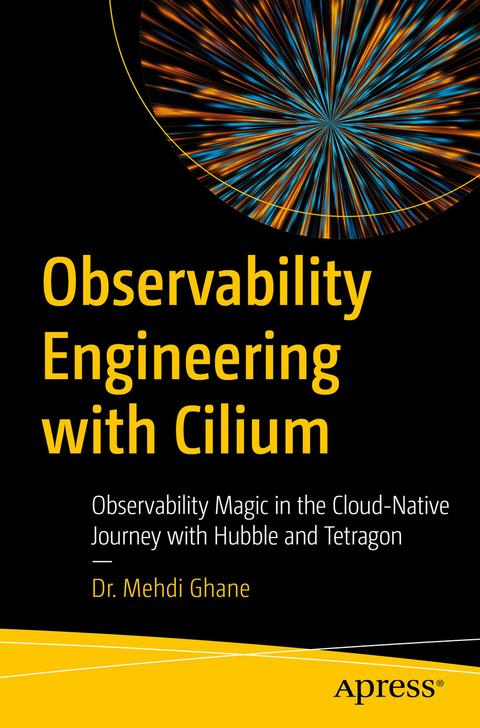
Observability Engineering with Cilium (eBook)
319 Seiten
Apress (Verlag)
979-8-8688-1258-3 (ISBN)
In the dynamic realm of software deployment, the rise of cloud native technologies has transformed technological and cultural standards. This shift, while bringing innovation and agility, also introduces paradigms and complexities with the interplay of microservices in on-prem, multi and hybrid cloud. To address these challenges, Observability engineering is now a necessity and is crucial for survival in the competitive world of Industry 4.0, AI and cloud native.
Observability Engineering with Cilium dives into the cloud native ecosystem, exploring observability's core principles and applications. The goal is to delve into the under-addressed aspects of observability critical for cloud native deployment. It aims to provide a deep understanding of cloud native environments. Throughout, we demystify key definitions, paradigms and shed light on socio-economic and socio-technical change, Conway's Law, maturity models and other less-discussed aspects to guide you in designing, building, and operating a comprehensive Observability platform, leveraging technologies like Kubernetes, service mesh and eBPF and tools like Cilium, Hubble, Tetragon, Prometheus, OpenTelemetry, Cribl, Splunk, Pixie, Falco, Grafana Beyla and Alloy.
By the end of this book, you'll have the tools to level up your knowledge base to become a sophisticated cloud native observability engineer.
You Will Learn:
- The complexities of cloud native environments by exploring modern observability trends with cutting-edge technologies like eBPF, Cisco Cilium, and other innovative tools and methodologies
- How to effectively utilize eBPF across on-prem and hybrid cloud environments
- How to identify risks in your cloud native journey as well as how to mitigate them
- Insights into software instrumentation essential for effective monitoring and diagnostics
- How to navigate trade-offs, processes, and challenges to enhance observability efficiency KPIs
This Book is for:
Kubernetes specialists, and application architects, as well as CISOs, CTOs, and CIOs who wish to learn how to utilize modern concepts and tools to plan, design and operate a flexible Observability platform that backs you during migration from current state of operation to the cloud native state.
In the dynamic realm of software deployment, the rise of cloud-native technologies has transformed technological and cultural standards. This shift, while bringing innovation and agility, also introduces paradigms and complexities with the interplay of microservices in on-prem, multi and hybrid cloud. To address these challenges, Observability engineering is now a necessity and is crucial for survival in the competitive world of Industry 4.0, AI and cloud native.Observability Engineering with Cilium dives into the cloud-native ecosystem, exploring observability's core principles and applications. The goal is to delve into the under-addressed aspects of observability critical for cloud-native deployment. It aims to provide a deep understanding of cloud-native environments. Throughout, we demystify key definitions, paradigms and shed light on socio-economic and socio-technical change, Conway's Law, maturity models and other less-discussed aspects to guide you in designing, building, and operating a comprehensive Observability platform, leveraging technologies like Kubernetes, service mesh and eBPF and tools like Cilium, Hubble, Tetragon, Prometheus, OpenTelemetry, Cribl, Splunk, Pixie, Falco, Grafana Beyla and Alloy.By the end of this book, you'll have the tools to level up your knowledge base to become a sophisticated cloud-native observability engineer.You Will Learn:The complexities of cloud-native environments by exploring modern observability patterns with technologies like eBPF, Cisco Cilium, and innovative methodologiesHow to effectively utilize eBPF across on-prem and hybrid cloud environmentsHow to identify risks in your cloud-native journey as well as how to mitigate themInsights into software instrumentation essential for effective monitoring and diagnosticsHow to navigate trade-offs, processes, and challenges to enhance observability efficiency KPIsThis Book is for:Kubernetes specialists, and application architects, as well as CISOs, CTOs, and CIOs who wish to learn how to utilize modern concepts to plan, design and operate a flexible Observability platform that backs you during migration from current state of operation to the cloud-native state.
| Erscheint lt. Verlag | 4.7.2025 |
|---|---|
| Zusatzinfo | XVII, 319 p. 70 illus., 66 illus. in color. |
| Sprache | englisch |
| Themenwelt | Mathematik / Informatik ► Informatik ► Betriebssysteme / Server |
| Mathematik / Informatik ► Informatik ► Datenbanken | |
| Mathematik / Informatik ► Informatik ► Netzwerke | |
| Mathematik / Informatik ► Mathematik ► Finanz- / Wirtschaftsmathematik | |
| Schlagworte | Cilium • Cloud Native • Grafana • observability • Tetragon |
| ISBN-13 | 979-8-8688-1258-3 / 9798868812583 |
| Informationen gemäß Produktsicherheitsverordnung (GPSR) | |
| Haben Sie eine Frage zum Produkt? |
 PDF (Wasserzeichen)
Größe: 11,1 MB
DRM: Digitales Wasserzeichen
Dieses eBook enthält ein digitales Wasserzeichen und ist damit für Sie personalisiert. Bei einer missbräuchlichen Weitergabe des eBooks an Dritte ist eine Rückverfolgung an die Quelle möglich.
Dateiformat: PDF (Portable Document Format)
Mit einem festen Seitenlayout eignet sich die PDF besonders für Fachbücher mit Spalten, Tabellen und Abbildungen. Eine PDF kann auf fast allen Geräten angezeigt werden, ist aber für kleine Displays (Smartphone, eReader) nur eingeschränkt geeignet.
Systemvoraussetzungen:
PC/Mac: Mit einem PC oder Mac können Sie dieses eBook lesen. Sie benötigen dafür einen PDF-Viewer - z.B. den Adobe Reader oder Adobe Digital Editions.
eReader: Dieses eBook kann mit (fast) allen eBook-Readern gelesen werden. Mit dem amazon-Kindle ist es aber nicht kompatibel.
Smartphone/Tablet: Egal ob Apple oder Android, dieses eBook können Sie lesen. Sie benötigen dafür einen PDF-Viewer - z.B. die kostenlose Adobe Digital Editions-App.
Buying eBooks from abroad
For tax law reasons we can sell eBooks just within Germany and Switzerland. Regrettably we cannot fulfill eBook-orders from other countries.
aus dem Bereich