


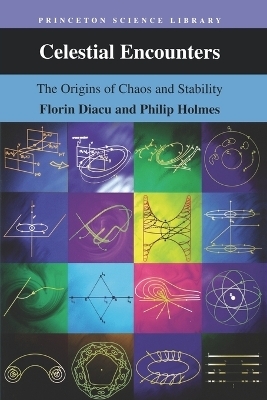
Celestial Encounters
The Origins of Chaos and Stability
Seiten
1999
Princeton University Press (Verlag)
978-0-691-00545-4 (ISBN)
Princeton University Press (Verlag)
978-0-691-00545-4 (ISBN)
Presenting the story of Poincare's work, this book traces the history of attempts to solve the problems of celestial mechanics posed in Isaac Newton's "Principia" in 1686. It introduces the people whose ideas led to the field called nonlinear dynamics.
Celestial Encounters is for anyone who has ever wondered about the foundations of chaos. In 1888, the 34-year-old Henri Poincare submitted a paper that was to change the course of science, but not before it underwent significant changes itself. "The Three-Body Problem and the Equations of Dynamics" won a prize sponsored by King Oscar II of Sweden and Norway and the journal Acta Mathematica, but after accepting the prize, Poincare found a serious mistake in his work. While correcting it, he discovered the phenomenon of chaos. Starting with the story of Poincare's work, Florin Diacu and Philip Holmes trace the history of attempts to solve the problems of celestial mechanics first posed in Isaac Newton's Principia in 1686. In describing how mathematical rigor was brought to bear on one of our oldest fascinations--the motions of the heavens--they introduce the people whose ideas led to the flourishing field now called nonlinear dynamics. In presenting the modern theory of dynamical systems, the models underlying much of modern science are described pictorially, using the geometrical language invented by Poincare.
More generally, the authors reflect on mathematical creativity and the roles that chance encounters, politics, and circumstance play in it.
Celestial Encounters is for anyone who has ever wondered about the foundations of chaos. In 1888, the 34-year-old Henri Poincare submitted a paper that was to change the course of science, but not before it underwent significant changes itself. "The Three-Body Problem and the Equations of Dynamics" won a prize sponsored by King Oscar II of Sweden and Norway and the journal Acta Mathematica, but after accepting the prize, Poincare found a serious mistake in his work. While correcting it, he discovered the phenomenon of chaos. Starting with the story of Poincare's work, Florin Diacu and Philip Holmes trace the history of attempts to solve the problems of celestial mechanics first posed in Isaac Newton's Principia in 1686. In describing how mathematical rigor was brought to bear on one of our oldest fascinations--the motions of the heavens--they introduce the people whose ideas led to the flourishing field now called nonlinear dynamics. In presenting the modern theory of dynamical systems, the models underlying much of modern science are described pictorially, using the geometrical language invented by Poincare.
More generally, the authors reflect on mathematical creativity and the roles that chance encounters, politics, and circumstance play in it.
Florin Diacu is Associate Professor of Mathematics at the University of Victoria in Canada. Philip Holmes, a Fellow of the American Academy of Arts and Sciences, is Professor of Mechanics and Applied Mathematics at Princeton University, where he directs the Program in Applied and Computational Mathematics.
Preface and Acknowledgments A Note to the Reader 1. A Great Discovery - And a Mistake 2. Symbolic Dynamics 3. Collisions and Other Singularities 4. Stability 5. KAM Theory Notes Bibliography Index
| Erscheint lt. Verlag | 28.3.1999 |
|---|---|
| Zusatzinfo | 23 halftones 64 line illus. |
| Verlagsort | New Jersey |
| Sprache | englisch |
| Maße | 197 x 254 mm |
| Gewicht | 340 g |
| Themenwelt | Mathematik / Informatik ► Mathematik ► Angewandte Mathematik |
| Naturwissenschaften ► Physik / Astronomie ► Astronomie / Astrophysik | |
| ISBN-10 | 0-691-00545-1 / 0691005451 |
| ISBN-13 | 978-0-691-00545-4 / 9780691005454 |
| Zustand | Neuware |
| Informationen gemäß Produktsicherheitsverordnung (GPSR) | |
| Haben Sie eine Frage zum Produkt? |
Mehr entdecken
aus dem Bereich



aus dem Bereich
für Ingenieure und Naturwissenschaftler
Buch | Softcover (2024)
Springer Vieweg (Verlag)
CHF 48,95
Buch | Softcover (2025)
Springer Vieweg (Verlag)
CHF 62,95
Buch | Softcover (2025)
Springer Fachmedien Wiesbaden (Verlag)
CHF 69,95


