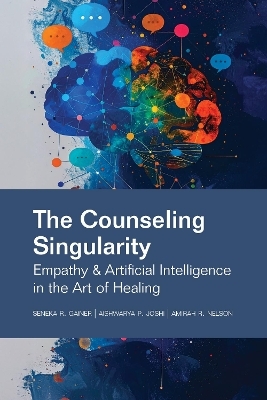
The Counseling Singularity
American Counseling Association (Verlag)
978-1-55620-007-6 (ISBN)
- Titel nicht im Sortiment
- Artikel merken
Dr. Seneka Gainer is an Assistant Professor and Clinical Director in Clinical Mental Health Counseling at Jacksonville University. She is a Licensed Professional Counselor (LPC), Licensed Marriage and Family Therapist (LMFT), and National Certified Counselor (NCC). With nearly 20 years of experience in clinical practice, supervision, and counselor education, her work centers on counselor development, empathy, and ethical leadership. She serves as Clinical Strategist at Inner Peak AI, where she helps design clinically informed, developmentally appropriate mental health tools. Dr. Gainer co-leads the NBCC AI Regulatory Research Team and presents nationally on the ethical integration of artificial intelligence in counselor education. She has authored and co-authored publications on trauma-informed practice and counselor development. A past Governing Council member of ACA and former NECA president, Dr. Gainer’s teaching, research, and scholarship explores empathy as a teachable practice, systems-informed counselor education, and the ethical use of emerging technologies in counselor training. Dr. Aishwarya P. Joshi (she/her) is an Assistant Professor at the University of Vermont, a licensed mental health counselor in Ohio and Idaho, and a board-certified counselor in India. With over a decade of experience delivering multilingual mental health services across global contexts, she brings a culturally grounded lens to counselor education. Her research focuses on the mental health needs of international students and faculty, the experiences of Black women in STEM, trauma-informed care, and equity-driven public policy. Dr. Joshi integrates artificial intelligence into counselor preparation, utilizing AI-based simulations to build crisis competency and enhance training in areas such as human sexuality and professional ethics. A leading voice in culturally responsive innovation, she emphasizes that mental health accessibility, affordability, and literacy are global imperatives. Through her teaching, research, and advocacy, Dr. Joshi calls on counselors and educators worldwide to reimagine the profession through inclusive, trauma-informed, and technologically enhanced practices. Dr. Amirah Nelson is an Assistant Professor in the Department of Counseling, Rehabilitation, and Psychometric Services at Jackson State University. She earned her Ph.D. in Counselor Education and Supervision from Idaho State University and an M.A. in Holistic Counseling from Salve Regina University, along with a Certificate of Advanced Graduate Studies in Creative and Expressive Arts. Her clinical and research interests include culturally responsive counseling, trauma-informed care, expressive arts, and the ethical integration of artificial intelligence in counselor education and practice. Dr. Nelson is EMDR-trained and draws from humanistic and postmodern approaches. She has presented nationally and published on cultural competence, innovative training models, and the intersection of counseling and AI. She is actively engaged in professional initiatives that promote equity, inclusion, and technological innovation in mental health.
Chapter 1: Introduction
An overview of the book’s purpose, the rise of AI in mental health, and how counselors can confidently navigate this technological shift.
Chapter 2: Understanding AI and Machine Learning
Foundational concepts demystified: what AI is, how it works, and what counselors really need to know.
Chapter 3: AI Tools for Counselors
A practical guide to assessment tools, virtual therapeutic assistants, and administrative supports.
Chapter 4: Integrating AI into Clinical Practice
Using the BRIDGE framework to ethically and effectively incorporate AI into sessions, supervision, and psychoeducation.
Chapter 5: Ethical Considerations
Examining confidentiality, bias, data security, and professional boundaries when using AI in mental health.
Chapter 6: Client-Centered Counseling with AI
How to preserve empathy, cultural humility, and personalized care in a tech-augmented counseling process.
Chapter 7: Advancing the Counseling Profession Through Training, Technology, and Lifelong Learning
AI’s role in professional development, counselor education, supervision, and staying future-ready.
Chapter 8: The Future of AI in Counseling—Trends & Transformations
Exploring emerging tools, shifting roles, and how AI may shape the profession long-term.
Chapter 9: Using AI in Practice: Language, Roles, and Reflection
Practical applications, new clinical language, co-creation with AI, and reflection on counselor identity.
Chapter 10: From Concept to Practice: Bringing AI Into Your Counseling Work
Bridging vision with action: strategies for applying what you've learned and embracing change.
| Erscheint lt. Verlag | 24.3.2026 |
|---|---|
| Zusatzinfo | Illustrations |
| Verlagsort | Alexandria, VA |
| Sprache | englisch |
| Themenwelt | Geisteswissenschaften ► Psychologie |
| Informatik ► Theorie / Studium ► Künstliche Intelligenz / Robotik | |
| Medizin / Pharmazie ► Medizinische Fachgebiete ► Psychiatrie / Psychotherapie | |
| ISBN-10 | 1-55620-007-2 / 1556200072 |
| ISBN-13 | 978-1-55620-007-6 / 9781556200076 |
| Zustand | Neuware |
| Informationen gemäß Produktsicherheitsverordnung (GPSR) | |
| Haben Sie eine Frage zum Produkt? |
aus dem Bereich