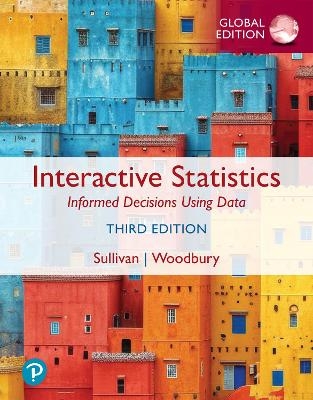
MyLab Statistics with Pearson eText Instant Access for Interactive Statistics: Informed Decisions Using Data, Global Edition
Pearson Education Limited (Hersteller)
978-1-292-48360-3 (ISBN)
About our authors Michael Sullivan III is a professor of mathematics at Joliet Junior College. He holds graduate degrees from DePaul University in both mathematics and economics. Mike is an author or co-author on more than 20 books, including a precalculus series and a developmental mathematics series. Mike is the father of 3 children and an avid golfer, who tries to spend as much of his limited free time as possible on the golf course. George Woodbury earned a bachelor's degree in Mathematics from the University of California - Santa Barbara and a master's degree in Mathematics from California State University - Northridge. He currently teaches at College of the Sequoias in Visalia, CA, just outside of Fresno. George has been honored as an instructor by both his students and his colleagues. Aside from teaching and writing, George served as the department chair of the math/engineering division from 1999 through 2004. He has been a user of MyLab Math and MyLab Statistics since inception, continually coming up with creative ways to integrate his teaching methods with technology. He actively blogs his thoughts on math, statistics, teaching and study skills.
1: Data Collection
1.1 Introduction to the Practice of Statistics
1.2 Observational Studies versus Designed Experiments
1.3 Simple Random Sampling
1.4 Other Effective Sampling Methods
1.5 Bias in Sampling
1.6 The Design of Experiments
Chapter 1 Review
Chapter 1 Practice Test
Chapter 1 Projects
2: Organizing and Summarizing Data
Preparing for Section 2.1: Organizing Qualitative Data
2.1 Organizing Qualitative Data
Preparing for Section 2.2: Organizing Quantitative Data: The Popular Displays
2.2 Organizing Quantitative Data: The Popular Displays
2.3 Additional Displays of Quantitative Data
2.4 Graphical Misrepresentations of Data
Chapter 2 Review
Chapter 2 Practice Test
Chapter 2 Projects
3: Numerically Summarizing Data
Preparing for Section 3.1: Measures of Central Tendency
3.1 Measures of Central Tendency
3.2 Measures of Dispersion
Preparing for Section 3.3: Measures of Central Tendency and Dispersion from Grouped Data
3.3 Measures of Central Tendency and Dispersion from Grouped Data
3.4 Measures of Position
3.5 The Five-Number Summary and Boxplots
Chapter 3 Review
Chapter 3 Practice Test
Chapter 3 Projects
4: Describing the Relation between Two Variables
Preparing for Section 4.1: Scatter Diagrams and Correlation
4.1 Scatter Diagrams and Correlation
Preparing for Section 4.2: Least-Squares Regression
4.2 Least-Squares Regression
Preparing for Section 4.3: Diagnostics on the Least-Squares Regression Line
4.3 Diagnostics on the Least-Squares Regression Line
Preparing for Section 4.4: Contingency Tables and Association
4.4 Contingency Tables and Association
Chapter 4 Review
Chapter 4 Practice Test
Chapter 4 Projects
5: Probability
Preparing for Section 5.1: Probability Rules
5.1 Probability Rules
5.2 The Addition Rule and Complements
5.3 Independence and the Multiplication Rule
5.4 Conditional Probability and the General Multiplication Rule
5.5 Counting Techniques
5.6 Simulation
5.7 Putting It Together: Which Method Do I Use?
Chapter 5 Review
Chapter 5 Practice Test
Chapter 5 Projects
6: Discrete Probability Distributions
Preparing for Section 6.1: Discrete Random Variables
6.1 Discrete Random Variables
Preparing for Section 6.2: The Binomial Probability Distribution
6.2 The Binomial Probability Distribution
6.3 The Poisson Probability Distribution
Chapter 6 Review
Chapter 6 Practice Test
Chapter 6 Projects
7: The Normal Probability Distribution
Preparing for Section 7.1: Properties of the Normal Distribution
7.1 Properties of the Normal Distribution
Preparing for Section 7.2: Applications of the Normal Distribution
7.2 Applications of the Normal Distribution
Preparing for Section 7.3: Assessing Normality
7.3 Assessing Normality
Preparing for Section 7.4: The Normal Approximation to the Binomial Probability Distribution
7.4 The Normal Approximation to the Binomial Probability Distribution
Chapter 7 Review
Chapter 7 Practice Test
Chapter 7 Projects
8: Sampling Distributions
Preparing for Section 8.1: Distribution of the Sample Mean
8.1 Distribution of the Sample Mean
Preparing for Section 8.2: Distribution of the Sample Proportion
8.2 Distribution of the Sample Proportion
Chapter 8 Review
Chapter 8 Practice Test
Chapter 8 Projects
9: Estimating the Value of a Parameter
Preparing for Section 9.1: Estimating a Population Proportion
9.1 Estimating a Population Proportion
Preparing for Section 9.2: Estimating a Population Mean
9.2 Estimating a Population Mean
9.3 Putting It Together: Which Procedure Do I Use?
9.4 Estimating with Bootstrapping
Chapter 9 Review
Chapter 9 Practice Test
Chapter 9 Projects
10: Hypothesis Tests Regarding a Parameter
Preparing for Section 10.1: Estimating a Population Mean
10.1 The Language of Hypothesis Testing
Preparing for Section 10.2 Hypothesis Tests for a Population Proportion
10.2 Hypothesis Tests for a Population Proportion
Preparing for Section 10.3 Hypothesis Tests for a Population Mean
10.3 Hypothesis Tests for a Population Mean
Preparing for Section 10.3A Hypothesis Tests on a Population Mean Using Simulation and the Bootstrap
10.3A Hypothesis Tests on a Population Mean Using Simulation and the Bootstrap
Chapter 10 Review
Chapter 10 Practice Test
Chapter 10 Projects
11: Inference on Two Samples
Preparing for Section 11.1: Inference about Two Population Proportions
11.1 Inference about Two Population Proportions: Independent Samples
11.1A Using Randomization Techniques to Compare Two Proportions
Preparing for Section 11.2: Inference about Two Population Means: Dependent Samples
11.2 Inference about Two Population Means: Dependent Samples
Preparing for Section 11.2A: Using Bootstrapping to Conduct Inference on Two Dependent Means
11.2A Using Bootstrapping to Conduct Inference on Two Dependent Means
Preparing for Section 11.3: Inference about Two Population Means: Independent Samples
11.3 Inference about Two Population Means: Independent Samples
11.3A Using Randomization Techniques to Compare Two Independent Means
11.4 Putting It Together: Which Procedure Do I Use?
Chapter 11 Review
Chapter 11 Practice Test
Chapter 11 Projects
12: Inference on Categorical Data
Preparing for Section 12.1: Goodness-of-Fit Test
12.1 Goodness-of-Fit Test
Preparing for Section 12.2: Tests for Independence and the Homogeneity of Proportions
12.2 Tests for Independence and the Homogeneity of Proportions
Preparing for Section 12.3: Inference about Two Population Proportions: Dependent Samples
12.3 Inference about Two Population Proportions: Dependent Samples
Chapter 12 Review
Chapter 12 Practice Test
Chapter 12 Projects
13: Comparing Three or More Means
Preparing for Section 13.1: Comparing Three or More Means: One-Way Analysis of Variance
13.1 Comparing Three or More Means: One-Way Analysis of Variance
Preparing for Section 13.2: Post Hoc Tests on One-Way Analysis of Variance
13.2 Post Hoc Tests on One-Way Analysis of Variance
Chapter 13 Review
Chapter 13 Practice Test
Chapter 13 Projects
14: Inference on the Least-Squares Regression Model and Multiple Regression
Preparing for Section 14.1: Testing the Significance of the Least-Squares Regression Model
14.1 Testing the Significance of the Least-Squares Regression Model
14.1A Using Randomization Techniques on the Slope of the Least-Squares Regression Line
Preparing for Section 14.2: Confidence and Prediction Intervals
14.2 Confidence and Prediction Intervals
Preparing for Section 14.3: Introduction to Multiple Regression
Chapter 14 Review
Chapter 14 Practice Test
Chapter 14 Projects
Appendix
| Erscheint lt. Verlag | 7.4.2025 |
|---|---|
| Verlagsort | Harlow |
| Sprache | englisch |
| Themenwelt | Mathematik / Informatik ► Mathematik ► Statistik |
| ISBN-10 | 1-292-48360-1 / 1292483601 |
| ISBN-13 | 978-1-292-48360-3 / 9781292483603 |
| Zustand | Neuware |
| Informationen gemäß Produktsicherheitsverordnung (GPSR) | |
| Haben Sie eine Frage zum Produkt? |
aus dem Bereich