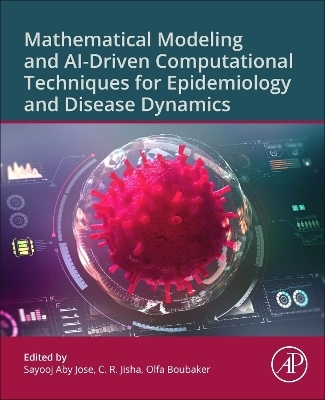
Mathematical Modeling and AI-Driven Computational Techniques for Epidemiology and Disease Dynamics
Academic Press Inc (Verlag)
978-0-443-33234-0 (ISBN)
- Noch nicht erschienen (ca. Februar 2026)
- Versandkostenfrei
- Auch auf Rechnung
- Artikel merken
Dr. Sayooj Aby Jose is currently working as an Assistant Research Professor at the Institute for Pandemic Sciences AI.celerator (IPSAI), Artificial Intelligence Institute, Seoul National University, South Korea. Previously, he worked as a Postdoctoral Researcher in the Department of Statistics at Seoul National University. He earned his Ph.D. in Mathematics from Alagappa University, India, specializing in mathematical epidemiology, biostatistics, and artificial intelligence. He is actively involved in various international professional roles and projects and serves as an editor for seven reputed journals. Since 2023, he has been supervising and coordinating international student project programme (ISPP) and seminar series in collaboration with the Department of Mathematics, Faculty of Education, Phuket Rajabhat University, Thailand, with a specific focus on modeling in public health. Dr. Jisha C. R. is a Project Scientist II at the National Centre for Medium Range Weather Forecasting (NCMRWF), India, specializing in applied mathematics, particularly in partial differential equations, machine learning, and scientific computing. She earned her Ph.D. from SRM Institute of Science and Technology, focusing on transient PDEs, and holds a Bachelor's, Master's, and M.Phil. in Mathematics from Calicut University, Kerala. Dr. Jisha has postdoctoral experience at UNIST, South Korea, and has published her research in leading journals. Olfa Boubaker is a Full Professor at the National Institute of Applied Sciences and Technology (INSAT) at the University of Carthage, Tunisia. Her research spans control theory, nonlinear systems, and robotics, with a focus on healthcare applications and human-centered technologies. She received her PhD in Electrical Engineering from the National Engineering School of Tunis (ENIT) and Habilitation Universitaire degree in Control Engineering from the National Engineering School of Sfax (ENIS), in Tunisia. Professor Boubaker leads interdisciplinary research projects at the interface of medicine and technology and serves as Series Editor of Medical Robots and Devices: New Developments and Advances. She has authored over 150 peer-reviewed papers and several books, and is an Associate Editor for Robotica and the International Journal of Advanced Robotic Systems. She also contributes to various scientific journals and mentors numerous engineering graduates.
Part I: Classical and Fractional Approaches to Infectious Disease Modeling
1. Mathematical and AI-Based Approaches in Epidemiology: Foundations and Frontiers
2. Comparative Numerical Methods for Infectious Disease Dynamics: Application to SEIR-type Models
3. Fractional Order Modeling and Stability Analysis of Vector-Borne Diseases: Application to Japanese Encephalitis Transmission
4. Optimal Control of Infectious Diseases Using Fractional Calculus: Application to Dengue Control via Atangana–Baleanu Model
Part II: Artificial Intelligence and Advanced Modeling in Epidemiology
5. Eco-Epidemiological Modeling with Memory Effects: Application to Fear, Quarantine, and Prey–Predator Interactions via Mittag-Leffler Kernel
6. Stochastic Analysis of Epidemic Models Under Random Perturbations: Application to SIR and SIRS Dual Epidemics
7. Deep Learning-Based Optimal Control Frameworks in Epidemiology: Application to Dengue Transmission Prediction and Control
8. AI-Driven Fractional Order Models for Emerging Viral Epidemics: Application to Oropouche Virus Outbreak Forecasting
Part III: Mathematical, Statistical, and AI-Based Models in Biomedicine and Healthcare
9. Explainable AI and Computational Intelligence in Healthcare: Application to Clinical Decision Support and Personalized Medicine
10. Soft Computing Models of Biological Tissue Dynamics: Application to Viscoelastic Behavior of Biological Tissues
11. Mathematical Modeling of Cancer Progression: Application to Ductal Carcinoma of the Breast
12. Modeling Immune Response and Antiviral Therapy Dynamics: Application to HBV Infection in Hepatic and Extrahepatic Sites
13. Statistical Modeling and Evaluation of Polyherbal Formulations: Application to Management of Diabetic Foot Ulcers
14. Conclusion | Prospects in computational epidemiology: challenges and emerging directions
| Erscheint lt. Verlag | 27.2.2026 |
|---|---|
| Verlagsort | San Diego |
| Sprache | englisch |
| Maße | 191 x 235 mm |
| Gewicht | 450 g |
| Themenwelt | Informatik ► Theorie / Studium ► Künstliche Intelligenz / Robotik |
| Medizin / Pharmazie ► Physiotherapie / Ergotherapie ► Orthopädie | |
| Technik ► Medizintechnik | |
| Technik ► Umwelttechnik / Biotechnologie | |
| ISBN-10 | 0-443-33234-7 / 0443332347 |
| ISBN-13 | 978-0-443-33234-0 / 9780443332340 |
| Zustand | Neuware |
| Informationen gemäß Produktsicherheitsverordnung (GPSR) | |
| Haben Sie eine Frage zum Produkt? |
aus dem Bereich