


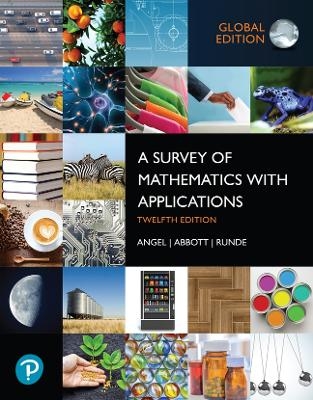
MyLab Math with Pearson eText Instant Access for A Survey of Mathematics with Applications, Global Edition
Pearson Education Limited (Hersteller)
978-1-292-75321-8 (ISBN)
The 12th Edition adds new Now Try exercises, expands coverage and exercises in financial literacy, and updates data and applications for currency and relevancy.
MyLab - Instant access.
This product is customised for your specific course. Once this product is added to cart you will be prompted to enter your course ID. This information should come from your instructor, either as a course ID code or an invitation LMS link.
About our authors Allen Angel received his BS and MS in mathematics from SUNY at New Paltz, and completed additional graduate work at Rutgers University. He taught at Sullivan County Community College and Monroe Community College, where he served as chairperson of the Mathematics Department. He served as Assistant Director of the National Science Foundation at Rutgers University for the summers of 1967 - 1970. He was President of The New York State Mathematics Association of Two-Year Colleges (NYSMATYC). He also served as Northeast Vice President of the American Mathematics Association of Two-Year Colleges (AMATYC). Allen lives in Palm Harbor, Florida but spends his summers in Penfield, New York. He enjoys playing tennis, watching sports, and traveling with his wife Kathy. Christine Abbott received her undergraduate degree in mathematics from SUNY Brockport and her graduate degree in mathematics education from Syracuse University. Since then she has taught mathematics at Monroe Community College and has recently chaired the department. In her spare time she enjoys watching sporting events, particularly baseball, college basketball, college football, and the NFL. She also enjoys spending time with her family, traveling and reading. Dennis Runde has a BS degree and an MS degree in Mathematics from the University of Wisconsin - Platteville and Milwaukee, respectively. He has a PhD in Mathematics Education from the University of South Florida. He has been teaching for more than 34 years at State College of Florida - Manatee - Sarasota. His interests include reading, history, biking, canoeing and cooking. He and his wife Kristin have raised 3 wonderful sons (Alex, Nick and Max), who each have earned a college degree and are successfully employed.
1: Critical Thinking Skills
1.1 Inductive and Deductive Reasoning
1.2 Estimation Techniques
1.3 Problem-Solving Procedures
2: Sets
2.1 Set Concepts
2.2 Subsets
2.3 Venn Diagrams, Set Operations, and Data Representation
2.4 Venn Diagrams with Three Sets and Verification of Equality of Sets
2.5 Set Applications and Survey Data Analysis
2.6 Infinite Sets
3: Logic
3.1 Statements and Logical Connectives
3.2 Truth Tables for Negation, Conjunction, and Disjunction
3.3 Truth Tables for the Conditional and Biconditional
3.4 Equivalent Statements
3.5 Symbolic Arguments
3.6 Euler Diagrams and Syllogistic Arguments
3.7 Switching Circuits
4: Systems of Numeration
4.1 Additive, Multiplicative, and Ciphered Systems of Numeration
4.2 Place-Value or Positional-Value Numeration Systems
4.3 Other Bases
4.4 Perform Computations in Other Bases
4.5 Early Computational Methods
5: Number Theory and the Real Number System
5.1 Number Theory
5.2 The Integers
5.3 The Rational Numbers
5.4 The Irrational Numbers
5.5 Real Numbers and Their Properties
5.6 Rules of Exponents and Scientific Notation
5.7 Arithmetic and Geometric Sequences
5.8 The Fibonacci Sequence and The Golden Ratio
6: Algebra, Graphs, and Functions
6.1 Order of Operations and Solving Linear Equations
6.2 Formulas and Modeling
6.3 Applications of Algebra
6.4 Variation
6.5 Solving Linear Inequalities
6.6 Graphing Linear Equations
6.7 Solving Systems of Linear Equations
6.8 Linear Inequalities in Two Variables and Systems of Linear Inequalities
6.9 Solving Quadratic Equations by Using Factoring and by Using the Quadratic Formula
6.10 Functions and Their Graphs
7: The Metric System
7.1 Basic Terms and Conversions Within the Metric System
7.2 Length, Area, and Volume
7.3 Mass and Temperature
7.4 Dimensional Analysis and Conversions to and from the Metric System
8: Geometry
8.1 Points, Lines, Planes, and Angles
8.2 Polygons
8.3 Perimeter and Area
8.4 Volume and Surface Area
8.5 Transformational Geometry, Symmetry, and Tessellations
8.6 Topology
8.7 Non-Euclidean Geometry and Fractal Geometry
9: Mathematical Systems
9.1 Groups
9.2 Finite Mathematical Systems
9.3 Modular Arithmetic
9.4 Matrices
10: Consumer Mathematics
10.1 Percent
10.2 Personal Loans and Simple Interest
10.3 Compound Interest
10.4 Installment Buying
10.5 Buying a House with a Mortgage
10.6 Ordinary Annuities, Sinking Funds, and Retirement Investments
11: Probability
11.1 Empirical and Theoretical Probabilities
11.2 Odds
11.3 Expected Value (Expectation)
11.4 Tree Diagrams
11.5 OR and AND Problems
11.6 Conditional Probability
11.7 The Fundamental Counting Principle and Permutations
11.8 Combinations
11.9 Solving Probability Problems by Using Combinations
11.10 Binomial Probability Formula
12: Statistics
12.1 Sampling Techniques and Misuses of Statistics
12.2 Frequency Distributions and Statistical Graphs
12.3 Measures of Central Tendency and Position
12.4 Measures of Dispersion
12.5 The Normal Curve
12.6 Linear Correlation and Regression
13: Graph Theory
13.1 Graphs, Paths, and Circuits
13.2 Euler Paths and Euler Circuits
13.3 Hamilton Paths and Hamilton Circuits
13.4 Trees
14: Voting and Apportionment
14.1 Voting Methods
14.2 Flaws of the Voting Methods
14.3 Apportionment Methods
14.4 Flaws of the Apportionment Methods
Answers
Index of Applications
Index
| Erscheint lt. Verlag | 16.5.2025 |
|---|---|
| Verlagsort | Harlow |
| Sprache | englisch |
| Themenwelt | Mathematik / Informatik ► Mathematik |
| ISBN-10 | 1-292-75321-8 / 1292753218 |
| ISBN-13 | 978-1-292-75321-8 / 9781292753218 |
| Zustand | Neuware |
| Informationen gemäß Produktsicherheitsverordnung (GPSR) | |
| Haben Sie eine Frage zum Produkt? |


