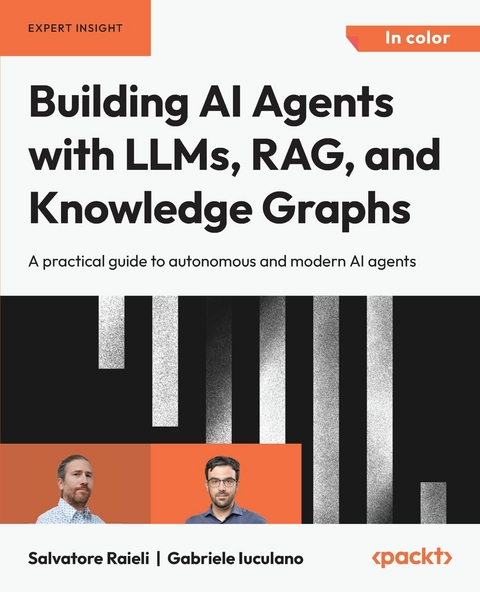
Building AI Agents with LLMs, RAG, and Knowledge Graphs (eBook)
566 Seiten
Packt Publishing (Verlag)
9781835080382 (ISBN)

This book addresses the challenge of building AI that not only generates text but also grounds its responses in real data and takes action. Authored by AI specialists with expertise in drug discovery and systems optimization, this guide empowers you to leverage retrieval-augmented generation (RAG), knowledge graphs, and agent-based architectures to engineer truly intelligent behavior. By combining large language models (LLMs) with up-to-date information retrieval and structured knowledge, you'll create AI agents capable of deeper reasoning and more reliable problem-solving.
Inside, you'll find a practical roadmap from concept to implementation. You'll discover how to connect language models with external data via RAG pipelines for increasing factual accuracy and incorporate knowledge graphs for context-rich reasoning. The chapters will help you build and orchestrate autonomous agents that combine planning, tool use, and knowledge retrieval to achieve complex goals. Concrete Python examples and real-world case studies reinforce each concept and show how the techniques fit together.
By the end of this book, you'll be able to build intelligent AI agents that reason, retrieve, and interact dynamically, empowering you to deploy powerful AI solutions across industries.
Email sign-up and proof of purchase required
Master LLM fundamentals to advanced techniques like RAG, reinforcement learning, and knowledge graphs to build, deploy, and scale intelligent AI agents that reason, retrieve, and act autonomouslyDRM-free PDF version + access to Packt's next-gen ReaderKey FeaturesImplement RAG and knowledge graphs for advanced problem-solvingLeverage innovative approaches like LangChain to create real-world intelligent systemsIntegrate large language models, graph databases, and tool use for next-gen AI solutionsBook DescriptionThis book addresses the challenge of building AI that not only generates text but also grounds its responses in real data and takes action. Authored by AI specialists with expertise in drug discovery and systems optimization, this guide empowers you to leverage retrieval-augmented generation (RAG), knowledge graphs, and agent-based architectures to engineer truly intelligent behavior. By combining large language models (LLMs) with up-to-date information retrieval and structured knowledge, you'll create AI agents capable of deeper reasoning and more reliable problem-solving. Inside, you'll find a practical roadmap from concept to implementation. You ll discover how to connect language models with external data via RAG pipelines for increasing factual accuracy and incorporate knowledge graphs for context-rich reasoning. The chapters will help you build and orchestrate autonomous agents that combine planning, tool use, and knowledge retrieval to achieve complex goals. Concrete Python examples and real-world case studies reinforce each concept and show how the techniques fit together. By the end of this book, you ll be able to build intelligent AI agents that reason, retrieve, and interact dynamically, empowering you to deploy powerful AI solutions across industries. Email sign-up and proof of purchase requiredWhat you will learnLearn how LLMs work, their structure, uses, and limits, and design RAG pipelines to link them to external dataBuild and query knowledge graphs for structured context and factual groundingDevelop AI agents that plan, reason, and use tools to complete tasksIntegrate LLMs with external APIs and databases to incorporate live dataApply techniques to minimize hallucinations and ensure accurate outputsOrchestrate multiple agents to solve complex, multi-step problemsOptimize prompts, memory, and context handling for long-running tasksDeploy and monitor AI agents in production environmentsWho this book is forIf you are a data scientist or researcher who wants to learn how to create and deploy an AI agent to solve limitless tasks, this book is for you. To get the most out of this book, you should have basic knowledge of Python and Gen AI. This book is also excellent for experienced data scientists who want to explore state-of-the-art developments in LLM and LLM-based applications.]]>
1
Analyzing Text Data with Deep Learning
Language is one of the most amazing abilities of human beings; it evolves during the individual’s lifetime and is capable of conveying a message with complex meaning. Language in its natural form is not understandable to machines, and it is extremely challenging to develop an algorithm that can pick up the different nuances. Therefore, in this chapter, we will discuss how to represent text in a form that is digestible by machines.
In natural form, text cannot be directly fed to a deep learning model. In this chapter, we will discuss how text can be represented in a form that can be used by machine learning models. Starting with natural text, we will transform the text into numerical vectors that are increasingly sophisticated (one-hot encoding, bag of words (BoW), term frequency-inverse document frequency (TF-IDF)) until we create vectors of real numbers that represent the meaning of a word (or document) and allow us to conduct operations (word2vec). In this chapter, we introduce deep learning models, such as recurrent neural networks (RNNs), long short-term memory (LSTM), gated recurrent units (GRUs), and convolutional neural network (CNNs), to analyze sequences and discuss their strengths as well as the problems associated with them. Finally, we will assemble these models all together to conduct text classification, showing the power of the learned approaches.
By the end of this chapter, we will be able to take a corpus of text and use deep learning to analyze it. These are the bases that will help us understand how a large language model (LLM) (such as ChatGPT) works internally.
In this chapter, we'll be covering the following topics:
- Representing text for AI
- Embedding, application, and representation
- RNNs, LSTMs, GRUs, and CNNs for text
- Performing sentiment analysis with embedding and deep learning
Technical requirements
In this chapter, we will use standard libraries for Python. The necessary libraries can be found within each of the Jupyter notebooks that are in the GitHub repository for this chapter: https://github.com/PacktPublishing/Modern-AI-Agents/tree/main/chr1. The code can be executed on a CPU, but a GPU is advised.
Representing text for AI
Compared to other types of data (such as images or tables), it is much more challenging to represent text in a digestible representation for computers, especially because there is no unique relationship between the meaning of a word (signified) and the symbol that represents it (signifier). In fact, the meaning of a word changes from the context and the author’s intentions in using it in a sentence. In addition, native text has to be transformed into a numerical representation to be ingested by an algorithm, which is not a trivial task. Nevertheless, several approaches were initially developed to be able to find a vector representation of a text. These vector representations have the advantage that they can then be used as input to a computer.
First, a collection of texts (corpus) should be divided into fundamental units (words). This process requires making certain decisions and process operations that collectively are called text normalization. A sentence, therefore, is divided into words by exploiting the natural division of spaces (text segmentation); each punctuation mark is also considered a single word. In fact, punctuation marks are considered to be the boundaries of sentences and convey important information (change of topic, questions, exclamations).
The second step is the definition of what a word is and whether some terms in the corpus should be directly joined under the same vocabulary instance. For example, “He” and “he” represent the same instance; the former is only capitalized. Since an algorithm does not include such nuances, one must normalize the text in lowercase. In some cases, we want to conduct more sophisticated normalizations such as lemmatization (joining words with the same root: “came” and “comes” are two forms of the verb) or stemming (stripping all suffixes of words).
Tokenization is the task of transforming a text into fundamental units. This is because, in addition to words, a text may also include percentages, numbers, websites, and other components. We will return to this later, but in the meantime, we will look at some simpler forms of tokenization.
One-hot encoding
In traditional natural language processing (NLP), text representation is conducted using discrete symbols. The simplest example is one-hot encoding. From a sequence of text in a corpus (consisting of n different words), we obtain an n-dimensional vector. In fact, the first step is to compute the set of different words present in the whole text corpus called vocabulary. For each word, we obtain a vector as long as the size of the vocabulary. Then for each word, we will have a long vector composed mainly of zeros and ones to represent the word (one-hot vectors). This system is mainly used when we want a matrix of features and then train a model. This process is also called vectorization; here's a sparse vector for the following two words:
restaurant=000001000
pizzeria=001000000
There are different problems associated with this representation. First, it captures only the presence (or the absence) of a word in a document. Thus, we are losing all the semantic relationships between the words. Second, an average language has about 200,000 words, so for each word, we would have a vector of length 200,000. This leads to very sparse and high-dimensional vectors. For large corpora, we need high memory to store the vectors and high computational capacity to handle them. In addition, there is no notion of similarity. The two words in the preceding example are two places that sell food, and we would like the vectors representing these words to encode this similarity. If the vectors had a notion of similarity, we could conduct clustering, and the synonyms would be in the same cluster.
In order to obtain such a matrix, we must do the following:
- Standardize the text before tokenization. In this case, we simply transform everything into lowercase.
- We construct a vocabulary constituted of unique words and save the vocabulary so that in a case from a vector, we can get the corresponding word.
- We create an array and then populate it with 1 at the index of the word in the vocabulary; 0s elsewhere.
Let’s take a look at how this works in code:
import numpy as np def one_hot_encoding(sentence): words = sentence.lower().split() vocabulary = sorted(set(words)) word_to_index = {word: i for i, word in enumerate(vocabulary)} one_hot_matrix = np.zeros(( len(words), len(vocabulary)), dtype=int) for i, word in enumerate(words): one_hot_matrix[i, word_to_index[word]] = 1 return one_hot_matrix, vocabularyLet’s look at a specific example:
sentence = "Should we go to a pizzeria or do you prefer a restaurant?" one_hot_matrix, vocabulary = one_hot_encoding(sentence) print("Vocabulary:", vocabulary) print("One-Hot Encoding Matrix:/n", one_hot_matrix)We get the following output:
Important note
Observe how choosing another sentence will result in a different matrix and how, by increasing the length of the sentence, the matrix grows proportionally to the number of different words. Also, note that for repeated words, we get equal vectors. Check the preceding output.
Even if it is a simple method, we have obtained a first representation of text in a vectorial form.
Bag-of-words
In the previous section, we discussed one-hot encoding and some of the problems associated with this form of text representation. In the previous example, we worked with a single sentence, but a corpus is made up of thousands if not millions of documents; each of these documents contains several words with a different frequency. We want a system that preserves this frequency information, as it is important for the classification of text. In fact, documents that have similar content are similar, and their meaning will also be similar.
BoW is an algorithm for extracting features from text that preserves this frequency property. BoW is a very simple algorithm that ignores the position of words in the text and only considers this frequency property. The name “bag” comes precisely from the fact that any information concerning sentence order and...
| Erscheint lt. Verlag | 11.7.2025 |
|---|---|
| Sprache | englisch |
| Themenwelt | Mathematik / Informatik ► Informatik ► Datenbanken |
| Informatik ► Theorie / Studium ► Künstliche Intelligenz / Robotik | |
| ISBN-13 | 9781835080382 / 9781835080382 |
| Informationen gemäß Produktsicherheitsverordnung (GPSR) | |
| Haben Sie eine Frage zum Produkt? |
 EPUB (Ohne DRM)
Digital Rights Management: ohne DRM
Dieses eBook enthält kein DRM oder Kopierschutz. Eine Weitergabe an Dritte ist jedoch rechtlich nicht zulässig, weil Sie beim Kauf nur die Rechte an der persönlichen Nutzung erwerben.
Dateiformat: EPUB (Electronic Publication)
EPUB ist ein offener Standard für eBooks und eignet sich besonders zur Darstellung von Belletristik und Sachbüchern. Der Fließtext wird dynamisch an die Display- und Schriftgröße angepasst. Auch für mobile Lesegeräte ist EPUB daher gut geeignet.
Systemvoraussetzungen:
PC/Mac: Mit einem PC oder Mac können Sie dieses eBook lesen. Sie benötigen dafür die kostenlose Software Adobe Digital Editions.
eReader: Dieses eBook kann mit (fast) allen eBook-Readern gelesen werden. Mit dem amazon-Kindle ist es aber nicht kompatibel.
Smartphone/Tablet: Egal ob Apple oder Android, dieses eBook können Sie lesen. Sie benötigen dafür eine kostenlose App.
Geräteliste und zusätzliche Hinweise
Buying eBooks from abroad
For tax law reasons we can sell eBooks just within Germany and Switzerland. Regrettably we cannot fulfill eBook-orders from other countries.
aus dem Bereich