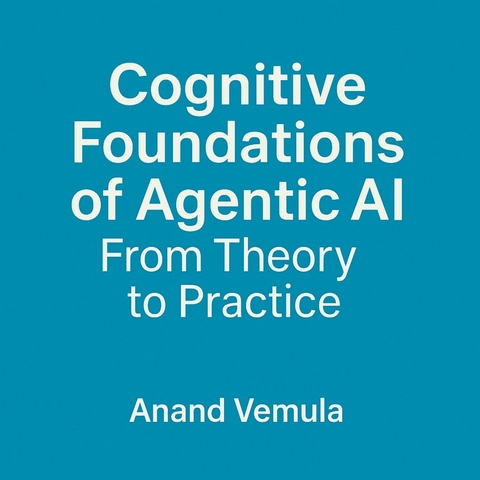
Cognitive Foundations of Agentic AI (eBook)
120 Seiten
Publishdrive (Verlag)
978-0-00-095668-2 (ISBN)
Cognitive Foundations of Agentic AI: From Theory to Practice explores the conceptual and technical underpinnings of AI systems that act with autonomy, proactivity, and social intelligence. Drawing from cognitive science, artificial intelligence, and systems theory, this book provides a structured view of how intelligent agents perceive, learn, reason, and interact in dynamic environments.
Beginning with a detailed exploration of what defines Agentic AI, the book delves into the cognitive processes that support agency-perception, learning, reasoning, memory, and decision-making. It bridges classical symbolic models with modern deep learning and neuro-symbolic systems to illustrate how hybrid architectures can enable generalizable, goal-driven behavior. Emphasis is placed on modeling real-world complexity, social cognition, and human-like interaction through language, emotional awareness, and theory of mind.
The text also critically examines challenges such as generalization, ethical alignment, uncertainty, and explainability. Through illustrative case studies in robotics, healthcare, digital assistants, and multi-agent systems, it highlights the real-world implications and limitations of agentic systems.
The final chapters outline practical pathways to building cognitive agents, including architecture design, training environments, and evaluation methods. It encourages a collaborative AI-human future where agents not only support but enhance human decision-making, learning, and creativity.
Ideal for AI practitioners, researchers, and graduate students, the book offers both a theoretical framework and practical insights into creating autonomous systems that think, learn, and act intelligently. It invites readers to rethink intelligence not as a fixed trait but as an emergent, contextual process deeply rooted in cognition.
Chapter 2: Cognitive Architectures for AI Agents.
Symbolic vs. Connectionist Approaches
The landscape of artificial intelligence and cognitive science has long been shaped by two fundamental and often contrasting paradigms for building intelligent systems: symbolic AI and connectionist AI. These approaches represent distinct philosophies regarding the nature of intelligence, how knowledge is represented, and how processing occurs within a cognitive architecture. Understanding their core tenets, strengths, and limitations is crucial for appreciating the evolution of AI and the design principles underlying modern agentic systems.
Symbolic AI, often referred to as Good Old-Fashioned AI (GOFAI), emerged from the early days of computer science and cognitive psychology, heavily influenced by the computational theory of mind. At its heart, symbolic AI posits that intelligence arises from the manipulation of discrete, explicit symbols that represent concepts, objects, and relationships in the world. Knowledge in symbolic systems is typically encoded in logical rules, semantic networks, frames, or other structured data representations that are human-readable and interpretable. For instance, a symbolic system might represent the concept of a 'bird' with properties like 'has_wings', 'can_fly', and 'lays_eggs'. Reasoning in such systems involves applying logical inference rules to these symbols to derive new conclusions. If the system knows 'all birds can fly' and 'Tweety is a bird', it can logically deduce 'Tweety can fly'.
The strengths of symbolic AI are particularly evident in tasks that require precise logical reasoning, explicit knowledge representation, and explainability. Expert systems, which encapsulate human expertise in specific domains through a set of IF-THEN rules, are a prime example. These systems excelled in areas like medical diagnosis or financial planning, where knowledge could be clearly articulated and formalized. The transparency of symbolic representations means that it is often possible to trace the reasoning steps of a symbolic AI system, providing a clear explanation for its decisions. This interpretability is a significant advantage in domains where trust and accountability are paramount. Furthermore, symbolic systems are well-suited for tasks that involve planning, problem-solving through search, and natural language understanding where grammatical rules and semantic structures can be explicitly modeled. The ability to directly manipulate abstract concepts allows symbolic AI to handle complex, high-level cognitive tasks that require structured thought.
However, symbolic AI faces significant limitations, particularly when dealing with the messy, ambiguous, and continuous nature of the real world. One major challenge is the knowledge acquisition bottleneck: manually encoding all the necessary knowledge and rules for a complex domain is an arduous, time-consuming, and often incomplete process. Human common sense, which is vast and often implicit, is notoriously difficult to formalize into explicit rules. Symbolic systems also struggle with sub-symbolic tasks like perception (e.g., recognizing a face in a crowd) or motor control, where the underlying processes are not easily broken down into discrete symbols and rules. They lack inherent mechanisms for learning from raw data and adapting to novel situations without explicit reprogramming. The brittleness of symbolic systems means they often fail catastrophically when encountering situations outside their predefined knowledge base, as they lack the ability to generalize or handle noisy input gracefully.
In contrast, connectionist AI, most prominently represented by artificial neural networks, takes inspiration from the structure and function of the human brain. Instead of explicit symbols and rules, knowledge in connectionist systems is distributed across a network of interconnected nodes (neurons) and weighted connections. Processing occurs through the propagation of activation signals across these connections, and learning involves adjusting the strengths (weights) of these connections based on exposure to data. There are no explicit rules for 'bird' or 'fly'; instead, the network learns to recognize patterns associated with these concepts through repeated exposure to examples.
Connectionist approaches excel in tasks that involve pattern recognition, classification, and learning from large datasets, particularly in domains where explicit rules are difficult or impossible to define. Deep learning, a subfield of connectionism utilizing multi-layered neural networks, has achieved unprecedented success in areas like image recognition, natural language processing, and speech recognition. These systems are highly robust to noisy input and can generalize well to unseen data within the same distribution. Their ability to learn complex, non-linear relationships directly from raw data has revolutionized many AI applications. Connectionist models are also inherently adaptive; they can continuously learn and refine their internal representations as they are exposed to new data, making them suitable for dynamic environments. The distributed nature of knowledge in neural networks also provides a degree of fault tolerance; the failure of a few nodes does not necessarily lead to catastrophic system failure.
However, connectionist AI also has its drawbacks. A primary limitation is the lack of interpretability or explainability. The knowledge encoded in the weights of a neural network is often opaque, making it difficult to understand why a particular decision was made. This 'black box' problem is a significant concern in critical applications. Furthermore, connectionist models typically require vast amounts of training data to achieve high performance, and their learning can be slow and computationally intensive. They can also suffer from catastrophic forgetting, where learning new information can overwrite or degrade previously learned knowledge. While they excel at pattern recognition, pure connectionist systems often struggle with tasks requiring abstract reasoning, symbolic manipulation, and complex planning, which are the strengths of symbolic AI. They do not naturally represent hierarchical structures or logical relationships in the same explicit way as symbolic systems.
This ongoing debate and the recognition of each paradigm's strengths and weaknesses have led to a growing consensus that a truly intelligent system, especially an agentic one, will likely need to incorporate elements from both. The human mind, after all, appears to utilize both symbolic reasoning (e.g., language, logic) and pattern recognition (e.g., vision, intuition). The future of cognitive architectures for AI agents will likely involve sophisticated integrations that allow for the explicit representation and manipulation of knowledge, alongside the powerful, data-driven learning capabilities of neural networks. This convergence aims to create systems that are not only capable of high-level abstract thought but also robustly grounded in the perceptual realities of the world, capable of learning from experience, and able to explain their reasoning when necessary. The journey from the initial, often adversarial, relationship between symbolic and connectionist camps to a more synergistic vision reflects a maturing understanding of intelligence itself.
Hybrid Cognitive Architectures
The recognition that neither purely symbolic nor purely connectionist approaches can fully capture the breadth and depth of human-like intelligence has led to the emergence of hybrid cognitive architectures. These architectures represent a concerted effort to combine the complementary strengths of both paradigms, aiming to build AI agents that can leverage the explicit, logical reasoning capabilities of symbolic systems alongside the robust, pattern-recognition and learning abilities of connectionist models. The goal is to overcome the limitations inherent in each isolated approach and create more powerful, flexible, and general-purpose intelligent systems.
The motivation for hybrid architectures stems from several observations. Symbolic systems excel at tasks requiring abstract reasoning, planning, and knowledge representation, where information can be clearly defined and manipulated. They offer transparency and explainability, making their decision-making processes understandable to humans. However, they struggle with perceptual tasks, learning from raw, noisy data, and adapting to novel, unstructured environments. Connectionist systems, particularly deep neural networks, have revolutionized fields like computer vision and natural language processing due to their remarkable ability to learn complex patterns from vast amounts of data and generalize within a given distribution. Yet, they often lack interpretability, struggle with systematic reasoning, and can be data-hungry and prone to catastrophic forgetting. Human cognition, on the other hand, appears to seamlessly integrate both types of processing: we can perform logical deductions (symbolic) and recognize faces instantly (connectionist), often without conscious effort. Hybrid architectures seek to emulate this synergistic integration.
There are several ways in which symbolic and connectionist components can be integrated within a hybrid architecture, often categorized into different levels of coupling:
1. Loose Coupling (Functional Integration): In this approach, symbolic and connectionist modules operate relatively independently, with information flowing between them at a high level. One module might preprocess data for the other, or they might collaborate on different sub-tasks of a larger problem. For example, a connectionist vision system might identify objects in an...
| Erscheint lt. Verlag | 18.6.2025 |
|---|---|
| Sprache | englisch |
| Themenwelt | Informatik ► Theorie / Studium ► Künstliche Intelligenz / Robotik |
| ISBN-10 | 0-00-095668-6 / 0000956686 |
| ISBN-13 | 978-0-00-095668-2 / 9780000956682 |
| Informationen gemäß Produktsicherheitsverordnung (GPSR) | |
| Haben Sie eine Frage zum Produkt? |
 EPUB (Adobe DRM)
Größe: 2,4 MB
Kopierschutz: Adobe-DRM
Adobe-DRM ist ein Kopierschutz, der das eBook vor Mißbrauch schützen soll. Dabei wird das eBook bereits beim Download auf Ihre persönliche Adobe-ID autorisiert. Lesen können Sie das eBook dann nur auf den Geräten, welche ebenfalls auf Ihre Adobe-ID registriert sind.
Details zum Adobe-DRM
Dateiformat: EPUB (Electronic Publication)
EPUB ist ein offener Standard für eBooks und eignet sich besonders zur Darstellung von Belletristik und Sachbüchern. Der Fließtext wird dynamisch an die Display- und Schriftgröße angepasst. Auch für mobile Lesegeräte ist EPUB daher gut geeignet.
Systemvoraussetzungen:
PC/Mac: Mit einem PC oder Mac können Sie dieses eBook lesen. Sie benötigen eine
eReader: Dieses eBook kann mit (fast) allen eBook-Readern gelesen werden. Mit dem amazon-Kindle ist es aber nicht kompatibel.
Smartphone/Tablet: Egal ob Apple oder Android, dieses eBook können Sie lesen. Sie benötigen eine
Geräteliste und zusätzliche Hinweise
Buying eBooks from abroad
For tax law reasons we can sell eBooks just within Germany and Switzerland. Regrettably we cannot fulfill eBook-orders from other countries.
aus dem Bereich