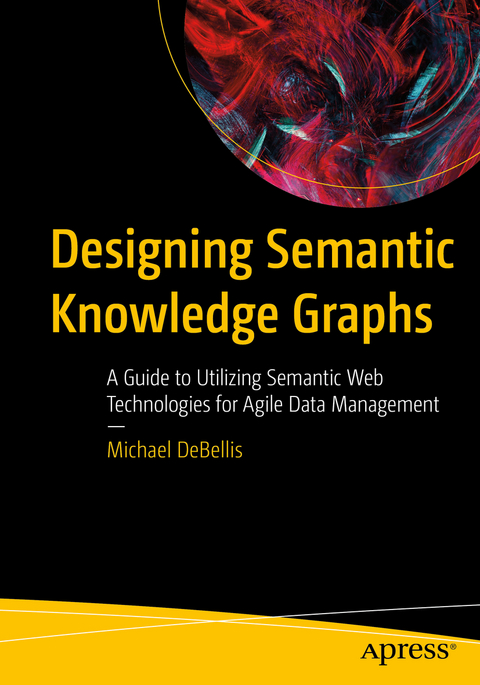
Designing Semantic Knowledge Graphs
Apress (Verlag)
979-8-8688-1822-6 (ISBN)
- Titel nicht im Sortiment
- Artikel merken
Yet many teams hesitate to adopt these technologies, often viewing them as overly complex or academic. This book aims to change that perception by showing how these tools can be used practically and effectively in real-world systems. From constraint validation to domain modeling to query and inference, you'll learn how Semantic Web standards can help you work with messy, evolving, and interconnected data.
Designing Semantic Knowledge Graphs is a hands-on guide for software engineers, architects, and data professionals who want to design and build semantic models that align with modern enterprise needs. You'll learn how to bridge domain models with real data, create agile ontologies that evolve with your systems, and automate the transformation of existing data sources into knowledge graph form. Along the way, you’ll explore ontology design patterns, leverage validation rules with SHACL, and integrate your knowledge graph with tools like LLMs and SPARQL for powerful query and reasoning capabilities.
All techniques are illustrated using free and widely used tools like Protégé and the community edition of AllegroGraph.
You Will:
Learn how Semantic Web standards like OWL, RDF, SPARQL, SHACL, and SWRL fit into modern data architecture
Understand techniques for modeling domains that balance top-down structure with bottom-up data realities
Explore common ontology design patterns
Learn strategies for data ingestion, transformation, and validation at scale
Learn how to create agile models that support change, iteration, and evolving requirements
Understand how to integrate knowledge graphs with other components like Large Language Models and APIs
Who is it for:
Developers, data scientists, software architects, and engineers who work with structured or semi-structured data and want to build smarter, more adaptable systems. This book will also be useful to product managers, analysts, and consultants seeking better insight into their organization's data strategy.
Michael DeBellis is a Semantic Web and AI consultant and researcher with over 40 years of experience in industry and academia. He began designing ontologies in the early 1980s while building expert systems for Accenture and later worked as a researcher at USC’s Information Sciences Institute (ISI), where he used Loom — a direct predecessor to the Web Ontology Language (OWL). Throughout his career at firms including Deloitte, Accenture, and ThoughtWorks, he has focused on applying advanced technology to real-world enterprise challenges. His work emphasizes the practical integration of Semantic Knowledge Graphs into complex systems, highlighting the importance of user requirements, legacy data, and enterprise architecture over purely theoretical modeling. He has published and presented internationally on a broad range of topics across multiple domains.
Chapter 1: Setting the Stage.- Chapter 2: What's the Semantic Web?.- Chapter 3: Fundamental Concepts.- Chapter 4: Domain Modeling.- Chapter 5: Data Ingestion.- Chapter 6: Testing and Validation.- Chapter 7: Data Security and Governance.- Chapter 8: Modern IT Architectures and Semantic Knowledge Graphs.- Chapter 9: Leveraging LLMs.- Chapter 10: Tools.- Chapter 11: Semantic Technologies: Valuable Real-World Applications.- Chapter 12: Conclusion.- Appendix A: Glossary of Terms. - Appendix B: Formal Description Logic. References.
| Erscheinungsdatum | 29.11.2025 |
|---|---|
| Zusatzinfo | Approx. 300 p. |
| Verlagsort | Berkley |
| Sprache | englisch |
| Maße | 178 x 254 mm |
| Themenwelt | Mathematik / Informatik ► Informatik ► Datenbanken |
| Mathematik / Informatik ► Informatik ► Software Entwicklung | |
| Mathematik / Informatik ► Informatik ► Web / Internet | |
| ISBN-13 | 979-8-8688-1822-6 / 9798868818226 |
| Zustand | Neuware |
| Informationen gemäß Produktsicherheitsverordnung (GPSR) | |
| Haben Sie eine Frage zum Produkt? |
aus dem Bereich