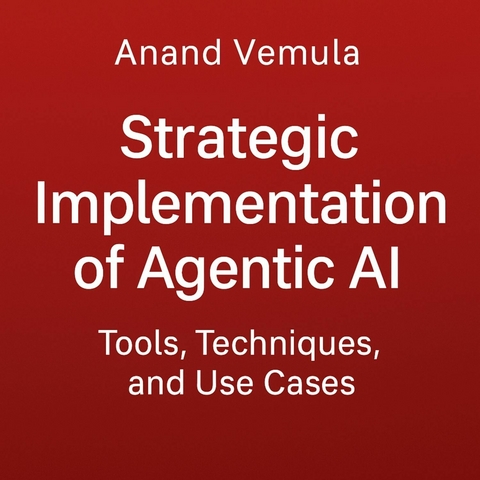
Strategic Implementation of Agentic AI (eBook)
66 Seiten
Publishdrive (Verlag)
978-0-00-095543-2 (ISBN)
Strategic Implementation of Agentic AI provides a comprehensive, practice-driven roadmap for deploying autonomous agents across real-world enterprise environments. The book is structured into four major parts-principles and deployment, tools and techniques, enterprise use cases, and strategic foresight-offering a 360-degree view of agentic AI from foundational theory to advanced integration.
Beginning with the core capabilities of agentic systems such as autonomy, proactivity, and goal orientation, the book lays out design methodologies that align AI behavior with organizational intent. It covers infrastructure design, from cloud-native deployments to agent platforms like LangChain and AutoGen, while addressing security, privacy, and responsible governance.
The second section explores the technical backbone of agentic AI: agent-oriented programming, prompt engineering, memory architectures, multi-agent coordination, and telemetry feedback loops. Each chapter demonstrates how to build scalable, modular agents with adaptive learning and decision-making capacity.
Real-world applications take center stage in the third part. Readers gain insight into agent deployment in business operations, sales, healthcare, education, manufacturing, and more-uncovering how agents optimize workflows, support decision-making, and enable human-machine collaboration at scale.
The final part focuses on strategic alignment, scaling ecosystems, ethics, regulatory impacts, and future planning. It offers tools to assess maturity, define KPIs, and envision a path toward intelligent, resilient, and ethical agentic ecosystems.
Written for technologists, architects, and enterprise leaders, this book bridges vision and implementation-offering a pragmatic guide to turning autonomous AI into a core strategic capability.
Chapter 3: Infrastructure and Platforms for Agentic Systems
Cloud-Native Architectures
Agentic AI systems require robust, elastic, and scalable infrastructure to function effectively across dynamic environments. A cloud-native architecture provides a foundation that enables modular development, flexible deployment, and high availability. Unlike monolithic legacy systems, cloud-native agentic platforms leverage microservices, containerization, event-driven communication, and elastic compute—all of which are essential to orchestrate perception, planning, action, and learning in real-time.
At the core of cloud-native infrastructure lies the microservices paradigm. Each capability of an agent—such as intent recognition, goal planning, contextual memory retrieval, or external action execution—is implemented as an independent service with a clearly defined API. This decouples system components, enabling independent scaling, updating, and failure recovery. For example, a perception module relying on large language models can be scaled independently of a low-latency execution engine designed for fast decisions.
Containerization using technologies like Docker standardizes deployment and runtime environments, allowing agents to operate consistently across development, staging, and production environments. Orchestrators such as Kubernetes manage container lifecycles, ensuring resource allocation, fault tolerance, service discovery, and horizontal scaling. These are critical for agentic systems that need to maintain persistent state across distributed components while reacting to fluctuating loads.
Serverless computing models further extend flexibility. Functions-as-a-Service (FaaS) allow agents to trigger specific behaviors in response to events—user queries, external data updates, or internal policy changes—without maintaining a continuously running service. This is cost-effective and performance-efficient for low-frequency or bursty workloads.
Event-driven architecture is essential for enabling agents to respond proactively. An agentic system that monitors business operations, for instance, may subscribe to event streams—such as CRM updates, customer chats, IoT sensor alerts, or financial data. These events trigger workflows within the agent, activating perception, context evaluation, and response generation in near-real time.
Cloud-based storage underpins the agent’s knowledge and memory. Structured data may reside in relational or NoSQL databases, while vector stores power similarity-based retrieval of embeddings for contextual awareness. Object storage holds documents, logs, or serialized models. A unified data fabric ensures that the agent can query its world model efficiently and update its beliefs as new information becomes available.
Finally, observability is critical in cloud-native agentic infrastructure. Logs, metrics, and traces from every microservice provide the raw data for monitoring behavior, debugging faults, analyzing performance, and guiding iterative improvement. Integrated observability stacks allow developers and operators to evaluate how agents behave in production environments, detect anomalies, and test new behavioral policies in controlled canary deployments.
Distributed Systems and Edge Deployment
As agentic AI becomes embedded in enterprise workflows, industrial systems, and real-time control applications, the need for distributed and edge-deployable architectures grows. Distributed systems allow agents to operate across networks of devices, services, and data centers—enabling scalability, locality, fault tolerance, and responsiveness.
Distributed agentic systems are composed of multiple interacting nodes, each responsible for a subset of the agent’s perception, planning, or action functions. For instance, in a smart city context, one node might process environmental sensor data, another manage traffic routing, and a third coordinate emergency services. These nodes share partial knowledge and synchronize through communication protocols or shared memory layers.
A major challenge in distributed systems is consistency. When multiple agents operate on overlapping state or coordinate decisions, they must maintain a shared understanding of the world without excessive latency or communication overhead. Consensus algorithms, event sourcing, and distributed ledger technologies can help ensure consistency in state updates across nodes.
Fault tolerance is another core property. In agentic deployments, some nodes may fail without warning. Distributed systems are designed to recover automatically from partial failures, rerouting tasks, resynchronizing states, and maintaining service availability. This is especially important in mission-critical environments, such as autonomous industrial control or battlefield coordination.
Edge deployment refers to placing parts of the agentic system closer to where data is generated or actions are taken—on local servers, IoT gateways, or embedded systems. Edge deployments reduce latency, minimize cloud dependency, and enhance privacy and resilience. In an autonomous drone fleet, for instance, agents must process sensor data and make split-second decisions without relying on cloud connectivity.
Edge agents typically maintain a minimal core: lightweight models for perception, simplified planning logic, and essential control actions. They may synchronize periodically with cloud-based systems that hold richer world models, perform heavy computation, or coordinate strategic planning. This hybrid model—edge for real-time decisions, cloud for global context—allows agentic systems to function reliably across diverse environments.
Security in distributed and edge deployments must also be addressed. Authentication, encryption, and secure boot processes prevent unauthorized access or tampering. Lightweight zero-trust architectures ensure that each component verifies the identity and intent of others before collaborating. Agents must also manage keys, tokens, and access policies dynamically to adapt to changing network conditions and security postures.
Network topology impacts how agents communicate. In loosely coupled environments, publish-subscribe protocols (like MQTT) enable efficient broadcast of state changes or events. In tightly coordinated environments, peer-to-peer or hierarchical coordination may be more effective. Choosing the right topology for agent orchestration is essential to ensure reliability, efficiency, and scalability.
Toolchains and Agent Platforms (LangChain, AutoGen, etc.)
The rise of agentic AI has led to the emergence of specialized development platforms and toolchains designed to streamline the creation, orchestration, and deployment of intelligent agents. These platforms provide abstractions, utilities, and building blocks that allow developers to focus on high-level logic and behavior without reinventing the low-level infrastructure or integration logic.
LangChain is a popular open-source framework that enables developers to build language-based agents using large language models (LLMs). Its primary contribution is chaining—constructing sequences of language model prompts, memory stores, tools, and action logic. LangChain simplifies tasks like semantic search, tool invocation, prompt templating, and maintaining conversation context. It supports integration with external APIs, databases, and vector stores, enabling LLMs to act as the cognitive engine of an agent.
LangChain also introduces agent executors—objects that dynamically select tools based on user input and context. This turns LLMs from static completion engines into reasoning and action systems. Combined with function calling or retrieval-augmented generation (RAG), LangChain-based agents can navigate complex workflows and incorporate external knowledge sources in real time.
AutoGen, by contrast, focuses on multi-agent coordination. Built by Microsoft, it allows developers to define multiple AI agents with specific roles—planner, executor, coder, verifier—and orchestrate conversations among them. These agents use LLMs to communicate via natural language, refining solutions collaboratively. This multi-agent paradigm is useful in tasks that require iterative improvement, distributed reasoning, or quality assurance.
AutoGen supports flexible agent configurations, memory sharing, and plug-in integration. Developers can define personality traits, behavioral constraints, and interaction protocols among agents. This allows simulation of teamwork, hierarchical planning, or cross-domain synthesis—scenarios where a single agent might struggle.
ReAct (Reasoning and Acting), another prominent pattern, combines language-based reasoning with tool-using behavior. ReAct agents use language models not only to generate answers but to reason step by step, call tools or APIs, and revise their thoughts dynamically. This pattern is powerful for agents operating in complex domains like data analysis, legal interpretation, or creative synthesis.
Beyond open-source tools, several commercial platforms have emerged for enterprise-grade agentic deployment:
- PromptLayer: for managing prompt engineering, versioning, and analytics.
- LangSmith: for debugging and fine-tuning complex agent chains.
- CrewAI: for building AI teams with distinct roles, goal assignment, and collaboration.
- Cognosys and Dust: for structured agents in enterprise decision support systems.
Toolchains often include support for knowledge integration (via vector databases like Pinecone, Weaviate, or Qdrant), task memory (Redis, Chroma), and UI components (Streamlit, Gradio, React-based dashboards). Seamless integration among these...
| Erscheint lt. Verlag | 18.6.2025 |
|---|---|
| Sprache | englisch |
| Themenwelt | Informatik ► Theorie / Studium ► Künstliche Intelligenz / Robotik |
| ISBN-10 | 0-00-095543-4 / 0000955434 |
| ISBN-13 | 978-0-00-095543-2 / 9780000955432 |
| Informationen gemäß Produktsicherheitsverordnung (GPSR) | |
| Haben Sie eine Frage zum Produkt? |
 EPUB (Adobe DRM)
Größe: 1,7 MB
Kopierschutz: Adobe-DRM
Adobe-DRM ist ein Kopierschutz, der das eBook vor Mißbrauch schützen soll. Dabei wird das eBook bereits beim Download auf Ihre persönliche Adobe-ID autorisiert. Lesen können Sie das eBook dann nur auf den Geräten, welche ebenfalls auf Ihre Adobe-ID registriert sind.
Details zum Adobe-DRM
Dateiformat: EPUB (Electronic Publication)
EPUB ist ein offener Standard für eBooks und eignet sich besonders zur Darstellung von Belletristik und Sachbüchern. Der Fließtext wird dynamisch an die Display- und Schriftgröße angepasst. Auch für mobile Lesegeräte ist EPUB daher gut geeignet.
Systemvoraussetzungen:
PC/Mac: Mit einem PC oder Mac können Sie dieses eBook lesen. Sie benötigen eine
eReader: Dieses eBook kann mit (fast) allen eBook-Readern gelesen werden. Mit dem amazon-Kindle ist es aber nicht kompatibel.
Smartphone/Tablet: Egal ob Apple oder Android, dieses eBook können Sie lesen. Sie benötigen eine
Geräteliste und zusätzliche Hinweise
Buying eBooks from abroad
For tax law reasons we can sell eBooks just within Germany and Switzerland. Regrettably we cannot fulfill eBook-orders from other countries.
aus dem Bereich