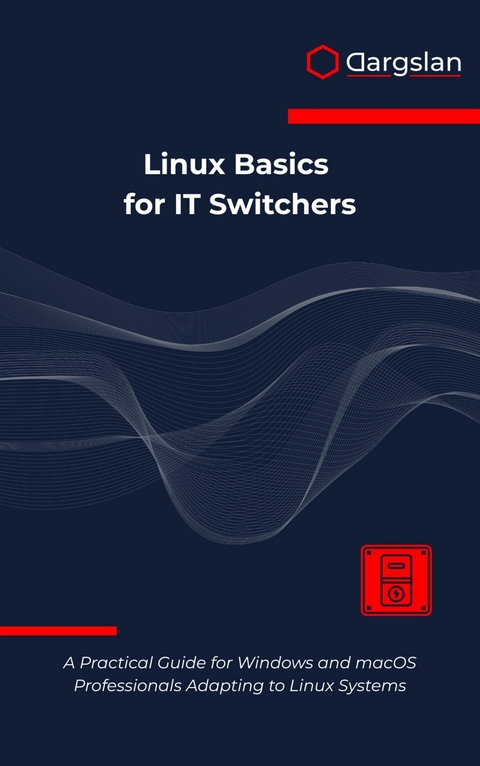
Linux Basics for IT Switchers (eBook)
381 Seiten
Dargslan s.r.o. (Verlag)
978-0-00-081159-2 (ISBN)
Linux Basics for IT Switchers: A Practical Guide for Windows and macOS Professionals Adapting to Linux Systems
Are you an experienced IT professional looking to add Linux skills to your toolkit? This practical, hands-on guide bridges the gap between your existing Windows or macOS knowledge and Linux proficiency.
In today's technology landscape, Linux expertise is becoming essential for IT careers. From cloud infrastructure and DevOps to cybersecurity and system administration, Linux powers the systems that run our digital world. Linux Basics for IT Switchers provides a direct pathway for established IT professionals to leverage their existing knowledge while mastering Linux fundamentals.
Unlike typical beginner Linux books, this guide acknowledges your technical background and focuses on the specific differences, similarities, and unique advantages of Linux systems. You'll progress through 18 carefully structured chapters that transform theoretical concepts into practical skills you can apply immediately in real-world scenarios.
What you'll learn:
How to select the right Linux distribution for your specific needs and environment
Navigate both graphical desktops and command-line interfaces with confidence
Master the Linux filesystem hierarchy and permission structure
Efficiently manage software installation, updates, and dependencies
Implement fundamental security practices specific to Linux systems
Configure networking and remote access in Linux environments
Automate routine tasks using Linux's powerful built-in tools
Troubleshoot common issues using systematic Linux-specific approaches
Practical features include:
Comparative reference tables showing Windows/macOS vs. Linux commands and concepts
Hands-on exercises with clear, step-by-step instructions
Real-world scenarios based on common IT workflows
Time-saving tips from experienced Linux professionals
Visual guides to complex Linux structures and relationships
Whether you're preparing for a career transition, supporting Linux systems at work, or expanding your technical versatility, this book provides the foundation you need. The comprehensive appendices serve as quick-reference resources as you apply your new Linux skills in production environments.
Transform your IT expertise with Linux knowledge that employers increasingly demand. Your journey to Linux proficiency starts here.
Introduction
Welcome to the World of Linux
Picture yourself sitting in front of a computer screen, the familiar Windows desktop staring back at you with its taskbar, start menu, and colorful icons. For years, perhaps decades, this has been your digital workspace—a comfortable, predictable environment where you've built your IT career. But somewhere in the back of your mind, you've heard whispers about Linux, this mysterious operating system that powers everything from smartphones to supercomputers, from web servers to space stations. Today, that curiosity has brought you here, to the threshold of a journey that will fundamentally change how you think about computing.
Linux isn't just another operating system—it's a philosophy, a community, and a powerful toolkit that has quietly revolutionized the technology landscape. While you've been clicking through Windows interfaces and managing Active Directory domains, Linux has been silently powering the internet backbone, running the majority of web servers, orchestrating cloud infrastructure, and enabling the digital transformation that defines our modern world. The irony is that even as a Windows-focused IT professional, you've been interacting with Linux systems every day without realizing it—every Google search, every Netflix stream, every online purchase has likely touched multiple Linux servers along the way.
The Linux Revolution: More Than Just an Operating System
To understand why Linux matters so profoundly in today's IT landscape, we need to step back and examine the broader technological ecosystem. When Linus Torvalds released the first Linux kernel in 1991, he probably didn't envision that his university project would eventually challenge the dominance of proprietary operating systems and become the foundation for a multi-billion-dollar industry. What started as a hobby project has evolved into the most widely deployed operating system on the planet.
Consider this: as you read these words, Linux is running on approximately 96% of the world's top one million web servers. It's the operating system of choice for 100% of the world's top 500 supercomputers. Every Android device in your pocket runs on Linux. The vast majority of cloud infrastructure—Amazon Web Services, Google Cloud Platform, Microsoft Azure—relies heavily on Linux. Even Microsoft, once Linux's greatest adversary, now embraces Linux within its own cloud services and has integrated Linux subsystems directly into Windows.
This ubiquity isn't accidental. Linux succeeded because it embodies principles that align perfectly with the demands of modern computing: stability, security, flexibility, and cost-effectiveness. While proprietary systems often lock you into specific vendors and licensing models, Linux offers freedom—freedom to modify, distribute, and deploy without the constraints of commercial licensing. This freedom has fostered an ecosystem of innovation that continues to drive technological advancement across every sector of the IT industry.
Why IT Professionals Are Making the Switch
The migration from Windows-centric IT environments to Linux-inclusive or Linux-first infrastructures isn't happening by accident. It's driven by compelling business and technical realities that forward-thinking organizations can no longer ignore. As an IT professional considering this transition, you're likely responding to one or more of these powerful motivating factors.
Cost optimization represents perhaps the most immediate and tangible benefit. Traditional Windows Server licensing can consume significant portions of IT budgets, especially as organizations scale their infrastructure. A medium-sized company might spend hundreds of thousands of dollars annually on Windows Server licenses, SQL Server licenses, and Client Access Licenses (CALs). Linux eliminates these licensing costs entirely, allowing organizations to redirect those resources toward innovation, additional hardware, or expanded teams. The total cost of ownership (TCO) calculations become even more favorable when you consider that Linux systems typically require less hardware resources to deliver equivalent performance.
Enhanced security has become a critical differentiator in an era of increasing cyber threats. Linux's architecture provides inherent security advantages through its permission model, process isolation, and reduced attack surface. Unlike Windows systems that often run with elevated privileges by default, Linux enforces the principle of least privilege throughout the system. The open-source nature of Linux means that security vulnerabilities are quickly identified and patched by a global community of developers, rather than waiting for a single vendor's release cycle.
Superior performance and stability make Linux particularly attractive for server environments and mission-critical applications. Linux systems routinely achieve uptimes measured in years rather than months, and they can efficiently utilize system resources in ways that often surprise Windows administrators. A Linux server can often handle significantly more concurrent connections, process more transactions, and maintain better responsiveness under load compared to equivalent Windows hardware.
Cloud-native compatibility has become essential as organizations embrace digital transformation. The major cloud platforms were built with Linux as the primary operating system, and many cloud-native technologies—containers, orchestration platforms like Kubernetes, microservices architectures—work most naturally in Linux environments. Organizations that remain exclusively Windows-focused often find themselves at a disadvantage when adopting modern cloud strategies.
Understanding the Linux Ecosystem
Linux isn't a monolithic entity like Windows or macOS. Instead, it represents a family of operating systems built around the Linux kernel, each tailored for specific use cases and preferences. This diversity might initially seem overwhelming to Windows administrators accustomed to a single, standardized platform, but it actually represents one of Linux's greatest strengths—the ability to choose the right tool for each specific job.
The concept of distributions (or "distros") is fundamental to understanding Linux. Think of the Linux kernel as the engine of a car, while distributions are complete vehicles built around that engine—some optimized for speed, others for reliability, still others for ease of use. Ubuntu, with its focus on user-friendliness and regular release cycles, has become the go-to choice for many organizations transitioning from Windows. Red Hat Enterprise Linux (RHEL) and its community counterpart, CentOS (now replaced by Rocky Linux and AlmaLinux), dominate enterprise server environments with their emphasis on stability and long-term support. SUSE Linux Enterprise Server provides another enterprise option with strong European adoption and excellent virtualization support.
For specialized use cases, other distributions excel in their niches. Debian provides the foundation for many other distributions and emphasizes stability and free software principles. Arch Linux offers cutting-edge packages and maximum customization for advanced users. Alpine Linux has become the standard for container deployments due to its minimal footprint and security focus.
The package management system represents another fundamental difference from Windows environments. Instead of downloading executable files from various websites and running installation wizards, Linux distributions provide centralized repositories of pre-compiled software packages. These packages are digitally signed, dependency-managed, and can be installed, updated, or removed with simple commands. This approach eliminates many of the security risks and compatibility issues common in Windows environments while providing a more consistent and reliable software deployment experience.
Open source licensing underpins the entire Linux ecosystem, but it's more than just "free software." The various open source licenses—GPL, MIT, Apache, BSD—create a legal framework that encourages collaboration while protecting both users and developers. This licensing model has enabled the rapid innovation and widespread adoption that characterizes the Linux ecosystem. Understanding these licenses becomes important when deploying Linux in enterprise environments, particularly when integrating with proprietary software or developing custom applications.
The Skills Gap and Opportunity
The rapid adoption of Linux across enterprise environments has created a significant skills gap in the job market. Organizations are struggling to find qualified Linux administrators, engineers, and architects, while many experienced Windows professionals find themselves at a career crossroads. This skills shortage represents both a challenge for employers and an unprecedented opportunity for IT professionals willing to expand their expertise.
Market demand for Linux skills continues to outpace supply across virtually every sector of the technology industry. Cloud computing roles almost universally require Linux expertise. DevOps positions assume familiarity with Linux-based tools and workflows. Cybersecurity professionals increasingly need Linux skills to understand and secure modern infrastructure. Even traditional system administrator roles are evolving to require hybrid Windows/Linux expertise as organizations adopt mixed environments.
The salary premium for Linux skills reflects this market reality. According to industry surveys, IT professionals with Linux expertise typically command salaries 10-20% higher than their Windows-only counterparts. This premium increases...
| Erscheint lt. Verlag | 27.5.2025 |
|---|---|
| Sprache | englisch |
| Themenwelt | Mathematik / Informatik ► Informatik ► Betriebssysteme / Server |
| ISBN-10 | 0-00-081159-9 / 0000811599 |
| ISBN-13 | 978-0-00-081159-2 / 9780000811592 |
| Informationen gemäß Produktsicherheitsverordnung (GPSR) | |
| Haben Sie eine Frage zum Produkt? |
 EPUB (Adobe DRM)
Größe: 1,3 MB
Kopierschutz: Adobe-DRM
Adobe-DRM ist ein Kopierschutz, der das eBook vor Mißbrauch schützen soll. Dabei wird das eBook bereits beim Download auf Ihre persönliche Adobe-ID autorisiert. Lesen können Sie das eBook dann nur auf den Geräten, welche ebenfalls auf Ihre Adobe-ID registriert sind.
Details zum Adobe-DRM
Dateiformat: EPUB (Electronic Publication)
EPUB ist ein offener Standard für eBooks und eignet sich besonders zur Darstellung von Belletristik und Sachbüchern. Der Fließtext wird dynamisch an die Display- und Schriftgröße angepasst. Auch für mobile Lesegeräte ist EPUB daher gut geeignet.
Systemvoraussetzungen:
PC/Mac: Mit einem PC oder Mac können Sie dieses eBook lesen. Sie benötigen eine
eReader: Dieses eBook kann mit (fast) allen eBook-Readern gelesen werden. Mit dem amazon-Kindle ist es aber nicht kompatibel.
Smartphone/Tablet: Egal ob Apple oder Android, dieses eBook können Sie lesen. Sie benötigen eine
Geräteliste und zusätzliche Hinweise
Buying eBooks from abroad
For tax law reasons we can sell eBooks just within Germany and Switzerland. Regrettably we cannot fulfill eBook-orders from other countries.
aus dem Bereich