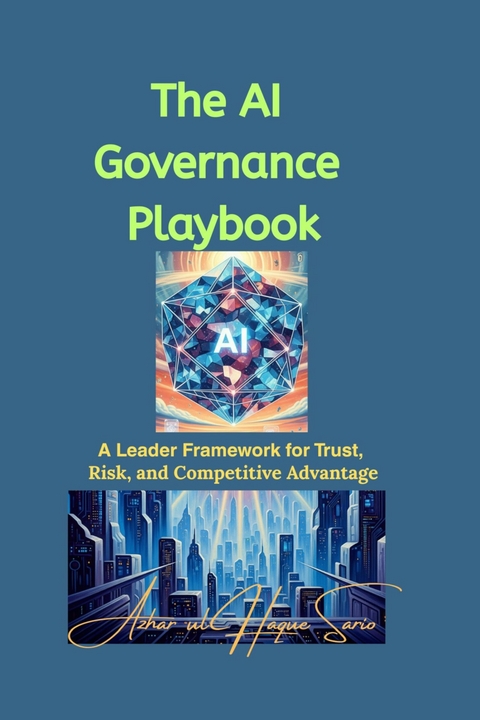
The AI Governance Playbook (eBook)
210 Seiten
Azhar Sario Hungary (Verlag)
978-3-384-64239-4 (ISBN)
Forget the hype and the hypotheticals; the biggest threat from artificial intelligence isn't a distant sci-fi scenario-it's the immediate, tangible risk of ungoverned AI already operating inside your business. This is The AI Governance Playbook, your essential guide to navigating the most critical business challenge of the 21st century. As organizations rush to deploy AI, they're stepping into a minefield of financial, legal, and reputational risks. We've all seen the headlines: a single chatbot error erasing $100 billion in shareholder value, biased algorithms leading to legal nightmares, and a staggering 42% of AI projects failing outright, not because of faulty tech, but due to a catastrophic lack of governance. This book cuts through the noise to provide a clear, actionable framework for leaders who need to turn this risk into a decisive competitive advantage.
This playbook is your step-by-step guide to mastering AI governance. It demystifies the technology without a single line of code, using simple analogies to explain complex concepts like LLMs and the AI data pipeline. You'll learn how to build a modern AI governance team, from the Chief AI Officer to the AI Ethicist, and understand why these roles command a 56% wage premium in today's market. We'll walk through the globally recognized NIST AI Risk Management Framework, showing you how to adapt it to your existing business processes. You'll get practical tools like model cards and AI risk registers to ensure transparency and manage the 'black box' problem. We explore how to navigate the complex global legal landscape, from the EU AI Act to the patchwork of US state laws, and provide a harmonized approach to compliance. Most importantly, you'll discover how to create a culture of responsible AI use, manage the human side of change, and communicate AI risk and ROI effectively to your board. Finally, we'll show you how to leverage your commitment to AI ethics as a powerful brand differentiator, winning customer trust in an increasingly skeptical world.
What sets The AI Governance Playbook apart is its relentless focus on practical application and strategic value, designed specifically for business leaders, not just technologists. While other books get lost in abstract ethical debates or dense technical jargon, this playbook provides a clear, actionable framework grounded in the business realities of 2025. It moves beyond the 'what' and 'why' to deliver the 'how': how to integrate AI risk into existing ERM frameworks like COSO, how to apply a change management model like ADKAR to ensure employee adoption, and how to calculate the tangible ROI of your governance program. It speaks the language of the C-suite, providing dashboard templates and communication strategies to translate technical risk into business impact. This isn't just another book about AI; it's a leader's guide to survival and success in the AI era, turning governance from a perceived cost center into your greatest strategic asset.
Disclaimer: This work is an independent publication and has not been authorized, sponsored, or otherwise approved by the International Association of Privacy Professionals (IAPP), the National Institute of Standards and Technology (NIST), the Committee of Sponsoring Organizations of the Treadway Commission (COSO), the International Organization for Standardization (ISO), or Prosci Inc. The use of trademarks such as AIGP, CIPP, CIPM, NIST AI RMF, COSO, ISO 31000, and ADKAR® is for informational and descriptive purposes only, under the principle of nominative fair use, and does not imply any affiliation with or endorsement by the trademark holders.
Part II: The AI Governance Framework
Principle: Mastering the AI Risk Management Lifecycle
The Captain's Guide to the AI Seas: Navigating Risk with Wisdom and Courage
We’ve set sail into a new age. The Age of AI. Like the explorers of old, we stand on the shores of an immense, shimmering ocean of possibility. Every day, sleek new vessels—powerful AI tools—are launched, promising to carry us to untold shores of efficiency and discovery. But this ocean is as treacherous as it is vast. There are storms of bias we cannot see, phantom currents of misinformation, and deep, hidden reefs of unintended consequences that can shipwreck the most ambitious ventures.
To navigate these waters is not merely a technical challenge; it's a test of leadership, of ethics, of our very humanity. How do we captain our organizations through this thrilling, perilous new world?
We need more than just a faster ship. We need the timeless art of seamanship. For our era, that art is captured in the National Institute of Standards and Technology (NIST) AI Risk Management Framework (RMF). Forget the dry name; think of it as the master captain’s logbook, a shared map passed down to all who dare to sail these seas. It doesn't tell you exactly where to go, but it teaches you how to read the stars, how to chart your course, and how to command your vessel with a steady hand. For any leader who wants to do more than just stay afloat, mastering its four core principles is like learning the ways of the wind and tide.
1. GOVERN: Setting the North Star for Your Voyage
Before any great voyage, a captain doesn't just load the cargo. They define the mission. The "Govern" function is this essential, soul-searching work done in the quiet of the harbor before the ropes are cast off. It's about embedding a culture of courage and caution into the very timbers of your ship.
This is where you choose your North Star—the unwavering ethical principles that will guide you, even in the darkest night. What will your crew stand for? How will you honor the dignity and privacy of the people you encounter? These are not just policies to be filed away; they are your solemn oath, the flag you fly from the mast.
You also establish the chain of command. Who is on the watch? Who has the authority to change course when an iceberg is spotted? On a ship, ambiguity leads to disaster. In AI, it’s no different. Every member of the crew, from the data scientist in the engine room to the legal expert on the quarterdeck, must know their role and their responsibility.
Most importantly, you must decide what kind of storms you are willing to weather. This is your risk tolerance. A small trading vessel hugs the coast, while a galleon bound for a new world must be prepared for tempests. What level of risk is acceptable in the pursuit of your goal? Answering this honestly, before the waves start crashing, is the mark of a true commander. Governance is the moral compass of your entire expedition. Without it, you are not a captain; you are just a castaway.
2. MAP: Charting the Ghosts in the Machine
With your compass set, you must now become a cartographer of the unseen. The "Map" function is the art of charting the specific waters your AI will sail. Old maps are useless here; you must draw your own, anticipating dangers before they appear.
Your chart begins with the water itself: your data. Where does it come from? Is it a clear, fresh spring, or a murky, stagnant pool hiding ancient biases? Polluted data will poison your entire journey.
Next, you chart your destination. Is this AI designed to recommend a sea shanty, or to perform life-saving surgery on the high seas? The purpose of the voyage defines the gravity of the risks. A miscalculation on a pleasure cruise is an inconvenience; on a rescue mission, it's a tragedy.
You must also chart the people who will interact with your creation. Who are they? Seasoned sailors who understand the ship's every creak and groan? Or land-loving passengers who might mistake a warning bell for a dinner chime? Understanding their world is key to predicting how they will behave.
This process of mapping is an act of imagination. You must listen for the ghosts in the machine—the subtle ways your AI could fail, the vulnerabilities it could expose, the societal storms it could inadvertently create. It’s about peering through the fog of the immediate and seeing the shape of the future, allowing you to plot a course around dangers that are still over the horizon.
3. MEASURE: Reading the Winds and the Currents
Once at sea, a captain’s senses are alive. They are constantly measuring—the speed of the ship, the direction of the wind, the depth of the water beneath the keel. The "Measure" function is this continuous act of observation, turning the abstract dangers you’ve mapped into tangible knowledge.
Some of your instruments are precise, like a sextant against the stars. These are your quantitative metrics: What is the AI’s accuracy? How many errors does it make per thousand calculations? Do these errors disproportionately affect one group of people, like a rogue current pushing you off course?
Other instruments are more intuitive, like the feel of the ship's wheel in your hands. These are your qualitative measures: How transparent is the AI’s inner working? Does it feel fair to those who use it? Can a human being look at its decision and say, “I understand”? This is the seaman’s art—the wisdom that numbers alone cannot capture.
This is not a one-time reading. It is a constant vigilance. The ocean of data is always shifting. A model that was true yesterday can drift into dangerous territory today. By measuring continuously, you track your true position, ensuring you haven't been slowly, silently pulled into the digital doldrums or, worse, toward a catastrophic failure. This is how you know, with evidence, if your voyage is still true.
4. MANAGE: Steering the Helm Through the Storm
Knowledge is nothing without action. "Manage" is the final, decisive act: taking the helm and steering. Based on your charts and your readings, you must now command the ship.
Your first action is to choose your battles. You cannot fight every wave. You use the wisdom of your governance to prioritize. Which risks loom largest on the horizon? You focus your crew’s energy on the threats that truly matter.
Then, you act. If you see a storm of bias brewing, you might change course by finding cleaner data or adjusting your algorithms (mitigation). If a risk is unavoidable but manageable, you might order the crew to batten down the hatches and sail through it (acceptance). In some cases, you might even offload a particularly risky cargo to another vessel better equipped to handle it (transfer).
Management is also about what you do when the storm hits. When your AI makes a mistake, what is your plan? How do you right the ship, learn from the error, and communicate to those affected? A great captain is defined not by the storms they avoid, but by how they lead their crew through the ones they cannot. This means having well-rehearsed drills, a clear plan of action, and the humility to make corrections and repair trust.
The True North of Innovation
By embracing this cycle—Govern, Map, Measure, and Manage—a leader does something profound. You transform risk management from a bureaucratic anchor, dragging on progress, into the very keel and rudder of your ship. It becomes the source of stability that allows you to build a faster, more ambitious vessel. It is the tool that gives you the confidence to sail further.
This framework empowers you to be a true captain in the Age of AI. It calls you to lead with vision, to explore with caution, and to ensure that the new worlds we discover are not only prosperous, but also fair, just, and worthy of our highest ideals. It is how we ensure our technological voyages serve all of humanity, bringing us safely to a better shore.
The Ghost in the Machine: Weaving AI into the Enterprise Soul
Your organization is a seasoned navigator. For years, you’ve sailed the turbulent seas of commerce using trusted maps—the sturdy, reliable charts of COSO and ISO 31000. These frameworks have been your sextant and compass, helping you plot courses, anticipate storms, and manage the known risks of finance, operations, and strategy. You have a well-built ship and a capable crew.
Then, a new force of nature appears.
Artificial Intelligence isn’t just another current or a predictable trade wind. It’s a meteorological phenomenon of its own—powerful, transformative, and shimmering with unknown variables. To treat it as just another IT squall is to dangerously misjudge the weather. The National Institute of Standards and Technology (NIST) didn't create its AI Risk Management Framework (AI RMF) to replace your trusted maps, but to serve as a legend for this new, awe-inspiring climate. It’s a guide to understanding the strange new clouds, the sudden tides, and the profound power humming in the air.
The true test of a master navigator isn’t just sailing the familiar seas, but integrating this new reality into every decision. It's about recognizing that AI isn’t a sideshow in the cargo hold; it’s the new wind in...
| Erscheint lt. Verlag | 27.6.2025 |
|---|---|
| Sprache | englisch |
| Themenwelt | Informatik ► Theorie / Studium ► Künstliche Intelligenz / Robotik |
| Schlagworte | AI governance • Business Strategy • Chief AI Officer • EU AI Act • Explainable AI • responsible AI • Risk Management |
| ISBN-10 | 3-384-64239-2 / 3384642392 |
| ISBN-13 | 978-3-384-64239-4 / 9783384642394 |
| Informationen gemäß Produktsicherheitsverordnung (GPSR) | |
| Haben Sie eine Frage zum Produkt? |
 EPUB (Ohne DRM)
Digital Rights Management: ohne DRM
Dieses eBook enthält kein DRM oder Kopierschutz. Eine Weitergabe an Dritte ist jedoch rechtlich nicht zulässig, weil Sie beim Kauf nur die Rechte an der persönlichen Nutzung erwerben.
Dateiformat: EPUB (Electronic Publication)
EPUB ist ein offener Standard für eBooks und eignet sich besonders zur Darstellung von Belletristik und Sachbüchern. Der Fließtext wird dynamisch an die Display- und Schriftgröße angepasst. Auch für mobile Lesegeräte ist EPUB daher gut geeignet.
Systemvoraussetzungen:
PC/Mac: Mit einem PC oder Mac können Sie dieses eBook lesen. Sie benötigen dafür die kostenlose Software Adobe Digital Editions.
eReader: Dieses eBook kann mit (fast) allen eBook-Readern gelesen werden. Mit dem amazon-Kindle ist es aber nicht kompatibel.
Smartphone/Tablet: Egal ob Apple oder Android, dieses eBook können Sie lesen. Sie benötigen dafür eine kostenlose App.
Geräteliste und zusätzliche Hinweise
Buying eBooks from abroad
For tax law reasons we can sell eBooks just within Germany and Switzerland. Regrettably we cannot fulfill eBook-orders from other countries.
aus dem Bereich