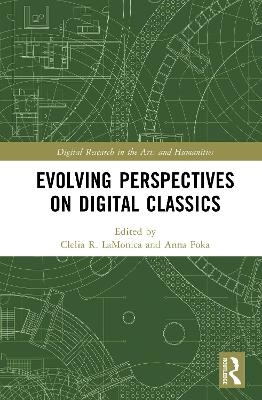
Evolving Perspectives on Digital Classics
Routledge (Verlag)
978-1-032-89982-4 (ISBN)
The volume includes contributions from Sweden, Norway, Greece, Italy, the US, the UK, and Australia and primarily examines ancient textual and material data that connect multiple disciplines, focusing on what researchers can do beyond rigid boundaries. Part I discusses annotating and describing ancient narratives and entities. Part II explores the digital representation and modelling of ancient spaces. Part III highlights computational and AI-driven literary analysis. Part IV focuses on philological methods in digital text analysis. Part V considers innovative applications in cultural and educational contexts.
Evolving Perspectives on Digital Classics demonstrates how digital methodologies can deepen understanding of the ancient world. The book encourages readers to adopt sound practices in data curation and analysis. It will appeal to scholars and students from a wide range of disciplines, including digital humanities, classics, philology, archaeology, and ancient history.
Clelia R. LaMonica is Senior Lecturer at Uppsala University and a research affiliate at the Culture, Cognition, and Coevolution Lab at Harvard University. Her research interests include digital humanities, socio-linguistics, philology, and natural language processing. Anna Foka is Professor of Digital Humanities and Founder and Director of the Centre for Digital Humanities at the Department of ALM (Archives, Library and Information Studies, Museum and Heritage Studies), at Uppsala University. Her research focuses on digital humanities, especially the use of AI and digital technologies in cultural heritage and historical collections. She explores intersections with classics, archaeology, and gender studies and is interested in concepts of sustainability, diversity, and the impact of digital methods and infrastructure on knowledge production in the humanities.
Introduction to Evolving Perspectives on Digital Classics: Innovation, Methodology, and the Ancient World; Part I Annotating and Describing Ancient Narratives and Entities; 1. Structuring the Sights and Stories of Pausanias with Wikidata; 2. SLaVEgents: Digital Prosopography of Enslaved Persons in Western Eurasia and North Africa (1000 BCE-300 CE); Part II Ancient Spaces; 3. The Data of Mythic Spaces; 4. From the Pillars of Heracles to Ecbatana: Digital Representation of Ancient Travel Narratives; Part III Computational and AI-Driven Literary Analysis; 5. Artificial Intelligence for Classical Literary Texts; 6. Stylometry for Latin Literary Criticism; Part IV Philological Methods in Digital Text Analysis; 7. Pretrained Word Vectors for Latin Philology; 8. Deciphering Ancient Scripts: Integrated, State-of-the-Art Approaches; Part V Innovative Applications in Culture and Education; 9. New Technologies for Learning and Teaching Ancient Greek and Latin; 10. Digital Art History, Digital Humanities, and Digital Classics: Finding the Missing Link
| Erscheinungsdatum | 04.11.2025 |
|---|---|
| Reihe/Serie | Digital Research in the Arts and Humanities |
| Zusatzinfo | 6 Tables, black and white; 35 Halftones, black and white; 35 Illustrations, black and white |
| Verlagsort | London |
| Sprache | englisch |
| Maße | 156 x 234 mm |
| Gewicht | 590 g |
| Themenwelt | Geschichte ► Allgemeine Geschichte ► Vor- und Frühgeschichte |
| Geschichte ► Allgemeine Geschichte ► Altertum / Antike | |
| Mathematik / Informatik ► Informatik | |
| Sozialwissenschaften ► Kommunikation / Medien ► Buchhandel / Bibliothekswesen | |
| ISBN-10 | 1-032-89982-4 / 1032899824 |
| ISBN-13 | 978-1-032-89982-4 / 9781032899824 |
| Zustand | Neuware |
| Informationen gemäß Produktsicherheitsverordnung (GPSR) | |
| Haben Sie eine Frage zum Produkt? |
aus dem Bereich