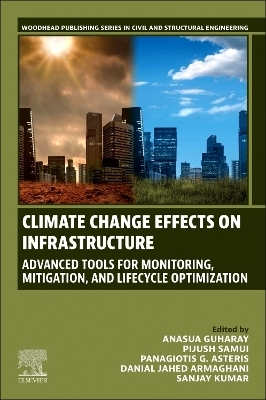
Climate Change Effects on Infrastructure
Woodhead Publishing (Verlag)
978-0-443-33685-0 (ISBN)
- Noch nicht erschienen (ca. Februar 2026)
- Versandkostenfrei
- Auch auf Rechnung
- Artikel merken
With its evaluation of a host of assets in the built environment, Climate Change Effects on Infrastructure: Advanced Tools for Monitoring, Mitigation, and Lifecycle Optimization instructs readers how to assess and predict structural vulnerabilities resulting from climate change as well as ensuing hazard patterns using mathematical tools and data-driven models. The carefully compiled contributions also comprehensively survey the latest technological developments and the most useful approaches to counteract and/or prevent damage and connected socio-economic risks.
The volume proves to be an even more invaluable resource thanks to its real-world application examples that spotlight the urgency of further investigations into the implementation of cost-effective and sustainable adaptive measures that can enhance or extend the reliable performance, durability, and efficiency of structures and infrastructure systems throughout their entire lifecycle.
Dr. GuhaRay is an Associate Professor in the Department of Civil Engineering at BITS Pilani, India. She is also cross-appointed faculty at Hiroshima University, Japan. She received her PhD in Geotechnical Engineering from IIT Kharagpur, India, in 2014. Dr. GuhaRay’s main areas of expertise are ground improvement with green materials, reliability applications in geotechnical engineering, and stabilization of expansive soil with activated binders. Dr. GuhaRay has previously co-edited Green Materials in Civil Engineering for Elsevier and contributed to several journal papers, book chapters, and peer-reviewed conference proceedings alongside international teams of experts. Dr. Samui is an Associate Professor in the Department of Civil Engineering at NIT Patna, India. He received his PhD in Geotechnical Engineering from the Indian Institute of Science Bangalore, India, in 2008. His research interests include geohazard, earthquake engineering, concrete technology, pile foundation and slope stability, and application of AI for solving different problems in civil engineering. Dr. Samui is a repeat Elsevier editor but also a prolific contributor to journal papers, book chapters, and peer-reviewed conference proceedings. Professor Asteris received his B.S., M.S., and PhD in Civil Engineering from the National Technical University of Athens, Greece. He is currently a Full Professor and the Head of the Computational Mechanics Laboratory, and the Head of the Civil Engineering Department of the School of Pedagogical and Technological Education, Athens. Prof. Asteris is a trailblazer in the field of computational structural engineering. His research spans diverse areas, including artificial neural networks, soft computing, applied and computational mathematics, and masonry materials and structures. He is also the editor-in-chief of two international scientific journals and a member of the editorial board of more than ten international journals. Dr. Armaghani is currently working as a Postdoctoral Research Fellow at the School of Civil and Environmental Engineering, University of Technology Sydney, Australia. His research focuses on understanding and mitigating geotechnical and geological hazards, as well as a wide range of related topics, including slope stability analysis, rock mechanics, tunnel construction, surface and deep excavations, and applying machine learning models to solve different engineering-specific concerns. His contributions published in well-established ISI and Scopus-indexed journals and presented at national, and international conferences have had significant impact in the academic and scientific community, garnering him a spot among the top 2% of scientists from 2020 to 2023 in the list published by Stanford University. Dr. Sanjay Kumar is an Assistant Professor in the Department of Civil Engineering at NIT Patna, India. He received his PhD in Structural Engineering from the same institute in 2019. Dr. Sanjay has more than seventeen years of teaching experience, eight years of research experience, and a lot of practical knowledge from having worked in industry too. His research focuses on innovations in materials and design for civil engineering structures.
1. The relationship between the built environment and climate change
Part I: Effects of Climate Change on Civil Engineering Infrastructure
2. Assessing Carbon Emissions and Cost-Effectiveness of Nano-Silica Soil Stabilization for Sustainable Pavement Construction: A Comprehensive Framework for Policy and Practice
3. Analysis of Slope Instabilities using Finite Element Method considering Rainfall Effects
4. Investigating the Influence of Climate Variability on Slope Stability and Water Dynamics
5. Environmental Trade-Offs of Nuclear Energy in Climate Change Mitigation: Waste Management and Soil Impact
6. Climate-induced changes in hydrological regimes and water security
7. Effect of Climate Change on Slope Stability: A Review Study
Part II: Adapting Urban Infrastructure to Climate Change
8. Climate Change and Infrastructure Resilience: Addressing Impacts and Developing Adaptation Strategies
9. Combating climate change impact on urban geotechnical infrastructures: challenges and future perspectives
10. Infrastructural Acclimatization: Innovations and Strategies towards Sustainable Development
11. Leveraging Artificial Intelligence for Climate-Resilient Infrastructure Management
12. Climate Change and Frost Conditions: Impacts on Dynamic Behavior of Civil Structures
13. Impact of urban infrastructure in land surface temperature
14. AI-Driven Solutions for Climate Resilience in Infrastructure
Part III: Case Studies
15. An Assessment of Potential Environmental Impacts of Climate Change and Sea Level Rise on Decentralized Waste Water Treatment Infrastructures: A Broward County Case Study, FL, USA
16. Assessment of Landslide Susceptibility Zones for the Kaski District, Located in Nepal's Gandaki Province
17. Mitigating the Impact of Climate Change on Railway Infrastructure Stability in India
| Erscheint lt. Verlag | 1.2.2026 |
|---|---|
| Reihe/Serie | Woodhead Publishing Series in Civil and Structural Engineering |
| Sprache | englisch |
| Maße | 152 x 229 mm |
| Themenwelt | Mathematik / Informatik ► Mathematik ► Angewandte Mathematik |
| Technik ► Bauwesen | |
| ISBN-10 | 0-443-33685-7 / 0443336857 |
| ISBN-13 | 978-0-443-33685-0 / 9780443336850 |
| Zustand | Neuware |
| Informationen gemäß Produktsicherheitsverordnung (GPSR) | |
| Haben Sie eine Frage zum Produkt? |
aus dem Bereich