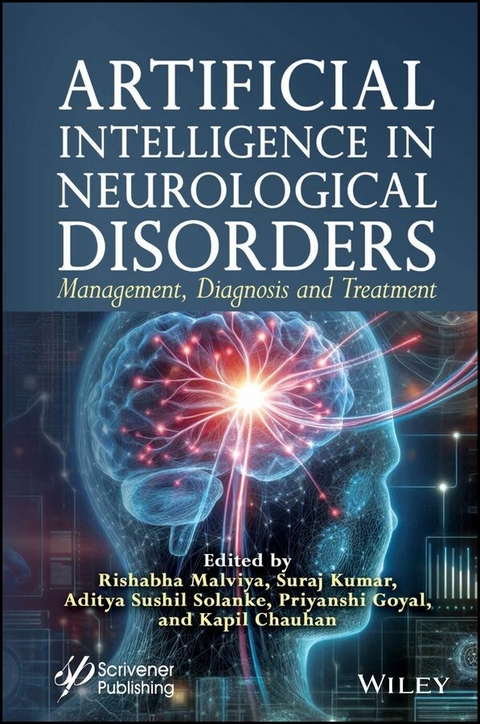
Artificial Intelligence in Neurological Disorders (eBook)
386 Seiten
Wiley-Scrivener (Verlag)
978-1-394-34751-3 (ISBN)
The book gives invaluable insights into how artificial intelligence is revolutionizing the management and treatment of neurological disorders, empowering you to stay ahead in the rapidly evolving landscape of healthcare.
Embark on a groundbreaking exploration of the intersection between cutting-edge technology and the intricate complexities of neurological disorders. Artificial Intelligence in Neurological Disorders: Management, Diagnosis and Treatment comprehensively introduces how artificial intelligence is becoming a vital ally in neurology, offering unprecedented advancements in management, diagnosis, and treatment. As the digital age converges with medical expertise, this book unveils a comprehensive roadmap for leveraging artificial intelligence to revolutionize neurological healthcare. Delve into the core principles that underpin AI applications in the field by exploring intricate algorithms that enhance the precision of diagnosis and how machine learning not only refines the understanding of neurological disorders but also paves the way for personalized treatment strategies tailored to individual patient needs. With compelling case studies and real-world examples, the realms of neuroscience and artificial intelligence converge, illustrating the symbiotic relationship that holds the promise of transforming patient care.
Readers of this book will find it:
- Provides future perspectives on advancing artificial intelligence applications in neurological disorders;
- Focuses on the role of AI in diagnostics, delving into how advanced algorithms and machine learning techniques contribute to more accurate and timely diagnosis of neurological disorders;
- Emphasizes practical integration of AI tools into clinical practice, offering insights into how healthcare professionals can leverage AI technology for more effective patient care;
- Recognizes the interdisciplinary nature of neurology and AI, bridging the gap between these fields, making it accessible to healthcare professionals, researchers, and technologists;
- Addresses the ethical implications of AI in healthcare, exploring issues such as data privacy, bias, and the responsible deployment of AI technologies in the neurological domain.
Audience
Researchers, scientists, industrialists, faculty members, healthcare professionals, hospital management, biomedical industrialists, engineers, and IT professionals interested in studying the intersection of AI and neurology.
Rishabha Malviya, PhD is an associate professor in the Department of Pharmacy in the School of Medical and Allied Services at Galgotias University with over 13 years of research experience. He has authored 57 books, 58 chapters, and over 150 research papers for national and international journals of repute, as well as 51 patents. His areas of interest include formulation optimization, nanoformulation, targeted drug delivery, localized drug delivery, and characterization of natural polymers as pharmaceutical excipients.
Suraj Kumar is an assistant professor in the School of Medical and Allied Sciences at Galgotias University. He has published over ten papers in international journals and five book chapters. His research interests include sustainable polymeric fibers, nanoparticles, and controlled drug delivery.
Aditya Sushil Solanke, PhD is a Senior Resident in Neurosurgery at Byramjee Jeejeebhoy Government Medical College and Sassoon Hospital, India. He completed his Bachelor of Medicine, Bachelor of Surgery, and Masters in General Surgery from the Government Medical College in Nagpur.
Priyanshi Goyal, M.Pharm is an assistant professor in the School of Pharmacy at Mangalayatan University. She has authored seven review articles and two books and attended 14 national and international conferences and webinars. Her area of interest is treatment strategies for neurological disorders.
Kapil Chauhan, PhD is an emergency physician at Max Hospital in Dehradun, India. He completed his Bachelor of Medicine and Bachelor of Surgery from Teerthanker Mahavir Medical College and Masters in Emergency Medicine from Max Hospital.
1
Artificial Intelligence in Neuroscience: A Clinician’s Perception
Abstract
Undoubtedly, it is a fact that, despite the unprecedented hype, the implementation of AI in the next decade will cause a paradigm shift in healthcare for drug delivery. The following study aims to determine the clinical application by which Al is being used in the field of neurology. From a clinical perspective, the author will discuss the field’s exponential growth, although they will not provide the sophisticated, technical, computational jargon that typically accompanies such discussions. This article will introduce the basics of artificial intelligence in healthcare and its numerous uses in neurosciences. Clinically significant information is concealed in these enormous data sets, but powerful AI algorithms can unlock it. However, it is difficult to translate technical computational accomplishment into meaningful therapeutic impact. Earlier AI may be used in therapeutic settings, but that undergoes extensive and methodical studies. Its potential to create a significant influence should not be underestimated, as was the case with previous disruptive innovations. Soon we will be living in a world where medical data collected as point-of-service data is analyzed by sophisticated machine algorithms in real time to provide useful insights.
Keywords: Artificial intelligence, neuroscience, healthcare, machine learning, clinical application
1.1 Introduction
McCarthy originally used the term “artificial intelligence” in [1], which was published in 1956. One of the main authors is a practicing therapist who believes that the “A” in AI should refer to “ambient,” as in “to enhance, magnify, accelerate, and help.” Just what does “artificial” mean in the context of artificial intelligence? Ultimately, AI may be seen as an advancement of the inherent cognitive abilities that are present in every human being. The scope of a domain expert’s work can be widened with the aid of augmented intelligence. The processing of data-rich processes can be sped up with the help of accelerated engineering and analysis. In the present day, AI enables a constellation of ubiquitous technologies that have a major effect on regular life. By comparison, AI is more like a pole vault than a simple technological advance. Artificial intelligence (AI) is the application of computing resources to accomplishing activities typically associated with human intelligence, such as the perception of visual or auditory stimuli, the recognition of spoken language, the making of decisions, and the translation of languages. Overall functioning, AI will be an integral part of the medicine of the future and will be more predictive, personalized, precise, participatory, and preventative, or 5P. Because most of the 410 trillion gigabytes (41 zettabytes) of digital data that we have access to today are unstructured, artificial intelligence will be necessary to spot patterns and trends that humans simply cannot see.
1.2 Artificial Intelligence and Healthcare
Major repercussions for healthcare are brought about by AI’s reliance on data. Both the collection and dissemination of medical records and the businesses that deal with them are subject to strict rules and regulations. AI makes it simpler to adhere to system regulations. Anticipate the future clinician to become a relic where algorithms can make diagnoses, wearable tech can monitor vital signs, and robots can be sent in to do surgical procedures at the surgeon’s command. It may be asserted that the dominion of human physicians doctors is gradually yielding to a new era. Although artificial intelligence (AI) is currently the purview of the world’s largest technological corporations, the use of AI technologies intended to increase patient interaction will still require endorsement and recommendation from clinicians. The future duties of specialists, with the assistance of AI technologies, will transition from extracting data (from photos and histology) to managing data (inside a therapeutic context). By relieving doctors of the burden of sifting through large quantities of data, AI promises to restore a human touch to medicine [2]. In his provocative piece “Surgery, Virtual Reality, and the Future,” Vosburgh stresses the importance of AI in addressing the challenges faced by surgeons as opposed to the problems assumed to be faced by surgeons by programmers. Patients need to have their morphological, functional, and physiological status evaluated accurately represented by technology, which is why [3] this concept is so important. Only necessary information should be provided and only at the appropriate time.
To avoid extinction, workflows need to be supplemented rather than reimagined. Even though artificial intelligence (AI) is currently the purview of the world’s largest technological companies, physicians’ support and suggestions are still necessary for AI products designed to increase patient involvement to be widely used. The future duty of professionals, with the help of AI technologies, is data management for AI systems, not image and histological analysis, in a therapeutic setting. By relieving doctors of the burden of sifting through mountains of data, AI promises to restore a human touch to healthcare. For example, in the study “Surgery, Virtual Reality, and the Future,” Vosburgh maintains that artificial intelligence research should center on easing the burdens of practicing doctors rather than those that technologists assume they face [3]. There is a pressing need to develop technological solutions that can accurately reflect the patient’s anatomic, functional, and physiologic state. Only necessary information should be provided and only at the appropriate time. Instead of redefining workflows, they should be supplemented. Neuroscience necessitates knowledge of the intelligent operation of the organic brain for the application of AI in neurosciences [4]. Artificial intelligence attempts to ape human intelligence. A paradigm shift is happening in healthcare as a result of the healthcare data being widely available, and analytical methods are advancing quickly. AI aids in healthcare decision-making by sifting through mountains of data to find the nuggets of knowledge that are most relevant to individual patients. Learning and self-correcting features can be built into AI to help it get better at its job with each new piece of data. An AI system can help doctors by giving them access to the most recent research published in medical journals, textbooks, and practical practices. Information on a big group of patients can be gleaned by an AI system.
Machine learning methods analyze genetic data, structured images, and patient trait clusters and infer disease prognoses. Information from clinical notes and medical journals, for example, is extracted using NLP techniques, adding to the depth and breadth of structured medical data. To facilitate ML analysis, NLP methods seek to convert texts into structured data that computers can understand [5]. Medical data collected at the point of service could soon be analyzed by complex machine algorithms to give real-time, actionable insights. Making accurate predictions based on collected data is crucial to the fields of personalized medicine and precision public health. The next hurdle will be translating technical accomplishment into real clinical impact (Figure 1.1). Positive outcomes are emerging from collaborations between physicians and data scientists, a process bolstered by the maturing field of clinical informatics. Although AI should be evaluated thoroughly and systematically before being included in ordinary clinical treatment, its potential to cause a large impact should not be underestimated, as it is similar to that of other paradigm-shifting innovations [6].
Figure 1.1 Translating technical accomplishment into real clinical impact.
The future of neurological management will include the use of precision medicine (PM), which is founded on AI. Treatment and prevention of disease using PM is a new method that recognizes the importance of individual variability in genetics, environment, and lifestyle. To function, PM requires both an abundance of computing resources with the creation of self-teaching computer programs at a previously unimaginable rate [7].
1.3 Prediction Model of AI
Data mining in clinical research is being combined with evolutionary computation to develop very resilient models that can categorize >99% of instances. EpiCS is a clinical data modeling learning classifier system that achieves statistical parity with traditional methods (logistic regression analysis and decision tree induction) after training [8]. In a study of 1,271 patient records, researchers compared the performance of artificial neural networks (ANNs) and multivariable logistic regression models in predicting outcomes after head trauma. Researchers looked into how easily these findings might be replicated. ANNs significantly beat logistic models in discrimination and calibration but lacked accuracy [9]. It has been claimed that ANN can predict changes in intracranial pressure. In a randomized clinical trial involving 150 patients undergoing low back surgery, AI predicted more accurate results than doctors did 86% of the time. However, it typically takes a significant number of individuals to construct a database for probability systems. When it comes to predicting the reappearance of craniocervical trauma and chronic...
| Erscheint lt. Verlag | 25.6.2025 |
|---|---|
| Sprache | englisch |
| Themenwelt | Mathematik / Informatik ► Informatik |
| ISBN-10 | 1-394-34751-0 / 1394347510 |
| ISBN-13 | 978-1-394-34751-3 / 9781394347513 |
| Informationen gemäß Produktsicherheitsverordnung (GPSR) | |
| Haben Sie eine Frage zum Produkt? |
 EPUB (Adobe DRM)
Kopierschutz: Adobe-DRM
Adobe-DRM ist ein Kopierschutz, der das eBook vor Mißbrauch schützen soll. Dabei wird das eBook bereits beim Download auf Ihre persönliche Adobe-ID autorisiert. Lesen können Sie das eBook dann nur auf den Geräten, welche ebenfalls auf Ihre Adobe-ID registriert sind.
Details zum Adobe-DRM
Dateiformat: EPUB (Electronic Publication)
EPUB ist ein offener Standard für eBooks und eignet sich besonders zur Darstellung von Belletristik und Sachbüchern. Der Fließtext wird dynamisch an die Display- und Schriftgröße angepasst. Auch für mobile Lesegeräte ist EPUB daher gut geeignet.
Systemvoraussetzungen:
PC/Mac: Mit einem PC oder Mac können Sie dieses eBook lesen. Sie benötigen eine
eReader: Dieses eBook kann mit (fast) allen eBook-Readern gelesen werden. Mit dem amazon-Kindle ist es aber nicht kompatibel.
Smartphone/Tablet: Egal ob Apple oder Android, dieses eBook können Sie lesen. Sie benötigen eine
Geräteliste und zusätzliche Hinweise
Buying eBooks from abroad
For tax law reasons we can sell eBooks just within Germany and Switzerland. Regrettably we cannot fulfill eBook-orders from other countries.
aus dem Bereich