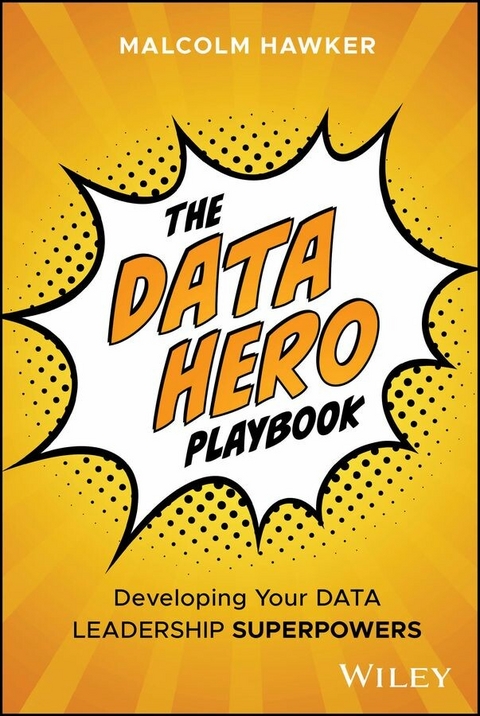
The Data Hero Playbook (eBook)
340 Seiten
Wiley (Verlag)
978-1-394-31065-4 (ISBN)
A powerful new mindset for data leaders in any organization
In The Data Hero Playbook: Developing Your Data Leadership Superpowers, veteran data professional and thought leader Malcolm Hawker offers fresh and exciting new ways to collect, manage, and use data. Called 'Heroic Data Leadership,' Hawker's new mindset for data professionals will unlock the true potential of your organization's data. It puts to bed the limiting, counterproductive mindsets that often plague data leaders and offers original and effective alternatives you can apply immediately to generate tangible business results.
The book shows you how to re-center customer satisfaction within your data strategy and convincingly demonstrates why sound data management must be paired with the delivery of value to the customer in order to have a significant impact on your company's bottom line.
Inside the book:
- Step-by-step recommendations for productive behaviors and best practices within your data teams
- Illuminating quotes and anecdotes from data professionals leading data functions at large companies today
- Narratives and stories explaining how to transition from stale, limiting data mindsets to more productive and effective approaches
An essential resource for data professionals at organizations of all types and sizes, The Data Hero Playbook is the hands-on roadmap to data leadership that managers, analysts, executives, entrepreneurs, and founders have been waiting for.
MALCOLM HAWKER is a data strategy and management leader with over 25 years' experience in the industry. He has authored industry-defining research and has consulted to some of the world's largest businesses on their data and analytics strategies. He's a frequent public speaker on data and analytics best practices.
A powerful new mindset for data leaders in any organization In The Data Hero Playbook: Developing Your Data Leadership Superpowers, veteran data professional and thought leader Malcolm Hawker offers fresh and exciting new ways to collect, manage, and use data. Called Heroic Data Leadership, Hawker's new mindset for data professionals will unlock the true potential of your organization's data. It puts to bed the limiting, counterproductive mindsets that often plague data leaders and offers original and effective alternatives you can apply immediately to generate tangible business results. The book shows you how to re-center customer satisfaction within your data strategy and convincingly demonstrates why sound data management must be paired with the delivery of value to the customer in order to have a significant impact on your company's bottom line. Inside the book: Step-by-step recommendations for productive behaviors and best practices within your data teams Illuminating quotes and anecdotes from data professionals leading data functions at large companies today Narratives and stories explaining how to transition from stale, limiting data mindsets to more productive and effective approaches An essential resource for data professionals at organizations of all types and sizes, The Data Hero Playbook is the hands-on roadmap to data leadership that managers, analysts, executives, entrepreneurs, and founders have been waiting for.
Chapter 2
The Data Hero Superpower: A Positive Mindset
In the opening chapter I stressed the importance of a more positive, growth‐oriented mindset. What exactly does that mean? What impact do positive mindsets have on individual and corporate productivity? What behaviors and perspectives typify people with more limiting mindsets, and how could they impact job performance? Could an unproductive, limiting mindset be sufficient to hold back an entire industry from providing prolonged and meaningful value?
In this chapter, we will explore these questions in more detail.
What's a Mindset?
A mindset is an established set of attitudes that influences a person's perceptions, beliefs, and behaviors. In the context of a corporation, a mindset can also describe a group's attitude, which in turn affects how individuals in the group approach their work, solve problems, and interact with each other. Mindsets are extremely influential in how we all view the world and, in turn, how we choose to engage with it.
A person with a more limiting mindset will tend to see problems and not opportunities, and they tend to be highly resistant to change. Mindsets that hinder growth are characterized by doubt, pessimism, and complaining – and those who embrace them are prone to blaming external forces and people for a failure to overcome obstacles. These people are also more likely to see another's intentions as negative and not supportive. People with more limiting mindsets tend toward black‐and‐white thinking and will often see choices in business as an “all or nothing” propositions.
Your mindset influences everything you think and everything you do. The worst (or best) part about a mindset is that they have highly reinforcing properties: if you think positively, you are likely to create more positive situations and outcomes, and if you think negatively, you're likely to create more negative situations or outcomes. And the more outcomes you drive (one way or the other), the more the mindset is reinforced.
I was first exposed to the concept of a mindset when I read Mindset: The New Psychology of Success, by Stanford Psychologist and Professor Carol Dweck, published in 2015. I first read this book in early 2022 after joining Profisee because our CEO, Len Finkle, is passionate about the importance of all employees having a growth mindset – so much so he made reading the book part of the company onboarding process.
What Dweck shares in her book is that there are essentially two mindsets that we (and by association, our organizations) can embrace: either a growth mindset or a fixed mindset. Dweck argues that those with a growth mindset, who believe abilities and intelligence can be developed through hard work and dedication, are more likely to achieve success. She asserts that a growth mindset fosters resilience and persistence, which are crucial traits for business leaders and organizations aiming for long‐term success.
Conversely, Dweck sees fixed mindsets as those that tend to be more intractable, as embodied within people who choose to avoid challenges, ignore feedback, and give up easily. People with a fixed mindset, according to Dweck, are more interested in being told they are right than in learning, and they are more likely to see their level of intelligence as static. When given the choice between validation and growth, people with a fixed mindset will typically choose the former.
The words Dweck uses to describe either ends of the mindset spectrum are a rooted in quantitative academic research and may often do not completely align to the mindsets that I’ve encountered over my lengthy professional career – particularly those that stand in opposition to growth. As such, in this book I will use the terms “positive” and “limiting” to describe the opposite mindsets that I see as being mission critical to either promote or change. The perspectives I describe on either end of this spectrum are firmly rooted in, but not limited to, the mindset definitions posited by Dweck and other researchers in this space. This is why I’ve used different words than Dweck to describe these polar opposites, since what I’ve observed goes beyond the boundaries of Dweck’s research.
This is particularly the case in my use of the word “limiting” to describe the mindsets that are the opposite of those needed to promote growth. Being unable or unwilling to grow is one thing, but forwarding perspectives and embracing behaviors that actively subvert the stated goals of your company and your department is another thing entirely. If you embrace behaviors that harm your customer relationships, then the impacts of your choices go well beyond simply embracing the status quo or being “fixed.” They hinder your company, they hinder your career, and they are limiting in every definition of the word.
There are many possible psychological explanations for many of the examples of what I'm calling either positive or limiting mindsets in this book. Often, they align to what Dweck would call a growth or fixed mindset. Other times, they may align to other phenomena, and when they do, I'll share those details and cite my sources or experiences.
Ultimately, as you'll read in more detail later, this book is about empowering data leaders. I'm not writing this to judge; I'm writing this to help improve the careers and results of data professionals. If you come to realize that the behaviors and perspectives I'm labeling in this book as more “limiting” describe you, then you have a choice to make. Either you can reject my thesis and double down on the status quo or you can take the opportunity to explore different ways of thinking about old problems. I hope you choose the latter.
That's because the former reinforces the status quo, where available data suggests the odds that you'll deliver meaningful value for your company are significantly worse than a coin flip. Rejecting the status quo will open the door to entirely different perspectives on how to leverage the power of a positive, growth‐centric mindset in your job as a data professional. In doing so, you'll learn that growth mindsets are quantifiably proven to increase job satisfaction, retention, and productivity. Embracing more of a growth mindset seems like a winning proposition to me (even if you think I'm completely wrong), but as you'll read in the following chapters, I didn't always have this perspective. I only recently broke free of the mindset that was limiting my personal development and career growth, and thankfully so.
If you are struck by how often your current perspectives may align to a highly limiting mindset, take comfort in knowing things don't have to stay that way. Mindsets can thankfully shift, and I'm living proof. For decades, I embodied the behaviors of a person with a problematic mindset toward the data I managed, my role as a data professional, and my customers. For more than a decade I managed my career in full alignment with more of a very limiting mindset. Yet somehow, I've lived to tell the story of what it takes for a data professional to break free from a mindset that hinders their growth, and you're reading it now.
So, if my use of the words “suboptimal” or “‘limiting’” to describe any of the perspectives or behaviors that you embrace causes you discomfort, or perhaps even makes you a bit irritated (or even slightly angry), then good. Let that discomfort be the motivation you need to take a step back and critically evaluate your desired results versus your actual results. Are you where you want to be in your career, or your company? Are you committed to helping your company leverage the transformative power of data? Do you want that big promotion? Do you want to change?
If you've read this far, then clearly you answered “yes” to one or more of these questions, and you're interested in finding ways to break from the status quo. That's a great thing, and it's a necessary step in your individual transformation. You're one step closer to becoming your company's data hero.
Mindset and Corporate Culture
The importance of organizational culture cannot be understated – and is the topic of hundreds of books and research papers. The old saying “culture eats strategy for breakfast” reflects the reality that a dysfunctional culture will ultimately thwart all efforts to execute on a business strategy.1 You can throw all the money in the world at processes and tools, but if the individual people of the organization cannot work together or trust each other, then all collective actions are likely doomed to fail.
An organizational culture is defined by the norms that characterize an organization. Norms are the collective values, beliefs, and practices of the organization. Norms significantly influence how individuals behave in an organization, and like a mindset, they can have both positive and negative impacts. Productive and economically successful organizations are often characterized by the norms of collaboration, innovation, and integrity.2 Conversely, norms such as a resistance to change, a lack of accountability, and a loyalty to the past can hinder corporate performance.
Certain values can drive behaviors that lead to positive results, and certain values can lead to negative results. This is true at an individual level, and it's...
| Erscheint lt. Verlag | 24.6.2025 |
|---|---|
| Sprache | englisch |
| Themenwelt | Mathematik / Informatik ► Informatik ► Theorie / Studium |
| Schlagworte | ai-enabled companies • ai-enabled leadership • data analytics leadership • data best practices • Data-Driven Decision Making • data-enabled leadership • data governance • Data leadership • Data Management • data mindsets • data transformation • Digital transformation |
| ISBN-10 | 1-394-31065-X / 139431065X |
| ISBN-13 | 978-1-394-31065-4 / 9781394310654 |
| Informationen gemäß Produktsicherheitsverordnung (GPSR) | |
| Haben Sie eine Frage zum Produkt? |
 EPUB (Adobe DRM)
Kopierschutz: Adobe-DRM
Adobe-DRM ist ein Kopierschutz, der das eBook vor Mißbrauch schützen soll. Dabei wird das eBook bereits beim Download auf Ihre persönliche Adobe-ID autorisiert. Lesen können Sie das eBook dann nur auf den Geräten, welche ebenfalls auf Ihre Adobe-ID registriert sind.
Details zum Adobe-DRM
Dateiformat: EPUB (Electronic Publication)
EPUB ist ein offener Standard für eBooks und eignet sich besonders zur Darstellung von Belletristik und Sachbüchern. Der Fließtext wird dynamisch an die Display- und Schriftgröße angepasst. Auch für mobile Lesegeräte ist EPUB daher gut geeignet.
Systemvoraussetzungen:
PC/Mac: Mit einem PC oder Mac können Sie dieses eBook lesen. Sie benötigen eine
eReader: Dieses eBook kann mit (fast) allen eBook-Readern gelesen werden. Mit dem amazon-Kindle ist es aber nicht kompatibel.
Smartphone/Tablet: Egal ob Apple oder Android, dieses eBook können Sie lesen. Sie benötigen eine
Geräteliste und zusätzliche Hinweise
Buying eBooks from abroad
For tax law reasons we can sell eBooks just within Germany and Switzerland. Regrettably we cannot fulfill eBook-orders from other countries.
aus dem Bereich