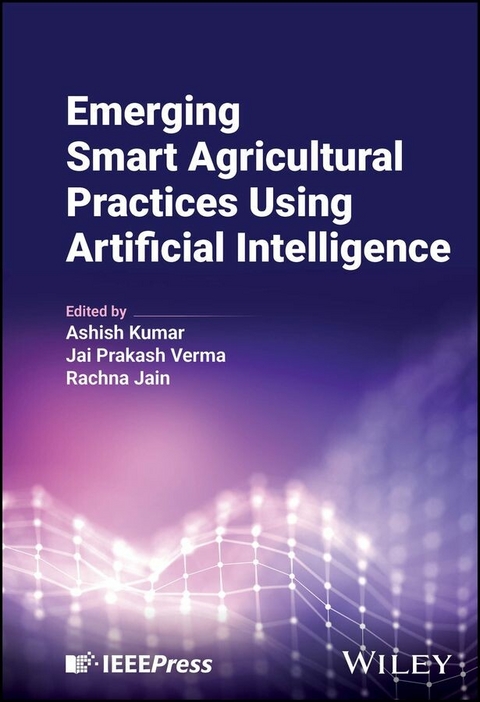
Emerging Smart Agricultural Practices Using Artificial Intelligence (eBook)
584 Seiten
Wiley-IEEE Press (Verlag)
978-1-394-27425-3 (ISBN)
Bring the latest technology to bear in the fight for sustainable agriculture with this timely volume
Artificial intelligence (AI) has the potential to revolutionize virtually every area of research and scientific practice, including agriculture. With AI solutions emerging to drive higher yields, produce increased resource efficiency, and foster sustainability, there is an urgent need for a volume outlining this progress and charting its future course.
Emerging Smart Agricultural Practices Using Artificial Intelligence meets this need with a deep dive into the rapidly developing intersection of agriculture and artificial intelligence. Taking an interdisciplinary approach which applies data science, computer science, and engineering techniques, the book provides cutting-edge insights on the latest advancements in AI-driven agricultural practices. The result is an absolutely critical tool in the ongoing fight to develop sustainable world agriculture.
In addition, this book provides:
- Case studies and real-world applications of new techniques throughout
- Detailed discussion of agricultural applications for AI-driven technologies such as machine learning, computer vision, and data analytics
- A regional approach showcasing international best practices and addressing the varying needs of farmers worldwide
Emerging Smart Agricultural Practices Using Artificial Intelligence is ideal for agricultural professionals and scientists, as well as data scientists, technologists, and agricultural policymakers.
Ashish Kumar, PhD, is an Associate Professor with Bennett University, Greater Noida, U.P. India. He has published widely on subjects including object tracking, image processing, artificial intelligence, and medical imaging analysis, and is a member of the IEEE.
Jai Prakash Verma, PhD, is an Associate Professor in the Department of Computer Science and Engineering, Nirma University, Ahmedabad, India. He offers customized training on big data analytics to the Indian Navy, SAC-ISRO scientists in Ahmedabad, and other experts from industry and academia.
Rachna Jain, PhD, is an Associate Professor in the Department of Information Technology Bhagwan Parshuram Institute of Technology. She has 18+ years of academic/research experience with more than 100+ publications in various international conferences and international journals (Scopus/ISI/SCI) of high repute.
Bring the latest technology to bear in the fight for sustainable agriculture with this timely volume Artificial intelligence (AI) has the potential to revolutionize virtually every area of research and scientific practice, including agriculture. With AI solutions emerging to drive higher yields, produce increased resource efficiency, and foster sustainability, there is an urgent need for a volume outlining this progress and charting its future course. Emerging Smart Agricultural Practices Using Artificial Intelligence meets this need with a deep dive into the rapidly developing intersection of agriculture and artificial intelligence. Taking an interdisciplinary approach which applies data science, computer science, and engineering techniques, the book provides cutting-edge insights on the latest advancements in AI-driven agricultural practices. The result is an absolutely critical tool in the ongoing fight to develop sustainable world agriculture. In addition, this book provides: Case studies and real-world applications of new techniques throughoutDetailed discussion of agricultural applications for AI-driven technologies such as machine learning, computer vision, and data analytics A regional approach showcasing international best practices and addressing the varying needs of farmers worldwide Emerging Smart Agricultural Practices Using Artificial Intelligence is ideal for agricultural professionals and scientists, as well as data scientists, technologists, and agricultural policymakers.
1
Agricultural Resilience: Water Quality and Human Well‐Being
Tanu Taneja1, B.S Bhatia2, and Shalom Akhai3
1 Research Scholar, Department of Civil Engineering, RIMT University, FatehgarhSahib, Punjab, India
2 Pro Vice Chancellor, Management Department, RIMT University, FatehgarhSahib, Punjab, India
3 Professor, Department of Mechanical Engineering, Maharishi Markandeshwar (Deemed to be University) Mullana, Ambala, Haryana, India
1.1 Introduction
The water consumed by humans directly or in the form of food products harvested or prepared using water directly affects human health, depending on the quality of the water being used [1]. When the water used for agriculture is contaminated/polluted, it reduces crop yields and lowers the nutritional value due to unacceptable levels of pollutants such as heavy metals, herbicides, and pathogens [2]. This long‐term contamination in soil due to harmful elements that may come into it by polluted water harms ecosystems [3]. When using sensor‐based and artificial intelligence (AI)‐driven water monitoring precision devices, farmers have access to real‐time irrigation water quality data, which aids to address and prevent harmful contamination levels of pollutants [4]. Farmers can also save water by avoiding over‐irrigation based on data analysis of the data collected using sensors, drones, and AI‐based systems [5]. It is also useful for disease prevention by identification of waterborne pathogens at early stages [6]. Good water quality is required not only by humans and food crops but also by livestock for consumption [7]. Water safety in animal health is crucial for agricultural resilience because livestock health affects sustainable and profitable farming [8]. Agricultural resilience requires water management that goes beyond conservation, efficiency, and ecological harmony [9]. Rainwater harvesting, efficient irrigation, and agroecology reduce farmers' dependency on conventional water sources and optimize water application and resource utilization [10]. Heavy metals, pesticides, and aquatic illnesses may enter the food chain from unclean water‐irrigated crops [11]. Community‐protecting programs need to understand how water quality affects health [12]. Sustainable and cost‐effective water filtration techniques solve agricultural water quality challenges by filtering and cleansing water naturally [13]. Farmers may improve water quality, agricultural profitability, and environmental and community well‐being by using AI, precision irrigation, and sustainable water management [14].
1.2 The Nexus of Water Quality and Agriculture
Crop growth, production, and nutrition depend on water quality. Due to its complex chemical and biological makeup, its relationship to agriculture is elaborated [15]. Pollination, flower loss, and yield are affected by contaminated water [16]. Lack of moisture delays seed germination, whereas enough water stimulates flowering and fruiting for a rich harvest. Water quality is important during irrigation because pollutants may affect soil structure and plant health, reducing agricultural yield. Water quality affects nutrition because plant roots absorb nutrients and contaminants [17]. Polluted water harms soil fertility's diverse microbial communities by spreading illnesses and poisons. Diseases, economic hardship, and agricultural instability may result from contaminants [18]. Technology like AI‐driven water monitoring systems, precision agriculture, and waterborne disease diagnosis in farming are improving water quality and agriculture [20]. Farmers may decrease over‐irrigation, pollutant leaching, and pollution using these technologies [20]. Water quality agriculture management also involves waterborne pathogen identification, which helps farmers identify harmful bacteria [21]. Ethical, animal welfare, and agricultural profitability depend on livestock water safety [22]. Sustainable water management technologies help farmers gather and store rain, control water application, and optimize resource usage. Water is purified chemical‐free by phytoremediation and wetland filtration [23]. Table 1.1 briefs the impact of water quality on agriculture.
In conclusion, water quality and soil health are interrelated, and innovative water filtration technology can help address these issues.
1.3 Impact of Contaminated Water on Crop Health
Water is crucial for crop health, transporting nutrients needed for development [31]. However, when polluted with heavy metals, pesticides, and viruses, it becomes a silent enemy, stunting growth, reducing yields, and lowering nutrition [33]. Heavy metals like lead, cadmium, and mercury disrupt plant physiological systems, impairing nutrition uptake and transport, leading to stunted development [34, 35]. Pesticides, used in agriculture to control pests, can also pollute water, causing stunted growth, leaf discoloration, and lower photosynthetic efficiency [36]. They can also build up in the soil, threatening agricultural land [37]. Waterborne pathogens, including bacteria, viruses, and fungus, can enter plants, producing wilting, lesions, and rotting, causing farmers significant economic losses [38]. Water contamination impacts crops via root absorption since soil pollutants circulate in their vascular systems and inhibit nutrient synthesis. This stunts growth, lowers yields, and may impact farmers, downstream consumers, and agriculture‐dependent firms [39]. Heavy metals and pesticides in contaminated water limit nutrient absorption and plant synthesis, lowering agricultural nutrition and possibly affecting human health [2, 11]. Soil contaminants worsen the issue, diminishing the land's ability to support many crop cycles. Water quality's various impacts must be understood to build resilient agricultural systems [33]. Monitoring water sources and soil quality, precision irrigation utilizing real‐time data, and investments in water treatment equipment, including filtration and purification systems, may prevent agricultural contamination [40, 41]. Table 1.2 summarizes contaminants and their effects.
Table 1.1 Impact of water quality on agriculture.
| Aspect of agriculture | Effects of poor water quality | Effects of good water quality | Research needs |
|---|
| Crop development and productivity [24–26] |
|
|
|
| Nutrition [27, 28] |
|
|
|
| Soil health [3, 29, 30] |
|
|
|
| Economic impacts [31, 32] |
|
|
|
Polluted water slows crop growth, lowers yields, and reduces crop nutrition and land sustainability. To enhance agricultural systems and feed rising populations, comprehensive agricultural...
| Erscheint lt. Verlag | 24.6.2025 |
|---|---|
| Sprache | englisch |
| Themenwelt | Mathematik / Informatik ► Informatik ► Theorie / Studium |
| Schlagworte | agriconomy • Artificial Intelligence • Big Data • computer vision • crop management • data analytics • Livestock monitoring • machine learning • object tracking • Precision Agriculture • Smart Agriculture • Smart Farming • sustainability |
| ISBN-10 | 1-394-27425-4 / 1394274254 |
| ISBN-13 | 978-1-394-27425-3 / 9781394274253 |
| Informationen gemäß Produktsicherheitsverordnung (GPSR) | |
| Haben Sie eine Frage zum Produkt? |
 EPUB (Adobe DRM)
Kopierschutz: Adobe-DRM
Adobe-DRM ist ein Kopierschutz, der das eBook vor Mißbrauch schützen soll. Dabei wird das eBook bereits beim Download auf Ihre persönliche Adobe-ID autorisiert. Lesen können Sie das eBook dann nur auf den Geräten, welche ebenfalls auf Ihre Adobe-ID registriert sind.
Details zum Adobe-DRM
Dateiformat: EPUB (Electronic Publication)
EPUB ist ein offener Standard für eBooks und eignet sich besonders zur Darstellung von Belletristik und Sachbüchern. Der Fließtext wird dynamisch an die Display- und Schriftgröße angepasst. Auch für mobile Lesegeräte ist EPUB daher gut geeignet.
Systemvoraussetzungen:
PC/Mac: Mit einem PC oder Mac können Sie dieses eBook lesen. Sie benötigen eine
eReader: Dieses eBook kann mit (fast) allen eBook-Readern gelesen werden. Mit dem amazon-Kindle ist es aber nicht kompatibel.
Smartphone/Tablet: Egal ob Apple oder Android, dieses eBook können Sie lesen. Sie benötigen eine
Geräteliste und zusätzliche Hinweise
Buying eBooks from abroad
For tax law reasons we can sell eBooks just within Germany and Switzerland. Regrettably we cannot fulfill eBook-orders from other countries.
aus dem Bereich