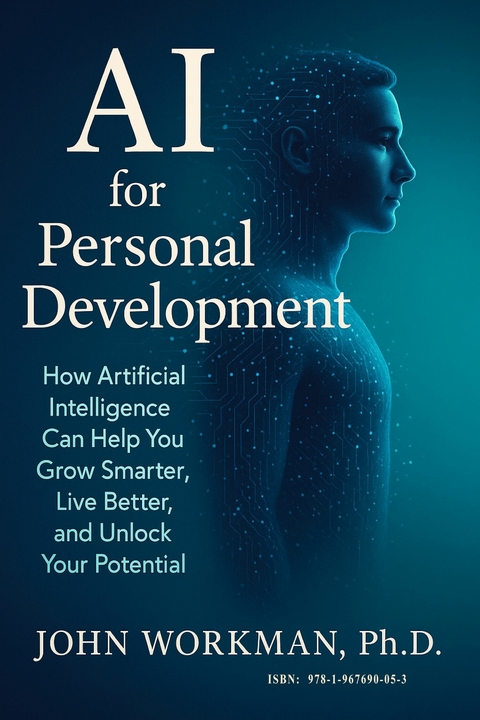
AI for Personal Development (eBook)
128 Seiten
Publishdrive (Verlag)
978-1-967690-05-3 (ISBN)
You embark on your day, feeling the weight of responsibilities looming large, and wonder how some people seem to effortlessly master their emotional intelligence while achieving their goals. A little exploration reveals that the key might be a supportive ally right at your fingertips: Artificial Intelligence. With the right understanding and tools, AI can transform your journey towards personal development from a daunting climb into a manageable and enjoyable adventure.
As you dive deeper, the possibilities unfold like pages of a well-crafted story. You start to see how AI can harness data to provide tailored feedback, enhancing your emotional awareness and offering real-time nudges to help you stay on course. Imagine gaining insights about your routines and habits while leveraging advanced tools that track your progress and help you adapt.
• Discover how to harness AI to amplify your personal growth journey.
• Learn to navigate emotional challenges with real-time support.
• Gain insights that allow for a deeper connection to your emotional patterns.
• Transform goal-setting into a dynamic and achievable process.
You embark on your day, feeling the weight of responsibilities looming large, and wonder how some people seem to effortlessly master their emotional intelligence while achieving their goals. A little exploration reveals that the key might be a supportive ally right at your fingertips: Artificial Intelligence. With the right understanding and tools, AI can transform your journey towards personal development from a daunting climb into a manageable and enjoyable adventure.As you dive deeper, the possibilities unfold like pages of a well-crafted story. You start to see how AI can harness data to provide tailored feedback, enhancing your emotional awareness and offering real-time nudges to help you stay on course. Imagine gaining insights about your routines and habits while leveraging advanced tools that track your progress and help you adapt. Discover how to harness AI to amplify your personal growth journey. Learn to navigate emotional challenges with real-time support. Gain insights that allow for a deeper connection to your emotional patterns. Transform goal-setting into a dynamic and achievable process.
Ch. 2 - Ethical AI: Protecting Privacy and Preserving Humanity
The modern digital era demands more urgent and complex conversations about data privacy. The increasing sophistication of artificial intelligence systems requires substantial personal information for integration into daily life functions. A continuous collection and analysis of personal data takes place through social media platforms and online shopping websites as well as health applications and smart home technologies. AI achieves exceptional performance through this data but simultaneously generates substantial dangers.
A significant security breach occurs at a widely used health-tracking app, resulting in the exposure of sensitive health data to millions of users. This situation exposes people to identity theft and financial fraud while removing their personal control, which makes them defenseless and betraying their trust. The danger exists now as it has already appeared in multiple ways. The 2018 Cambridge Analytica scandal became notorious when millions of Facebook users' data were collected without permission and then leveraged to sway political campaigns. Clearview AI, a facial recognition firm, illegally collected billions of images from the internet, which resulted in widespread international protests due to privacy breaches. The unauthorized use of personal information via artificial intelligence systems undermines public trust and causes actual harm to both people and communities.
has
AI advancements have caused widespread concern, which has led governments and international bodies to create protective rules for consumers. The European Union implemented the General Data Protection Regulation (GDPR) as a key response in 2018 (Ma, X., Wei, X., Chen, Z., Han, H., & Zhao, J. (2022). ECC: Passenger Counting in the Elevator Using Commodity WiFi. Applied Sciences, 12(14), 7321.). The legislation established new requirements for companies to receive unambiguous and explicit permission before they can collect personal information. The regulation provides users with rights to access their information and to request corrections or deletions while requiring companies to disclose their data handling practices. The adoption of the regulation prompted numerous organizations to update their privacy policies to meet requirements while boosting public understanding of data usage.
California's CCPA became effective in 2020 and provides state residents with the power to both know what data businesses collect about them and to withhold consent for selling their personal information. The CCPA represents an essential move toward regaining control of personal information for individuals, despite having a narrower scope than GDPR. The Personal Information Protection Law (PIPL) of China, enacted in 2021, sets strict data protection rules with a strong focus on consent while placing limitations on data transfers across national borders. The development of new legal structures demonstrates an expanding awareness that privacy should be considered a basic human right instead of an optional privilege.
However, awareness alone isn't enough. People need to actively evaluate their personal information-sharing practices while implementing protective measures for their privacy. People should frequently check their social media privacy options while refraining from sharing excessive personal information online and selecting AI tools that emphasize strong data protection measures. People need to implement practical security measures like activating two-factor authentication and using encrypted messaging services, along with supporting companies that maintain clear data policies to protect their personal information in a world where data functions as a currency.
Pause for a moment and reflect: What level of comfort do you feel when providing data every day? Are you aware of the specific apps and devices that can access your personal information? Do you know what privacy laws grant you as a holder of personal information? The initial action toward becoming a more aware and empowered member of this AI-driven reality begins with asking these questions. Data protection extends beyond avoiding security breaches to maintaining personal autonomy and dignity because personal information represents a fundamental asset in today's society.
Bias in AI Systems:
(Bias in AI refers to the presence of unfair or prejudiced outcomes resulting from skewed or incomplete training data (Bias - SENEN GROUP | Human-Centric Transformations through Data, Analytics & AI). These biases often reflect historical inequalities and can lead to discriminatory decisions in areas like facial recognition, hiring, and lending.)
The growing integration of artificial intelligence into daily activities such as social media feeds and loan approvals creates significant ethical challenges due to the bias present in these systems (What is UnFite? All You Need to Know - UnFite). AI models can achieve objectivity only through unbiased data, although they promise fairness in their design. The data that feeds AI systems usually carries existing societal biases alongside historical prejudices and inequalities.
The expanding application of facial recognition technology by police forces and security organizations has exposed significant biases. Research demonstrates that facial recognition systems more frequently misidentify women and people of color compared to other demographic groups. Error rates for Black women in facial recognition technology can be up to 34%, whereas white males experience error rates of only 1%. The differences found in facial recognition technology extend beyond technical issues because they result in real-world impacts like wrongful arrests and service denial while perpetuating existing social inequalities.
A major tech company discovered that its AI recruitment system consistently showed a preference for male applicants during hiring processes. The AI system adopted gender biases present in historical hiring data during its training process and continued to propagate these patterns. The results show why it is essential to challenge the perceived neutrality of AI systems since algorithms can reflect and intensify human defects despite appearing unbiased.
These biases originate from the training data. (Training data consists of the datasets used to teach an AI system how to make decisions or predictions (Stable diffusion VS Midjourney: All you need to know). If the data contains historical inequalities, the AI system may inadvertently learn and replicate those biases in its outputs.) When AI learns from data that centers on specific groups or mirrors existing societal biases, it will unintentionally continue those biases in its operations. The use of this technology without proper safeguards raises serious ethical concerns about its fairness and justice, as well as the effects it will have on society.
Addressing these issues requires a deliberate approach. Scheduled audits serve as an effective measure to detect biased results and prevent potential harm. AI development relies on training with diverse datasets that encompass all aspects of human experiences to operate effectively. When ethicists, social scientists, and representatives from marginalized communities participate in design and oversight processes, it leads to significant bias reduction. The AI Now Institute and similar organizations work to enhance the representation of diverse voices to guide AI development toward fairness and equity according to societal values.
Reflect on personal experiences with bias. Have you ever faced or observed unfair treatment rooted in stereotypes? Recognize how AI systems might mirror those same biases, often without awareness. Acknowledging this is the first step toward advocating for more ethical, fair, and inclusive AI, an essential pursuit for anyone committed to integrity and societal progress in this technology-driven age.
Establishing Clear Ethical Principles:
Developing explicit ethical guidelines transcends best practices because it becomes an ethical obligation during our journey through AI’s fast-changing environment. These principles serve as guiding lights, ensuring that AI aligns with core values: The ethical principles must encompass recognition of human dignity and operational transparency, together with accountability and fairness standards. Ethical principles function as a moral compass to enable us to utilize AI’s potential while ensuring protection for our rights and well-being.
Building responsible AI starts with transparency. Consider the application of an artificial intelligence system that analyzes thousands of resumes for candidate selection. The lack of transparency prevents you from comprehending the AI's decision-making process, including the data it examines and factors it values alongside potential biases affecting its judgments. Transparency requires organizations to reveal all operational processes while ensuring they remain comprehensible. Microsoft, IBM, and Google have responded to this requirement by creating ethics boards and guidelines that mandate their teams to share details about algorithm operations and data utilization. Trust grows between users and organizations when transparent practices enable users to make better decisions.
Accountability is equally vital. Who needs to take responsibility when AI systems create harmful results by incorrectly identifying individuals or unfairly denying loans? Ethical frameworks require...
| Erscheint lt. Verlag | 1.7.2025 |
|---|---|
| Reihe/Serie | The AI-Enhanced Living Series |
| Sprache | englisch |
| Themenwelt | Sachbuch/Ratgeber ► Beruf / Finanzen / Recht / Wirtschaft |
| Sachbuch/Ratgeber ► Gesundheit / Leben / Psychologie ► Lebenshilfe / Lebensführung | |
| Mathematik / Informatik ► Informatik | |
| Schlagworte | Personal development • personal growth and self-improvement • Self-Help |
| ISBN-10 | 1-967690-05-7 / 1967690057 |
| ISBN-13 | 978-1-967690-05-3 / 9781967690053 |
| Informationen gemäß Produktsicherheitsverordnung (GPSR) | |
| Haben Sie eine Frage zum Produkt? |
 EPUB (Adobe DRM)
Kopierschutz: Adobe-DRM
Adobe-DRM ist ein Kopierschutz, der das eBook vor Mißbrauch schützen soll. Dabei wird das eBook bereits beim Download auf Ihre persönliche Adobe-ID autorisiert. Lesen können Sie das eBook dann nur auf den Geräten, welche ebenfalls auf Ihre Adobe-ID registriert sind.
Details zum Adobe-DRM
Dateiformat: EPUB (Electronic Publication)
EPUB ist ein offener Standard für eBooks und eignet sich besonders zur Darstellung von Belletristik und Sachbüchern. Der Fließtext wird dynamisch an die Display- und Schriftgröße angepasst. Auch für mobile Lesegeräte ist EPUB daher gut geeignet.
Systemvoraussetzungen:
PC/Mac: Mit einem PC oder Mac können Sie dieses eBook lesen. Sie benötigen eine
eReader: Dieses eBook kann mit (fast) allen eBook-Readern gelesen werden. Mit dem amazon-Kindle ist es aber nicht kompatibel.
Smartphone/Tablet: Egal ob Apple oder Android, dieses eBook können Sie lesen. Sie benötigen eine
Geräteliste und zusätzliche Hinweise
Buying eBooks from abroad
For tax law reasons we can sell eBooks just within Germany and Switzerland. Regrettably we cannot fulfill eBook-orders from other countries.
EPUB (Ohne DRM)Digital Rights Management: ohne DRM
Dieses eBook enthält kein DRM oder Kopierschutz. Eine Weitergabe an Dritte ist jedoch rechtlich nicht zulässig, weil Sie beim Kauf nur die Rechte an der persönlichen Nutzung erwerben.
Dateiformat: EPUB (Electronic Publication)
EPUB ist ein offener Standard für eBooks und eignet sich besonders zur Darstellung von Belletristik und Sachbüchern. Der Fließtext wird dynamisch an die Display- und Schriftgröße angepasst. Auch für mobile Lesegeräte ist EPUB daher gut geeignet.
Systemvoraussetzungen:
PC/Mac: Mit einem PC oder Mac können Sie dieses eBook lesen. Sie benötigen dafür die kostenlose Software Adobe Digital Editions.
eReader: Dieses eBook kann mit (fast) allen eBook-Readern gelesen werden. Mit dem amazon-Kindle ist es aber nicht kompatibel.
Smartphone/Tablet: Egal ob Apple oder Android, dieses eBook können Sie lesen. Sie benötigen dafür eine kostenlose App.
Geräteliste und zusätzliche Hinweise
Buying eBooks from abroad
For tax law reasons we can sell eBooks just within Germany and Switzerland. Regrettably we cannot fulfill eBook-orders from other countries.
aus dem Bereich