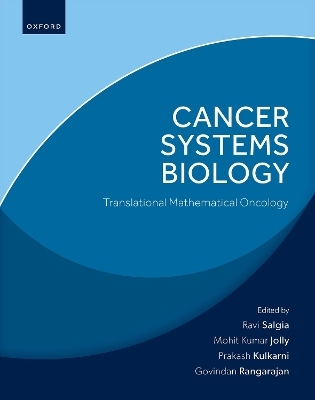
Cancer Systems Biology
Oxford University Press (Verlag)
978-0-19-286763-6 (ISBN)
Over the centuries, civilization has seen considerable advances in healthcare. Cancer is among the most challenging healthcare issues that we face today, but a number of discoveries have led to better care. Despite all the progress and the promise regarding early detection and precision medicine, we are still faced with the nettlesome problem - cancer is a moving target. Even within an individual tumour, deep sequencing analyses now indicate multiple, phenotypically distinct subpopulations, whose representation seems to vary dramatically from one stage to the next as the tumour progresses.
Cancer Systems Biology provides state-of-the-art reviews and thought-provoking ideas in a concise and succinct manner. This insightful textbook is a crosspollination of concepts from multiple disciplines and experimental approaches to study cancer. The chapters provide new ideas and thoughts outlining how a quantitative picture of cancer can provide a deeper understanding of the disease, and how a systems level perspective may hold the key to fully comprehend how cancer arises and progresses.
Written by experts in multiple disciplines, including systems biologists, science researchers, physicists, mathematicians, and clinicians, Cancer Systems Biology provides a comprehensive, up-to-date, treatise devoted to understanding cancer from a systems perspective. Providing new conceptual insights that can aid precision medicine, it will be essential reading for academic researchers in the field, clinicians, graduate students, and scientists with an interest in cancer biology.
Ravi Salgia, MD, PhD, is the Arthur and Rosalie Kaplan Chair in Medical Oncology at City of Hope National Medical Centre. Previously, he was Professor of Medicine at the University of Chicago. Prior to his tenure at the University of Chicago, Dr. Salgia was faculty at the Dana-Farber Cancer Institute and Harvard Medical School. He earned his undergraduate summa cum laude in mathematics, biology, and chemistry, and then his MD and PhD degrees from Loyola University in Chicago. His research interests focus on novel therapeutics against lung cancer, and he also maintains a strong interest in chaos theory and fractals and their application to cancer, especially lung cancer. Dr. Salgia has been honoured with numerous awards, including the ASCO Excellence in Teaching Award. Prof. Mohit Kumar Jolly earned his Bachelors and Masters degree from IIT Kanpur and PhD from Rice University, all in Bioengineering. Before moving to Indian Institute of Science (IISc), Bangalore to start his independent group in 2018, he was a Gulf Coast Consortia Postdoctoral Fellow in Computational Cancer Biology. His research interests are in phenotypic plasticity and heterogeneity driving cancer metastasis and drug resistance. He is the current Editor-in-Chief of NPJ Systems Biology & Applications. He received 2022 Young Alumnus Award of IIT Kanpur, 2023 ICTP Prize, and 2024 Young Outstanding Engineering Alumnus Award, Rice University. Prof. Prakash Kulkarni received his PhD in biochemistry from India and did postdoctoral training at the Indian Institute of Science, and New York University. He was an Assistant Professor at Johns Hopkins. Subsequently, he was Associate Professor at the Keck Laboratory for Structural Biology, University of Maryland. Previously, Prof. Kulkarni held Staff Scientist positions in Chemistry & Chemical Engineering, and Biology & Biological Engineering at Caltech, and in Genetics at Yale. His research interests are focused on understanding how protein conformational dynamics contributes to phenotypic switching, especially in evolution of multicellularity, cancer, and in non-genetic heterogeneity. He is a Fellow of the Royal Society of Biology, UK. Prof. Govindan Rangarajan obtained an Integrated MSc (Hons) degree from the Birla Institute of Technology and Science, Pilani, and a PhD from the University of Maryland, College Park, USA. He then worked at the Lawrence Berkeley Lab, University of California, Berkeley, before returning to India in 1992. He has been a faculty member of the Department of Mathematics, Indian Institute of Science (IISc), since 1992. He is currently the Director of IISc. Prof. Rangarajan's research interests include nonlinear dynamics and chaos and time series analysis. He is a JC Bose National Fellow. He is also a Fellow of the Indian Academy of Sciences and the National Academy of Sciences, India. He was awarded the Chevalier dans l'Ordre des Palmes Academiques (Knight of the Order of Academic Palms) by the Government of France. He was also a Homi Bhabha Fellow.
Section 1 - Cancer systems biology: An overview
1: Sui Huang: The necessary existence of cancer and its progression from first principles of cell state dynamics
2: Vera Pancaldi and Jean- Pascal Capp: Non- genetic intratumoral heterogeneity and phenotypic plasticity as consequences of microenvironment- driven epigenomic dysregulation
3: Caterina A.M. La Porta and Stefano Zapperi: Dimensions of cellular plasticity: EpithelialDS mesenchymal transition, cancer stem cells, and collective cell migration
4: Divyjoy Singh, Abhay Gupta, Mohit Kumar Jolly, and Prakash Kulkarni: Phenotypic switching in cancer: A systems- level perspective
5: Biplab Bose: Morphological state transition during epithelialDS mesenchymal transition
Section 2 - Cancer systems biology: New paradigms
6: Laurie Graves, Ayalur Raghu Subbalakshmi, William C. Eward, Mohit Kumar Jolly, and Jason A. Somarelli: Evolution- informed multilayer networks: Overlaying comparative evolutionary genomics with systems- level analyses for cancer drug discovery
7: Jintong Lang, Chunhe Li, and Jinzhi Lei: Landscape of cell- fate decisions in cancer cell plasticity
8: Arnab Barua and Haralampos Hatzikirou: The road to cancer and back: A thermodynamic point of view
9: Paromita Mitra, Uday Saha, Subhashis Ghosh, and Sandeep Singh: Cellular plasticity as emerging target against dynamic complexity in cancer
10: Vishaka Gopalan, Sidhartha Goyal, and Sumaiyah Rehman: Modeling phenotypic heterogeneity and cell- state transitions during cancer progression
Section 3 - Single cell 'omics' analysis
11: Benedict Anchang and Loukia G. Karacosta: Decoding drug resistance at a single- cell level using systems- level approaches
12: Manu Setty: Computational methods to infer lineage decision- making in cancer using single-cell data
13: Jianhua Xing and Weikang Wang: Analyzing cancer cell- state transition dynamics through live- cell imaging and high- dimensional single-cell trajectory analyses
14: Syeda Subia Ahmed, Danielle Pi, Nicholas Bodkin, Vito W. Rebecca, and Yogesh Goyal: Emerging single- cell technologies and concepts to trace cancer progression and drug resistance
Section 4 - Computational approaches to drug development
15: Supriyo Bhattacharya: Navigating protein dynamics: Bridging the gap with deep learning and machine intelligence
16: Vitor B.P. Leite, Murilo N. Sanches, and Rafael G. Viegas: Cancer- related intrinsically disordered proteins: Functional insights from energy landscape analysis
17: Priyanka Prakash: Targeting RAS
Section 5 - Statistical methods and data mining, machine learning, artificial intelligence, and cloud computing
18: Brandi N. Davis- Dusenbery, Cera R. Fisher, Rowan Beck, and Zelia F. Worman: The power of connectionDLenabling collaborative, multimodal data analysis at petabyte scale to advance understanding of oncology
19: Colton Ladbury and Arya Amini: Interpretation of machine learning models in cancer: The role of model- agnostic explainable artificial intelligence
20: Jay G. Ronquillo: Applying cloud computing and informatics in cancer
21: Luciane T. Kagohara and Joseph Tandurella: Single-cell sequencing analysis focused on cancer immunotherapy
22: Arnulf Stenzl, Jenny Ghith, and Bob J.A. Schijvenaars: Application of artificial intelligence to overcome clinical information overload in cancer
23: Xiwei Wu and Supriyo Bhattacharya: Application of artificial intelligence in cancer genomics
Section 6 - Biomechanics
24: Madhurima Sarkar, Asadullah, and Shamik Sen: A role for mechanical heterogeneity in the tumor microenvironment in driving cancer cell invasion
25: Christina R. Dollahon, Ting- Ching Wang, Srinikhil S. Vemuri, Suchitaa Sawhney, and Tanmay P. Lele: Adaptation of cancer cells to altered stiffness of the extra-cellular matrix
26: Ajay Tijore, Alka Kumari, and Abhishek Goswami: Decoding mechano- oncology principles through microfluidic devices and biomaterial platforms
27: Yasir Suhail, Wenqiang Du, Günter Wagner, and Kshitiz: Understanding contribution of fibroblasts in inception of cancer metastasis from an evolutionary perspective
28: Medhavi Vishwakarma and Amrapali Datta: Cell competition in tumorigenesis and epithelial defense against cancer
Section 7 - Translational mathematical oncology
29: Philipp M. Altrock, Guranda Chitadze, Arne Traulsen, and Frederick L. Locke: Modelling cell population dynamics during chimeric antigen receptor T- cell therapy
30: Srisairam Achuthan, Rishov Chatterjee, and Atish Mohanty: Modeling small cell lung cancer biology through deterministic and stochastic mathematical models
31: Jasmine Foo and Einar Bjarki Gunnarsson: Mathematical models of resistance evolution under continuous and pulsed anti- cancer therapies
32: Mohammad Kohandel, Cameron Meaney, and Dorsa Mohammadrezaei: Integrating in silico models with ex vivo data for designing better combinatorial therapies in cancer
33: Annice Najafi and Jason George: Tumour- immune co- evolution dynamics and it's impact on immuno- therapy optimization
34: Maria Jose Peláez, Shreya Goel, Vittorio Cristini, Zhihui Wang, and Prashant Dogra: Mechanistic modelling and machine learning to establish structureDS activity relationship of nanomaterials for improved tumour delivery
Section 8 - Ecology, evolution, and cancer
35: Rowan Barker- Clarke, Eshan S. King, Jeff Maltas, J. Arvid Ågren, Dagim Tadele, and Jacob G. Scott: Decoding cancer evolution through adaptive fitness landscapes
36: Andriy Marusyk: A case against causal reductionism in acquired therapy resistance
37: Ravi Salgia, Supriyo Bhattacharya, Atish Mohanty, and Govindan Rangarajan: Group behaviour and drug resistance in cancer
38: Jeffrey West, Jill Gallaher, Maximilian A.R. Strobl, Mark Robertson- Tessi, and Alexander R.A. Anderson: The Fundamentals of evolutionary therapy in cancer
Section 9 - Critical transitions and chaos in cancer
39: Smita Deb, Subhendu Bhandary, Mohit Kumar Jolly, and Partha Sharathi Dutta: Methods for identifying critical transitions during cancer progression
40: Abicumaran Uthamacumaran: Chaos and complexity: Hallmarks of cancer progression
41: Andrzej Kasperski and Henry H. Heng: Cancer formation as creation and penetration of unknown life spaces
| Erscheinungsdatum | 13.09.2025 |
|---|---|
| Verlagsort | Oxford |
| Sprache | englisch |
| Maße | 234 x 283 mm |
| Gewicht | 1574 g |
| Themenwelt | Mathematik / Informatik ► Mathematik |
| Medizin / Pharmazie ► Medizinische Fachgebiete ► Onkologie | |
| Studium ► 2. Studienabschnitt (Klinik) ► Humangenetik | |
| ISBN-10 | 0-19-286763-6 / 0192867636 |
| ISBN-13 | 978-0-19-286763-6 / 9780192867636 |
| Zustand | Neuware |
| Informationen gemäß Produktsicherheitsverordnung (GPSR) | |
| Haben Sie eine Frage zum Produkt? |
aus dem Bereich