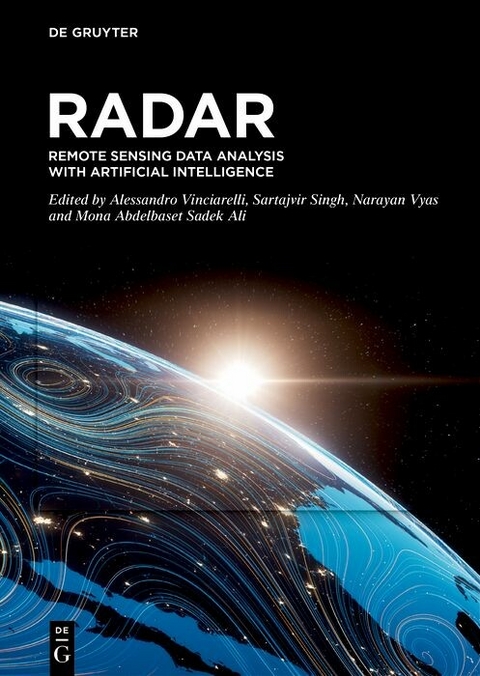
RADAR (eBook)
258 Seiten
De Gruyter (Verlag)
978-3-11-157320-5 (ISBN)
The integration of Radio Detection and Ranging (RADAR) remote sensing and Artificial Intelligence (AI) provides a platform for understanding various Earth's surface processes and their predictive analysis. This book offers state-of-the-art techniques and applications to address real-time challenges through AI-based RADAR remote sensing. Furthermore, it explores the potential applications of AI in emerging areas of remote sensing and image processing.
Integrating Sentinel-1 satellite data with machine learning for land use classification
Acknowledgments: The author would like to extend their gratitude to the European Space Agency (ESA) for providing the Sentinel-1 satellite data that formed the foundation of this study. The availability of high-quality RADAR data from Sentinel-1 has been instrumental in conducting this research and achieving meaningful results.
Abstract
The availability of radio detection and ranging (RADAR) remote sensing data has changed the Earth observation by allowing information to be obtained independently of the weather and environmental conditions. RADAR-based satellites, such as Sentinel-1 and SCATSAT, are beneficial because they can penetrate clouds and work regardless of whether it is night or day, making them indispensable surface mapping sensors. The European Space Agency’s (ESA) Sentinel-1 satellite is a RADAR-based Earth observation satellite whose dual-polarization (vertical-vertical and vertical-horizontal) synthetic aperture radar (SAR) provides high temporal resolution with adequate spatial resolution that makes it suitable for monitoring land use and land cover (LULC) changes. The study area in this research is Kota district, situated in the southeastern part of Rajasthan, India, which has a semiarid climate and a mixed area of agriculture, natural vegetation, and waterbodies. Google Earth Engine was used to process and classify Sentinel-1 data collected from February 1, 2024, to February 27, 2024, into several LULC categories, including water, built-up, and land. This study uses random forest, an ensemble machine learning model, for LULC classification. When used to create a land use classification map, it exhibited an overall accuracy of 90.57% and a kappa coefficient of 85.81%, demonstrating near-perfect agreement between the model and actual data.
1 Introduction
The Earth observation aims to observe and analyze the movement of the Earth’s surface to fight against major global issues such as globalization, urbanization, deforestation, climate change, and resources (unmanned aerial vehicles) [1]. High-resolution imagery and ground data captured by satellites, especially with advancements in sensor technology, allow researchers to track land cover changes in real time, providing estimates on agricultural productivity, water resource mapping, and assessments of natural disasters [2]. Satellite remote sensing has been rapidly evolving in the era of modern technologies, having transformed access to even the most remote and inaccessible regions of our planet in detail. This information is crucial for policymakers, scientists, and planners who make decisions on the distribution of resources, environmental protection, and disaster management [3]. The Earth observation data has come a long way since the days of optical imagery, and the last few decades have also seen the advent of radio detection and ranging (RADAR)-based sensing that allows users to look down in virtually all weather and day/night conditions. These tools have enhanced the degree of confidence and precision in data recording, allowing comprehensive analysis of surfaces on the Earth [4]. The Earth observation is also crucial to sustainable development because it enables data analysis at scale when combined with geospatial tools and artificial intelligence (AI) [5].
The advent of remote sensing, primarily through RADAR-based satellites such as Sentinel-1 and SCATSAT, has improved surface classification [6]. Optical sensors depend on sunlight and, thus, can be blocked by clouds or darkness [3]. In contrast, RADAR systems use microwave signals that can penetrate cloud cover and obtain data in almost any weather condition. A synthetic aperture radar (SAR) sensor, such as Sentinel-1, emits signals from space that travel to the Earth’s surface, and the backscatter is then measured to infer surface properties [7]. SAR-based satellites offer advantages in land classification, as they can discern surface roughness and moisture content. For example, VV (vertical-vertical) and VH (vertical-horizontal) polarizations have been commonly utilized for surface classification; VV experiences higher performance in detecting smoother surfaces such as water, while VH displays a higher response for vegetation and built-up areas [8]. With machine learning (ML) algorithms like random forest (RF), SAR data leads to realistic and highly prescribed land cover class discovery [9]. The method is economical and scalable, making it suitable for larger geographical areas. It provides timely information at an appropriate areal scale for making day-to-day agricultural, planning, and conservation decisions. Due to continuous development in RADAR hardware and global data processing solutions, remote sensing is today one of the central pillars of modern geospatial techniques. Table 1 presents several studies on the RADAR dataset for the Earth observation applications.
Table 1:Several studies performed using the RADAR dataset.
| Characteristics | Methods used | Objectives | Results | Source |
|---|
| Sentinel-1 uses persistent scatterer interferometry (PSI) techniques to monitor ground motion and assess landslide geohazards, while SCATSAT focuses on weather and oceanographic applications, distinguishing their areas of focus | PSI techniques applied to satellite RADAR images | Evaluate landslide geohazards and impacts using PSI data | Identified active deformation areas using PSI data | [10] |
| Sentinel-1 RADAR satellites can acquire Earth’s surface data under any atmospheric conditions, and the paper highlights the advantages of publicly available data and open-source software for effectively using RADAR satellite imagery | Active RADAR systems for Earth’s surface data acquisition | Explore Sentinel RADAR satellite system capabilities | Discussed the possibility of using the Sentinel RADAR satellite system | [23] |
| Sentinel-1, an ESA mission, provides SAR data for ocean research, while SCATSAT, an Indian satellite, focuses on ocean wind vector measurements, complementing Sentinel-1’s atmospheric data | SAR-derived surface wind products and validation results | Preliminary studies of Sentinel-1 SAR-derived surface winds | Presented the preliminary studies of SAR-derived surface wind products | [11] |
| SCATSAT-1, launched by ISRO, is a Ku-band scatterometer satellite used for climate studies and applications like crop yield prediction, while Sentinel-1, part of ESA’s Copernicus program, focuses on RADAR imaging for diverse Earth observation tasks | ML-based classification and information fusion | Summarize SCATSAT-1 products and applications globally | Summarized SCATSAT-1’s impact on various scientific domains | [12] |
| Sentinel-1 utilizes dual-polarization (VV-VH) data to enhance PSI-based synthetic aperture RADAR (PS-InSAR) analysis, improving ground deformation measurements by increasing the spatial density of measurement points | PS-InSAR method | Evaluate the VH channel’s contribution to PS-InSAR analysis | Obtained 186% increase in PS points using the VH channel | [13] |
| Sentinel-1, using SAR technology, captures high-resolution images for persistent scatterer interferometry (PS-InSAR) to monitor terrain deformations, as demonstrated in a case study in Focșani, Romania | Variation of targets’ intensities along SAR acquisitions | Identify persistent scatterer candidates in Focșani, Romania | Two algorithms identified persistent scatterers in... |
| Erscheint lt. Verlag | 11.8.2025 |
|---|---|
| Zusatzinfo | 35 b/w and 29 col. ill., 10 b/w tbl. |
| Sprache | englisch |
| Themenwelt | Mathematik / Informatik ► Informatik |
| Schlagworte | Künstliche Intelligenz • Radar remote sensing • RADAR Remote Sensing with Artificial Intelligence • RADAR Remote Sensing with Artificial Intelligence _x000D_ • Remote Sensing • Remote Sensing Data Analysis • Synthetic Aperture Radar • Synthetic aperture radar (SAR) |
| ISBN-10 | 3-11-157320-6 / 3111573206 |
| ISBN-13 | 978-3-11-157320-5 / 9783111573205 |
| Informationen gemäß Produktsicherheitsverordnung (GPSR) | |
| Haben Sie eine Frage zum Produkt? |
 EPUB (Wasserzeichen)
Größe: 6,3 MB
DRM: Digitales Wasserzeichen
Dieses eBook enthält ein digitales Wasserzeichen und ist damit für Sie personalisiert. Bei einer missbräuchlichen Weitergabe des eBooks an Dritte ist eine Rückverfolgung an die Quelle möglich.
Dateiformat: EPUB (Electronic Publication)
EPUB ist ein offener Standard für eBooks und eignet sich besonders zur Darstellung von Belletristik und Sachbüchern. Der Fließtext wird dynamisch an die Display- und Schriftgröße angepasst. Auch für mobile Lesegeräte ist EPUB daher gut geeignet.
Systemvoraussetzungen:
PC/Mac: Mit einem PC oder Mac können Sie dieses eBook lesen. Sie benötigen dafür die kostenlose Software Adobe Digital Editions.
eReader: Dieses eBook kann mit (fast) allen eBook-Readern gelesen werden. Mit dem amazon-Kindle ist es aber nicht kompatibel.
Smartphone/Tablet: Egal ob Apple oder Android, dieses eBook können Sie lesen. Sie benötigen dafür eine kostenlose App.
Geräteliste und zusätzliche Hinweise
Buying eBooks from abroad
For tax law reasons we can sell eBooks just within Germany and Switzerland. Regrettably we cannot fulfill eBook-orders from other countries.
aus dem Bereich