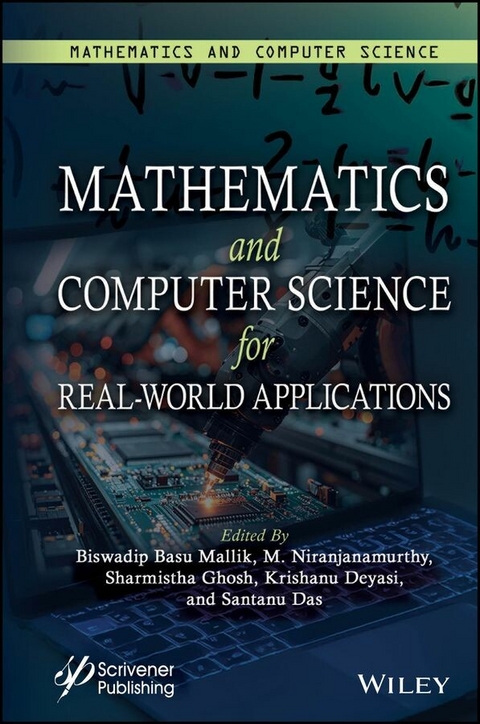
Mathematics and Computer Science for Real-World Applications, Volume 4 (eBook)
901 Seiten
Wiley-Scrivener (Verlag)
978-1-394-27533-5 (ISBN)

Mathematics and Computer Science for Real-World Applications gives invaluable insights into how mathematical and computer sciences drive essential modern innovations that enhance everyday life, making it a must-read for anyone interested in the intersection of mathematics and technology and their real-world applications.
Mathematical sciences are part of nearly all aspects of everyday life. The discipline has underpinned beneficial modern capabilities, including internet searches, medical imaging, computer animation, numerical weather predictions, and digital communication. Mathematics and computer science are constantly evolving and contributing to most areas of science and engineering, therefore, future generations of mathematical scientists should reassess the increasingly cross-disciplinary nature of the mathematical sciences.
Mathematics and Computer Science for Real-World Applications presents current scientific and technological innovations from leading academics, researchers, and experts across the globe in mathematical sciences and computing. The volume will discuss new technical ideas and features that can be incorporated into day-to-day life for the benefit of society. A diversified spectrum of scientific advancements is discussed, including applications of differential and integral equations, computational fluid dynamics, nanofluids, network theory and optimization, control theory, machine learning, and artificial intelligence. Readers will explore diverse ideas and innovations in the field of computing and its growing connections to various fields of mathematics.
Biswadip Basu Mallik, PhD is a senior assistant professor in the Department of Basic Science and Humanities at the Institute of Engineering and Management, Kolkata, with over 23 years of teaching experience. He has over 85 publications to his credit, including eight books and several book chapters, research articles, and conference proceedings. His research interests include computational fluid dynamics, mathematical modeling, data science, and machine learning.
M. Niranjanamurthy, PhD is an assistant professor in the Department of Artificial Intelligence and Machine Learning at the Bhusanayana Mukundadas Sreenivasaiah Institute of Technology and Management. He has over 90 publications, including six books and numerous book chapters, articles, and conference proceedings.
Sharmistha Ghosh, PhD is a mathematics professor in the Department of Basic Science and Humanities at the Institute of Engineering and Management, Kolkata, with over 22 years of experience. She has published one book in addition to numerous conference proceedings and articles in international refereed journals.
Krishanu Deyasi is an associate professor in the Department of Basic Sciences and Humanities at the Institute of Engineering and Management, India. He earned his PhD from the Indian Institute of Science Education and Research, and he has postdoctoral experience from The Institute of Mathematical Sciences, India. He has written three books and has published papers in scientific journals. He is also an editor for several scientific journals.
Santanu Das is as an assistant professor in the Department of Basic Sciences and Humanities at the Institute of Engineering and Management, India. He completed his undergraduate degree from and is pursuing his doctorate from Jadavpur University.
Mathematics and Computer Science for Real-World Applications gives invaluable insights into how mathematical and computer sciences drive essential modern innovations that enhance everyday life, making it a must-read for anyone interested in the intersection of mathematics and technology and their real-world applications. Mathematical sciences are part of nearly all aspects of everyday life. The discipline has underpinned beneficial modern capabilities, including internet searches, medical imaging, computer animation, numerical weather predictions, and digital communication. Mathematics and computer science are constantly evolving and contributing to most areas of science and engineering, therefore, future generations of mathematical scientists should reassess the increasingly cross-disciplinary nature of the mathematical sciences. Mathematics and Computer Science for Real-World Applications presents current scientific and technological innovations from leading academics, researchers, and experts across the globe in mathematical sciences and computing. The volume will discuss new technical ideas and features that can be incorporated into day-to-day life for the benefit of society. A diversified spectrum of scientific advancements is discussed, including applications of differential and integral equations, computational fluid dynamics, nanofluids, network theory and optimization, control theory, machine learning, and artificial intelligence. Readers will explore diverse ideas and innovations in the field of computing and its growing connections to various fields of mathematics.
1
Analysis of Medical Image Using a Multimodal Approach for Precise Cancer Detection
Soumen Santra1*, Mouparna De1, Dipankar Majumdar2 and Surajit Mandal3
1Department of MCA, Techno International New Town, Kolkata, West Bengal, India
2Department of CSE, RCC Institute of Information Technology, Kolkata, India
3Department of ECE, B.P. Poddar Institute of Management & Technology, Kolkata, India
Abstract
Cancer is one of the most serious medical conditions is cancer, and patients’ conditions worsen every day. The early identification of cancer is essential for successful treatment and better patient outcomes. Fast-acting image processing technology should be used for medical diagnosis. To achieve this, we provide a unique method for cancer identification that uses the Gaussian Mixture Model (GMM) algorithm in combination with a machine learning technique that aids in correct analysis. This method involves resizing and altering the color of the image to determine the precise location of cancer. This method makes the operation considerably simpler because it provides a better understanding of the cancer picture. This method’s main goal is to create a strong and trustworthy cancer detection system that will aid medical professionals in the early identification of cancer and has the potential to save many lives. This technique can act as a bridge between conventional diagnostic methods and cutting-edge technologies.
Keywords: Resizing, image preprocessing, gaussian mixture model (GMM) algorithm, conventional diagnostic methods, cutting-edge technology
1.1 Introduction
Cancer, a complex and common disease, poses a major challenge to public health worldwide. Cancer has become a serious global health problem because of its high mortality rate and insidious nature. Early and accurate cancer detection is key to improving patient outcomes and survival rates. Although effective, traditional cancer detection techniques, such as biopsy and medical imaging, are often invasive, expensive, and open to human interpretation, which can result in inconsistent diagnoses. Machine learning is a branch of artificial intelligence, has emerged as an effective strategy to improve the efficiency and accuracy of cancer detection in response to these difficulties [1]. Cancer, with its multifaceted etiology and complex pathway physiology, remains a formidable opponent. Its diversity among different types, subtypes, and individual cases requires precision and sophistication in diagnosis [2]. Traditional methods often fail to provide the precision and efficiency required for modern treatment [2, 3]. Cancer is characterized by uncontrolled proliferation of abnormal cells and their ability to invade neighboring tissues.
After viewing images from an X-ray, magnetic resonance imaging (MRI), or computed tomography (CT) scan, medical professionals present their ideas and make decisions [4]. These images are essential for identifying and describing anomalies and tumors, which makes them crucial for cancer surveillance and diagnosis. Several image-processing methods can be applied to this model to extract the characteristics of the impacted area of an image, which provides insight into their nature [5].
Digitally altered images are referred to as raw images. Raw photos are subjected to a variety of image-processing algorithms to identify their attributes [6]. In this study, we explored the incorporation of Gaussian mixture models (GMM) as a pioneering tool in cancer image analysis as per Figure 1.1. The GMM algorithm is a form of unsupervised learning that can be used to model complex data distributions in medical images. Deep learning, a branch of artificial intelligence, has emerged as a potent technique for feature extraction and identification of patterns, structures, and anomalies in pictures, complementing GMM [7, 8]. Machine learning integration enabled our diagnostic methodology to adapt, change, and improve over time. By integrating GMM, we aim to provide a more accurate and precise approach for classifying and characterizing cancer regions in these images. Typically, a medical image is of excellent quality.
Cancer detection through the utilization of cutting-edge technologies, such as image recognition and machine learning, can be challenging as it requires a huge, labeled training dataset, and there are several sites present on the Internet where a dataset can be gathered. This model collected different cancer datasets from Kaggle.com (https://data.mendeley.com/datasets/p2r42nm2ty/1).
Figure 1.1 The framework of the proposed medical image detection.
The use of radiological imaging, genetic information, electronic medical records, and patient demographics contribute to the development of a full understanding of the illness. With the use of machine learning models and the unification of these disparate data sources, we hope to obtain insightful knowledge that will enable earlier and more precise cancer diagnoses [9].
1.2 Methodology
1.2.1 Understanding the Objective and Scope
- Defining the goal of cancer image analysis, whether it is related to disease detection or medical image classification [10].
- Identification of a dataset of medical images for analysis.
1.2.2 Data Collection and Importation
- A dataset of cancer images relevant to our research and analysis was collected to ensure that the images were in a consistent format, such as JPG, JPEG, or PNG [11].
- Utilizing the ‘glob’ library to efficiently import medical (cancer) images from a specified directory, making it easier to process multiple images simultaneously.
1.2.3 Image Preprocessing
- Importing Libraries: Import the necessary libraries, including NumPy, cv2, and sklearn. mixture and glob.
- Load each cancer image using OpenCV to create image objects.
- Applying preprocessing techniques to standardize the images for analysis. The common preprocessing steps that we have included are [12]:
- Resizing images to uniform dimensions.
- Converting color spaces if necessary (e.g., from RGB to grayscale).
- Applying image thresholding to enhance cancer features.
- Removing noise or artifacts that might affect the analysis.
1.2.4 Feature Extraction
- Derivation of relevant features to be preprocessed for cancer imaging. These features include:
- Shape Descriptors: Extract shape features to characterize cancer cell shapes [13].
- Texture features: Texture features are extracted to characterize cancer image textures.
1.2.5 Segmentation Using Gaussian Mixture Model (GMM)
- Preprocess the images to enhance the features relevant to cancer image segmentation.
- Initialize a GMM using scikit-learn (sklearn. mixture) library to fit the GMM to the preprocessed image data, cluster the cancer and background pixels [14], and segment the cancer region based on the GMM clusters.
where:
- x represents the observed data point (a vector in the feature space).
- K is the number of Gaussian components in the mixture.
- πk represents the mixture coefficient or weight associated with the kth Gaussian component. It represents the probability of selecting the kth component.
- μk is the mean vector of the kth Gaussian component.
- Σk is the covariance matrix of the kth Gaussian component.
- N(x|μk, Σk) denotes the multivariate Gaussian distribution with mean μk and covariance Σk.
Different types of models are employed for cancer cell detection, each with its own balance between accuracy and efficiency. Convolutional neural networks (CNNs) [15], a type of deep learning model, are used in image classification tasks, such as cancer cell detection, because of their ability to learn intricate features from images. They typically offer high accuracy, often around 94%, but their efficiency can vary, with predictions taking approximately 0.5 s. Support Vector Machines (SVMs), which are classical machine learning models, also perform well in this domain, with an accuracy of approximately 88%. However, their efficiency tends to be lower, with predictions taking approximately 1.2 s. Random Forest, an ensemble learning method, achieves a high accuracy of approximately 91%, with moderate efficiency, required approximately 0.8 s for predictions. Logistic Regression, a simple linear model [16], offers moderate accuracy at around 85% and relatively better efficiency, with predictions taking around 0.6 s. Decision Trees, another non-parametric method, yield accuracy of about 87% with similar efficiency to Random Forest, taking around 0.7 s for predictions in Table 1.1. These models represent a spectrum of trade-offs between accuracy and efficiency, allowing tailored approaches based on specific requirements.
Table 1.1 Model accuracy and efficiency.
| Model | Accuracy (%) | Efficiency (s) |
|---|
| Convolutional Neural Network (CNN) | 94 | 0.5 |
| Support Vector Machine... |
| Erscheint lt. Verlag | 13.6.2025 |
|---|---|
| Sprache | englisch |
| Themenwelt | Mathematik / Informatik ► Mathematik |
| ISBN-10 | 1-394-27533-1 / 1394275331 |
| ISBN-13 | 978-1-394-27533-5 / 9781394275335 |
| Informationen gemäß Produktsicherheitsverordnung (GPSR) | |
| Haben Sie eine Frage zum Produkt? |
 EPUB (Adobe DRM)
Kopierschutz: Adobe-DRM
Adobe-DRM ist ein Kopierschutz, der das eBook vor Mißbrauch schützen soll. Dabei wird das eBook bereits beim Download auf Ihre persönliche Adobe-ID autorisiert. Lesen können Sie das eBook dann nur auf den Geräten, welche ebenfalls auf Ihre Adobe-ID registriert sind.
Details zum Adobe-DRM
Dateiformat: EPUB (Electronic Publication)
EPUB ist ein offener Standard für eBooks und eignet sich besonders zur Darstellung von Belletristik und Sachbüchern. Der Fließtext wird dynamisch an die Display- und Schriftgröße angepasst. Auch für mobile Lesegeräte ist EPUB daher gut geeignet.
Systemvoraussetzungen:
PC/Mac: Mit einem PC oder Mac können Sie dieses eBook lesen. Sie benötigen eine
eReader: Dieses eBook kann mit (fast) allen eBook-Readern gelesen werden. Mit dem amazon-Kindle ist es aber nicht kompatibel.
Smartphone/Tablet: Egal ob Apple oder Android, dieses eBook können Sie lesen. Sie benötigen eine
Geräteliste und zusätzliche Hinweise
Buying eBooks from abroad
For tax law reasons we can sell eBooks just within Germany and Switzerland. Regrettably we cannot fulfill eBook-orders from other countries.
aus dem Bereich