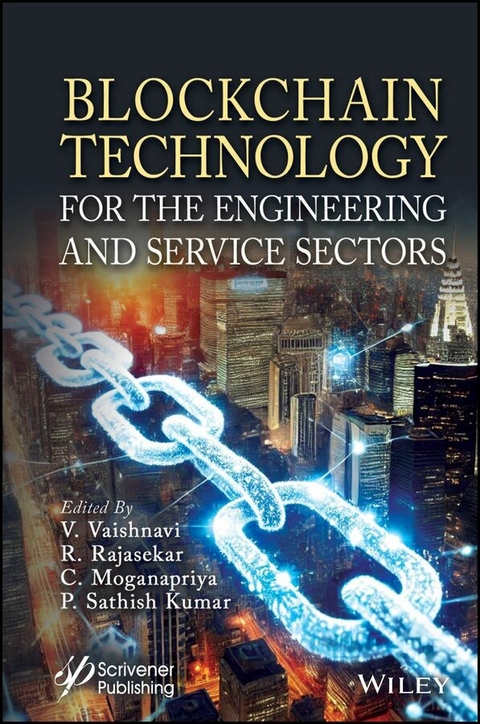
Blockchain Technology for the Engineering and Service Sectors (eBook)
604 Seiten
Wiley-Scrivener (Verlag)
978-1-394-23801-9 (ISBN)

Blockchain Technology for the Engineering and Service Sectors is essential for anyone looking to understand how to harness blockchain technology, driving innovation and efficiency across various sectors
Blockchain technology stands as one of the most transformative innovations of the 21st century, significantly impacting sectors including finance, manufacturing, and the service industry. Despite its relatively recent emergence, blockchain has the potential to revolutionize a wide array of industries, including tourism, agriculture, healthcare, and automobiles. With the growing interest in decentralized finance, governments and businesses are increasingly investing in research and development to enhance blockchain's capabilities. As the technology continues to evolve, we can expect even more ground-breaking advancements in the near future.
Blockchain Technology for the Engineering and Service Sectors is designed to provide a comprehensive exploration of blockchain technology, divided into two key areas of study. The first section delves into the history and technical evolution of blockchain, tracing its development from the inception of Bitcoin to its integration with other advanced technologies like the Internet of Things. The second section focuses on the frameworks and applications of blockchain, examining its use across various industries, including supply chain management, tourism, banking, healthcare, and automation. Additionally, the book addresses current challenges, emerging trends, and the future potential of blockchain technology. Through a detailed and structured presentation of these topics, readers will gain a deep understanding and expertise in the field of blockchain technology.
Audience
Researchers, engineers, and industry professionals working in research and development to explore the possibilities of blockchain.
Blockchain Technology for the Engineering and Service Sectors is essential for anyone looking to understand how to harness blockchain technology, driving innovation and efficiency across various sectors Blockchain technology stands as one of the most transformative innovations of the 21st century, significantly impacting sectors including finance, manufacturing, and the service industry. Despite its relatively recent emergence, blockchain has the potential to revolutionize a wide array of industries, including tourism, agriculture, healthcare, and automobiles. With the growing interest in decentralized finance, governments and businesses are increasingly investing in research and development to enhance blockchain s capabilities. As the technology continues to evolve, we can expect even more ground-breaking advancements in the near future. Blockchain Technology for the Engineering and Service Sectors is designed to provide a comprehensive exploration of blockchain technology, divided into two key areas of study. The first section delves into the history and technical evolution of blockchain, tracing its development from the inception of Bitcoin to its integration with other advanced technologies like the Internet of Things. The second section focuses on the frameworks and applications of blockchain, examining its use across various industries, including supply chain management, tourism, banking, healthcare, and automation. Additionally, the book addresses current challenges, emerging trends, and the future potential of blockchain technology. Through a detailed and structured presentation of these topics, readers will gain a deep understanding and expertise in the field of blockchain technology. Audience Researchers, engineers, and industry professionals working in research and development to explore the possibilities of blockchain.
1
Decoding the Blocks: A Comprehensive Introduction to Blockchain
Vaishnavi Vadivelu1*, R. Rajasekar2 and Mogana Priya Chinnasamy3
1Department of Management Studies, Kongu Engineering College, Perundurai, Erode, Tamil Nadu, India
2Department of Mechanical Engineering, Kongu Engineering College, Perundurai, Erode, Tamil Nadu, India
3School of Mechanical Engineering, Vellore Institute of Technology, Chennai Campus, Chennai, India
Abstract
Blockchain technology (BCT) ensures network security, visibility, and transparency by combining special characteristics such a decentralized structure, storage mechanism, distributed nodes and consensus algorithm, smart contracts, and asymmetric encryption. Numerous industries, including energy supply companies, startups, technology developers, financial institutions, national governments, and academics, have expressed a great deal of interest in it. Numerous sources have identified blockchains as a major source of innovation and advantages. They offer safe, transparent, and tamper-proof platforms that enable new business solutions, especially when combined with smart contracts. This current chapter delves into the intricacies of blockchain, exploring its fundamental structure, operational intricacies, defining traits, historical evolution, broad applications, diverse types, implementation nuances, and future prospects. Starting with an examination of its core architecture and operational mechanisms, the chapter clarifies the decentralized nature, cryptographic foundations, and immutable ledger underlying blockchain functionality. Through a retrospective lens, it traces blockchain’s evolution from its inception alongside Bitcoin to its current status as a disruptive force across industries. Real-world case studies and theoretical frameworks illustrate blockchain’s diverse applications, extending beyond cryptocurrencies to transform sectors like finance, supply chain management, and healthcare. Additionally, the chapter categorizes blockchain types and assesses key factors affecting their implementation, including scalability, interoperability, regulatory frameworks, and sustainability considerations. Looking forward, the chapter offers insights into blockchain’s future trajectory, foreseeing ongoing innovation, experimentation, and collaboration driving new possibilities. Anticipating widespread adoption as blockchain matures and trials yield successful outcomes, the chapter predicts its transformative impact on society will continue to grow. In summary, this book chapter serves as a comprehensive resource for understanding BCT providing valuable insights for policymakers, practitioners, researchers, and enthusiasts. By elucidating its structure, mechanics, history, applications, types, implementation factors, and future prospects, the chapter underscores blockchain’s profound implications in shaping the future of technology and society.
Keywords: Blockchain, cryptocurrencies, decentralization, transparency, immutable ledger, evolution, applications, implementation
1.1 Introduction
The foundational principles and ideas behind BCT have roots dating back to the 1980s. Digital signatures on documents were made possible in 1991 by the use of a chain of information as an electronic record. By the early 2000s, this concept merged with electronic cash, leading to the creation of Bitcoin, the pioneering blockchain application widely accepted across sectors. Bitcoin allowed direct transactions without intermediaries, initially providing user anonymity, though their transactions became visible. The term “pseudo-anonymous” was coined emphasizing the need for trust mechanisms in an environment where user identification was not straightforward. Before blockchain, trust was facilitated by intermediaries [1, 2].
In the absence of trusted intermediaries, BCT is recognized for its four key characteristics: ledger, security, shared, and distributed. These attributes create trust among users, even without their explicit knowledge [3, 4]. Over the past decade, information technology disruptions have reshaped industries and businesses, prompting questions about sustainability. Sustainability, in this context, entails reducing financial saving costs, the cost of mistrust, disruptions from other fintech companies, and eliminating the need for intermediaries [4, 5]. Nevertheless these difficulties, new business paradigms have been brought about by the internet, with blockchain being a widely used application in the banking industry following the global financial crisis of 2008. Paired with artificial intelligence, IoT, and virtual reality, blockchain’s decentralization, transparency, and immutability contribute to trust and security in network [6]. The application of blockchain extends beyond finance promising radical changes in telecommunications, healthcare, music and entertainment, energy, real estate, insurance, and other sectors. This chapter presents a complete introduction of BCT, including its various uses and future research directions. It illuminates the function and features of blockchain in numerous businesses uncovering hidden areas that provide opportunity to address obstacles.
1.2 The Evolution of Blockchain
The foundational ideas and principles of BCT have been in existence since the 1980s. In 1982, Chaum published his dissertation thesis, which was the first to explicitly suggest a system similar to blockchain [7]. In 1991, an electronic record for digitally signed documents was created using a chain of blocks that was cryptographically secured, as later reported by Haber and Stornetta [8]. Merkle trees were included into this encryption method [9]. In 1998, Szabo developed the idea for “bit gold,” a decentralized system of electronic money [10]. In the early 2000s, this concept was integrated with electronic cash eventually leading to the creation of Bitcoin. When Nakamoto first introduced Bitcoin in 2008, it was a peer-to-peer (P2P) network that offered electronic currency [11]. Additionally, this year saw the introduction of the term “blockchain,” referring to the distributed ledger technology that enables Bitcoin transactions [12]. Bitcoin, being the first widely accepted blockchain application, allowed users to engage in direct transactions without the need for third-party mediation. Unlike previous electronic cash schemes, Bitcoin gained widespread acclaim due to its decentralized nature providing users with control over their electronic cash without a single point of failure. Bitcoin initially allowed users to remain unidentified, but their transactions were visible resulting in pseudo-anonymous accounts. The need for trust mechanisms in an environment where user identification is not straightforward is becoming crucial. Prior to BCT, trust relied on intermediaries.
In 2013, Ethereum was introduced by Buterin through his whitepaper. Crowd sourcing was used to support Ethereum’s development in 2014, and on July 30, 2015, the Ethereum network was operational. Ethereum was the first project to provide Blockchain 2.0, setting itself apart from other endeavors that were only concerned with producing altcoins that resembled Bitcoin. In contrast to these initiatives, Ethereum used distributed apps on its blockchain to enable connections without trust. Ethereum was created for distributed data storage and smart contracts, which are small computer programs, whereas Bitcoin was intended for a distributed ledger. Over the course of three phases, the Ethereum 2.0 upgrade from 2020 to 2022 sought to improve the network’s speed, scalability, efficiency, and security [13].
Figure 1.1 History of blockchain adopted from Guo and Yu [13].
In 2015, the Linux Foundation unveiled the Hyperledger project, an open-source software initiative for blockchains. Geared toward constructing enterprise blockchains, Hyperledger blockchain frameworks differed from Bitcoin and Ethereum. Hyperledger encompasses eight blockchain frameworks (Hyperledger Besu, Hyperledger Fabric, Hyperledger Indy, Hyperledger Sawtooth, Hyperledger Burrow, Hyperledger Iroha, Hyperledger Grid, and Hyperledger Labs), five tools (Hyperledger Avalon, Hyperledger Cactus, Hyperledger Caliper, Hyperledger Cello, and Hyperledger Explorer), and four libraries (Hyperledger Aries, Hyperledger Quilt, Hyperledger Transact, and Hyperledger URSA) [14]. The history of blockchain, as depicted in Figure 1.1, showcases Bitcoin and Ethereum as public blockchains allowing anyone to participate in their networks (permission less blockchains). In contrast, the diverse Hyperledger blockchain networks are private blockchains necessitating participant verification before network entry (permissioned blockchains).
1.2.1 Development of Blockchain Generation
The progression of BCT can be classified into three clear phases as follows: Blockchain 1.0, focusing on digital currency; Blockchain 2.0, centered around the digital economy; and Blockchain 3.0, aimed at shaping the digital society [15–17].
- Blockchain 1.0—Digital Currency: The first phase of BCT, known as Blockchain 1.0, focuses on fundamental components, including public ledger, hashing, and mining. This phase comprises the underlying protocol, transaction enablement, and the introduction of digital currencies such as Bitcoin. Bitcoin distinguishes out as a real implementation that predates theoretical talks...
| Erscheint lt. Verlag | 10.6.2025 |
|---|---|
| Sprache | englisch |
| Themenwelt | Mathematik / Informatik ► Informatik ► Theorie / Studium |
| ISBN-10 | 1-394-23801-0 / 1394238010 |
| ISBN-13 | 978-1-394-23801-9 / 9781394238019 |
| Informationen gemäß Produktsicherheitsverordnung (GPSR) | |
| Haben Sie eine Frage zum Produkt? |
 EPUB (Adobe DRM)
Kopierschutz: Adobe-DRM
Adobe-DRM ist ein Kopierschutz, der das eBook vor Mißbrauch schützen soll. Dabei wird das eBook bereits beim Download auf Ihre persönliche Adobe-ID autorisiert. Lesen können Sie das eBook dann nur auf den Geräten, welche ebenfalls auf Ihre Adobe-ID registriert sind.
Details zum Adobe-DRM
Dateiformat: EPUB (Electronic Publication)
EPUB ist ein offener Standard für eBooks und eignet sich besonders zur Darstellung von Belletristik und Sachbüchern. Der Fließtext wird dynamisch an die Display- und Schriftgröße angepasst. Auch für mobile Lesegeräte ist EPUB daher gut geeignet.
Systemvoraussetzungen:
PC/Mac: Mit einem PC oder Mac können Sie dieses eBook lesen. Sie benötigen eine
eReader: Dieses eBook kann mit (fast) allen eBook-Readern gelesen werden. Mit dem amazon-Kindle ist es aber nicht kompatibel.
Smartphone/Tablet: Egal ob Apple oder Android, dieses eBook können Sie lesen. Sie benötigen eine
Geräteliste und zusätzliche Hinweise
Buying eBooks from abroad
For tax law reasons we can sell eBooks just within Germany and Switzerland. Regrettably we cannot fulfill eBook-orders from other countries.
aus dem Bereich