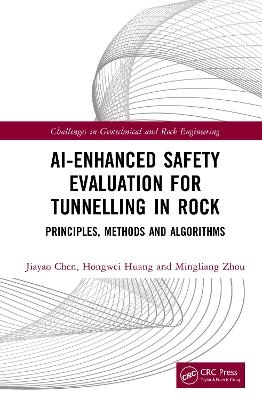
AI-Enhanced Safety Evaluation for Tunnelling in Rock
CRC Press (Verlag)
978-1-032-97606-8 (ISBN)
Artificial intelligence (AI) techniques for rock tunnel construction offer innovative solutions for assessing rock mass quality and ensuring excavation safety in challenging geological conditions. Both cutting-edge contact methods and noncontact methods such as digital photography can provide continuous geological data during excavation. Then, advanced deep learning algorithms for precise characterization of rock face features, along with pioneering multisource 3D data fusion modelling, can enable refined rock mass classification and sophisticated safety evaluation techniques tailored to complex geological environments.
By integrating machine vision and intelligent algorithms with rigorous statistical analysis and machine learning models, this book provides practical and refined solutions for the construction industry. It offers improved safety, efficiency, and reliability for tunnel projects and serves as a valuable reference for graduate students and academics.
Jiayao Chen is an associate professor at Beijing Jiaotong University. He is a board member and secretary of the Chinese Society of Civil Engineering Risk and Insurance Research Division. Hongwei Huang is a distinguished professor at Tongji University, China, a "Yangtze Scholar," and President of the Engineering Risk and Insurance Research Branch of the Chinese Civil Engineering Society. He also leads the International Joint Research Center for Resilient Infrastructure. Mingliang Zhou is an associate professor and assistant dean at the College of Civil Engineering, Tongji University and a recipient of the International Postdoctoral Exchange Fellowship. He earned his Ph.D. from Cambridge University, UK, and is a core member of ISSMGE's YMPG and TC309.
1. Introduction 2. Rock Mass Data Acquisition and Classification using Digital Photography 3. Automated Classification of Rock Mass Structural Features 4. Extraction and Quantitative Characterization of Weak Interlayers 5. Characterization of Groundwater Inflow 6. Extraction and Handling of Data on Joint Fractures 7. Characterization of Three-Dimensional Discontinuities and Traces 8. Intelligent Rock Mass Classification from Data Fusion 9. Tunnel Excavation Safety Assessment Based on Machine Vision and 3DEC Simulation 10. Conclusion and Outlook
| Erscheinungsdatum | 04.12.2025 |
|---|---|
| Reihe/Serie | Challenges in Geotechnical and Rock Engineering |
| Zusatzinfo | 54 Tables, black and white; 96 Line drawings, color; 15 Line drawings, black and white; 85 Halftones, color; 1 Halftones, black and white; 181 Illustrations, color; 16 Illustrations, black and white |
| Verlagsort | London |
| Sprache | englisch |
| Maße | 156 x 234 mm |
| Gewicht | 710 g |
| Themenwelt | Informatik ► Theorie / Studium ► Künstliche Intelligenz / Robotik |
| Naturwissenschaften ► Biologie ► Ökologie / Naturschutz | |
| Technik ► Bauwesen | |
| ISBN-10 | 1-032-97606-3 / 1032976063 |
| ISBN-13 | 978-1-032-97606-8 / 9781032976068 |
| Zustand | Neuware |
| Informationen gemäß Produktsicherheitsverordnung (GPSR) | |
| Haben Sie eine Frage zum Produkt? |
aus dem Bereich