


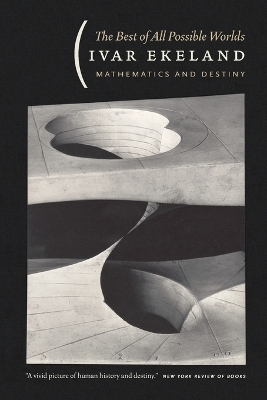
The Best of All Possible Worlds – Mathematics and Destiny
Seiten
2007
University of Chicago Press (Verlag)
9780226199955 (ISBN)
University of Chicago Press (Verlag)
9780226199955 (ISBN)
Tracing the impact of optimization and the ways in which it has influenced the study of mathematics, biology, economics, and even politics, this title reveals how the idea has driven some of our greatest intellectual breakthroughs.
Optimists believe this is the best of all possible worlds. And pessimists fear that might really be the case. But what is the best of all possible worlds? How do we define it? This question has preoccupied philosophers and theologians for ages, but there was a time, during the seventeenth and eighteenth centuries, when scientists and mathematicians felt they could provide the answer. This book is their story. Ivar Ekeland here takes the reader on a journey through scientific attempts to envision the best of all possible worlds. He begins with the French physicist Maupertuis, whose least action principle, Ekeland shows, was a pivotal breakthrough in mathematics, because it was the first expression of the concept of optimization, or the creation of systems that are the most efficient or functional. Tracing the profound impact of optimization and the unexpected ways in which it has influenced the study of mathematics, biology, economics, and even politics, Ekeland reveals how the idea has driven some of our greatest intellectual breakthroughs. The result is a dazzling display of erudition - one that will be essential reading for popular-science buffs and historians of science alike.
Optimists believe this is the best of all possible worlds. And pessimists fear that might really be the case. But what is the best of all possible worlds? How do we define it? This question has preoccupied philosophers and theologians for ages, but there was a time, during the seventeenth and eighteenth centuries, when scientists and mathematicians felt they could provide the answer. This book is their story. Ivar Ekeland here takes the reader on a journey through scientific attempts to envision the best of all possible worlds. He begins with the French physicist Maupertuis, whose least action principle, Ekeland shows, was a pivotal breakthrough in mathematics, because it was the first expression of the concept of optimization, or the creation of systems that are the most efficient or functional. Tracing the profound impact of optimization and the unexpected ways in which it has influenced the study of mathematics, biology, economics, and even politics, Ekeland reveals how the idea has driven some of our greatest intellectual breakthroughs. The result is a dazzling display of erudition - one that will be essential reading for popular-science buffs and historians of science alike.
Ivar Ekeland is professor of mathematics and economics at the University of British Columbia and director of the Pacific Institute for Mathematical Sciences. He is the author of several books, including Mathematics and the Unexpected and The Broken Dice, both published by the University of Chicago Press.
| Erscheint lt. Verlag | 9.11.2007 |
|---|---|
| Sprache | englisch |
| Maße | 152 x 227 mm |
| Gewicht | 330 g |
| Themenwelt | Mathematik / Informatik ► Mathematik ► Angewandte Mathematik |
| Mathematik / Informatik ► Mathematik ► Finanz- / Wirtschaftsmathematik | |
| ISBN-13 | 9780226199955 / 9780226199955 |
| Zustand | Neuware |
| Informationen gemäß Produktsicherheitsverordnung (GPSR) | |
| Haben Sie eine Frage zum Produkt? |
Mehr entdecken
aus dem Bereich



aus dem Bereich
für Ingenieure und Naturwissenschaftler
Buch | Softcover (2024)
Springer Vieweg (Verlag)
CHF 48,95
Buch | Softcover (2025)
Springer Vieweg (Verlag)
CHF 62,95
Buch | Softcover (2025)
Springer Fachmedien Wiesbaden (Verlag)
CHF 69,95


