


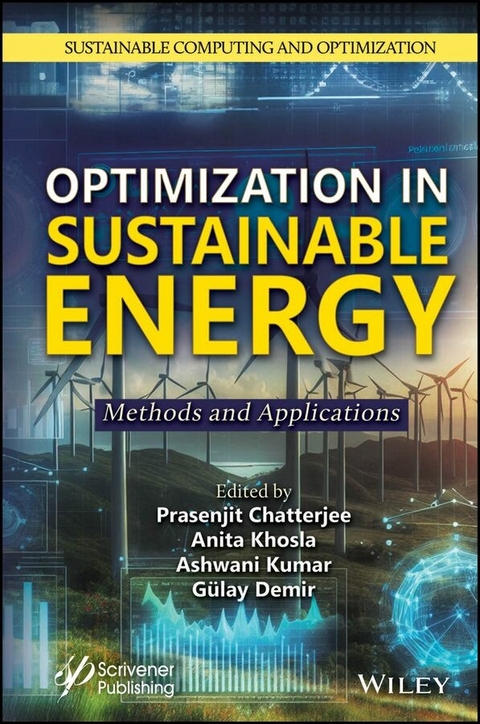
Optimization in Sustainable Energy (eBook)
694 Seiten
Wiley-Scrivener (Verlag)
978-1-394-24211-5 (ISBN)
This state-of-the-art book offers cutting-edge optimization techniques and practical decision-making frameworks essential for enhancing the efficiency and reliability of sustainable energy systems, making it an invaluable resource for researchers, policymakers, and energy professionals.
Optimization in Sustainable Energy: Methods and Applications brings together valuable knowledge, methods, and practical examples to help scholars, researchers, professionals, and policymakers address the growing challenges of optimizing sustainable energy. This volume covers a range of topics, including mathematical models, heuristic algorithms, renewable resource management, and energy storage optimization. Each chapter explores a different aspect of sustainable energy, providing both theoretical understanding and practical guidance.
The volume explores challenges and opportunities surrounding the integration of multi-criteria decision-making techniques in energy planning, highlighting insights on environmental, economic, and social factors influencing the strategic allocation of resources. The use of evolutionary algorithms, machine learning, and metaheuristics to optimize energy storage, distribution, and optimization are also discussed.
The transition towards sustainable energy is at the forefront of global priorities, driven by the urgent need to mitigate climate change, reduce carbon emissions, and enhance energy security. As countries and industries increasingly prioritize renewable sources like wind, solar, and hydroelectric power, the complexity of optimizing these systems becomes a critical challenge. Optimization in Sustainable Energy: Methods and Applications, is a comprehensive exploration of cutting-edge methodologies used to enhance the efficiency, reliability, and performance of sustainable energy systems.
Audience
Research scholars, academics, students, policymakers, and industry experts in mechanical engineering, electrical engineering, and energy science.
This state-of-the-art book offers cutting-edge optimization techniques and practical decision-making frameworks essential for enhancing the efficiency and reliability of sustainable energy systems, making it an invaluable resource for researchers, policymakers, and energy professionals. Optimization in Sustainable Energy: Methods and Applications brings together valuable knowledge, methods, and practical examples to help scholars, researchers, professionals, and policymakers address the growing challenges of optimizing sustainable energy. This volume covers a range of topics, including mathematical models, heuristic algorithms, renewable resource management, and energy storage optimization. Each chapter explores a different aspect of sustainable energy, providing both theoretical understanding and practical guidance. The volume explores challenges and opportunities surrounding the integration of multi-criteria decision-making techniques in energy planning, highlighting insights on environmental, economic, and social factors influencing the strategic allocation of resources. The use of evolutionary algorithms, machine learning, and metaheuristics to optimize energy storage, distribution, and optimization are also discussed. The transition towards sustainable energy is at the forefront of global priorities, driven by the urgent need to mitigate climate change, reduce carbon emissions, and enhance energy security. As countries and industries increasingly prioritize renewable sources like wind, solar, and hydroelectric power, the complexity of optimizing these systems becomes a critical challenge. Optimization in Sustainable Energy: Methods and Applications, is a comprehensive exploration of cutting-edge methodologies used to enhance the efficiency, reliability, and performance of sustainable energy systems. Audience Research scholars, academics, students, policymakers, and industry experts in mechanical engineering, electrical engineering, and energy science.
1
Strategic Roadmap for Turkey’s Sustainable Energy Transition: A Multi-Criteria Perspective
Gülay Demir1 and Prasenjit Chatterjee2*
1Vocational School of Health Services, Sivas Cumhuriyet University, Sivas, Türkiye
2Department of Mechanical Engineering, MCKV Institute of Engineering, Howrah, West Bengal, India
Abstract
This chapter explores the potential impact of renewable energy sources (RESs) on Turkey’s energy future by employing two analytical methods, namely, Weights by ENvelope and SLOpe (WENSLO) and Ranking of Alternatives with Weights of Criterion (RAWEC). The WENSLO method is used to weight criteria such as installed capacity, number of plants/facilities, installation cost, levelized cost of electricity, share in electricity generation, and lifetime of power plants. In contrast, the RAWEC technique was recommended for selecting RESs such as hydro, geothermal, wind, solar, and biomass. In this framework, the effectiveness and applicability of WENSLO and RAWEC methods have been analyzed to identify RESs suitable for meeting Turkey’s energy needs. This study aims to provide a strategic roadmap for Turkey’s sustainable energy transformation. Economic and sustainability criteria, such as the levelized cost of electricity and the lifetime of power plants, should be prioritized in determining the preferred energy sources. In this context, biomass and geothermal energy sources are advantageous in terms of both economic and sustainability and rank high in the ranking of preference, while technologically developing sources, such as solar and wind energy, are gaining more and more importance. This study provides guidance to decision makers in the energy sector to develop effective policies and make the right investment decisions, thus contributing to a more sustainable energy future.
Keywords: Renewable energy sources, MCDM, WENSLO, RAWEC, Performance analysis
1.1 Introduction
Increasing environmental concerns, rapidly depleting reserves, and high energy prices have popularized renewable energy options. Because renewable energy sources (RESs) are abundant in nature, cost less than traditional sources, and cause less environmental harm, many nations have implemented laws to promote renewable energy development and have activated several renewable energy applications [1–3]. RESs are continuously replenished by natural processes, and their environmental impacts are generally less compared to fossil fuels. They also have the potential to improve energy security and lower greenhouse gas emissions [4]. There are many different sources of renewable energy. Among these, the most popular ones used for energy production are the following [5]:
- Solar energy: Energy obtained by direct or indirect conversion of sunlight into electrical energy or heat. It is captured and utilized by technologies such as solar panels or thermal collectors.
- Wind energy: Wind energy is transformed into mechanical or electrical power by wind turbines. Wind turbines produce electricity by harnessing the kinetic energy of the wind.
- Hydroelectric energy: It is the energy obtained by converting water flow or water pressure into mechanical energy. It is obtained using structures such as dams or river turbines.
- Geothermal energy: It is the energy obtained by extracting and using hot water and steam from geothermal sources. It is used with systems such as heat pumps or geothermal power plants.
- Biomass energy: It is the energy obtained through the combustion of organic materials (plants, trees, waste, etc.) or biochemical processes. Biomass energy can be used with different technologies such as biogas, biodiesel, and biomass boilers.
For a rapidly developing country like Turkey, whose energy needs are constantly increasing, RESs are the cornerstone of a sustainable and environmentally friendly energy policy. However, deciding which RE source should be preferred is a complex process. Because the advantages, disadvantages and impacts of each source are different. This study will address the application of the multi-criteria decision making (MCDM) technique to identify the best RES in Turkey’s energy industry [6, 7]. The reasons for using MCDM techniques in the RE decision-making process can be summarized as follows:
- Complex decision process: The selection of acceptable RESs to satisfy Turkey’s energy demands is a complicated decision-making process that takes into account a variety of parameters. In this process, the advantages and disadvantages of different energy sources should be considered.
- Evaluation of various criteria: Several variables should be considered while selecting energy sources, including economic sustainability, environmental implications, technical maturity, installation cost, operating cost, and energy security.
- Determination of the optimum energy mix: Determining the most suitable RESs to meet Turkey’s energy needs is related to determining the optimum energy mix. This is important for diversifying energy supply, increasing energy security, and reducing environmental impacts.
1.1.1 Research Goals
The goal of this study is to offer a framework for deciding which RESs are best suitable for meeting Turkey’s energy needs. To this end, we aim to shed light on the strategic decision-making process in Turkey’s energy transition through the use of MCDM methods, Weight by Envelope and Slope (WENSLO) and Ranking of Alternatives with Weights of Criterion (RAWEC). The focus of the study is to evaluate different RESs and determine the most suitable combination for Turkey’s energy mix. In this direction, it is aimed to make strategic decisions to guide energy policies by taking into account factors such as installed capacity, number of power plants/facilities, installation cost, levelized electricity cost, share in electricity generation, and lifetime of power plants. This study aims to contribute to Turkey’s sustainable energy transformation and increase energy security.
1.1.1.1 Research Questions
Aiming to fill the gap in the existing literature, this study aims to investigate the following research questions:
RQ1. Which RESs are best suited to meet Turkey’s energy needs?
RQ2. How can MCDM methods, such as WENSLO and RAWEC, be used in Turkey’s energy transition?
RQ3. How can RESs, such as solar, wind, hydroelectric, geothermal, and biomass, be integrated into Turkey’s energy mix?
These research questions will provide guidance to better understand the main objectives and focal points of the study.
1.1.1.2 Contributions and Novelty
The major contributions of this study include offering a new perspective on strategic decision making in Turkey’s energy transformation process. Specifically, it introduces a novel framework for the application of MCDM methods aimed at identifying RESs that are most suitable for meeting Turkey’s energy needs. This approach provides valuable insights and guidance for policymakers and stakeholders in the energy sector. The use of MCDM methods, such as WENSLO and RAWEC, provides a contribution to the existing literature in this field. This study also introduces an innovative approach by applying these methods to evaluate various RESs in the context of formulating and implementing Turkey’s energy policies so that stakeholders can make more accurate and well-informed decisions. In conclusion, this study aims to contribute to Turkey’s sustainable energy transformation and shed light on the effective formulation and implementation of energy policies.
1.1.1.3 Organization of the Chapter
The chapter is organized as follows: Section 1.2 provides a complete literature assessment and highlights research needs. Section 1.3 describes the MCDM framework utilized in the analysis. The fourth section introduces the data and displays the suggested methodology’s outcomes. Section 1.5 focuses on the practical and managerial ramifications. Finally, Section 1.6 examines the results, limits, and future directions.
1.2 Literature Review
There are two sub-sections in the literature review section. The first subsection summarizes renewable energy studies using MCDM methods to provide some background information. The second sub-section discusses the literature on studies using WENSLO and RAWEC methods.
1.2.1 MCDM Research on Renewable Energy
Although there is a large body of research that has utilized MCDM approaches in renewable energy, this chapter provides a quick overview of a few of these studies. Alizadeh et al. [8] used benefit, opportunity, cost, risk (BOCR) along with analytic network process (ANP) methods for Iran, Zhou et al. [9] used geographical information system (GIS), bestworst method (BWM) and Tomada de Decisão Interativa Multicritério (TODIM) methods for China, Salameh et al. [10] used entropy, criteria importance through intercriteria correlation (CRITIC) and technique for order of preference by similarity to ideal solution (TOPSIS) methods for Saudi Arabia, Troldborg et al. [11] used preference ranking organization method for enrichment evaluations (PROMETHEE) method and stated that solar energy is the most suitable RES for Scotland. Štreimikienė et al. [12] stated that nuclear power is the most suitable RES for Lithuania with analytic...
| Erscheint lt. Verlag | 13.6.2025 |
|---|---|
| Reihe/Serie | Sustainable Computing and Optimization |
| Sprache | englisch |
| Themenwelt | Mathematik / Informatik ► Informatik ► Programmiersprachen / -werkzeuge |
| Technik ► Elektrotechnik / Energietechnik | |
| ISBN-10 | 1-394-24211-5 / 1394242115 |
| ISBN-13 | 978-1-394-24211-5 / 9781394242115 |
| Informationen gemäß Produktsicherheitsverordnung (GPSR) | |
| Haben Sie eine Frage zum Produkt? |
 EPUB (Adobe DRM)
Kopierschutz: Adobe-DRM
Adobe-DRM ist ein Kopierschutz, der das eBook vor Mißbrauch schützen soll. Dabei wird das eBook bereits beim Download auf Ihre persönliche Adobe-ID autorisiert. Lesen können Sie das eBook dann nur auf den Geräten, welche ebenfalls auf Ihre Adobe-ID registriert sind.
Details zum Adobe-DRM
Dateiformat: EPUB (Electronic Publication)
EPUB ist ein offener Standard für eBooks und eignet sich besonders zur Darstellung von Belletristik und Sachbüchern. Der Fließtext wird dynamisch an die Display- und Schriftgröße angepasst. Auch für mobile Lesegeräte ist EPUB daher gut geeignet.
Systemvoraussetzungen:
PC/Mac: Mit einem PC oder Mac können Sie dieses eBook lesen. Sie benötigen eine
eReader: Dieses eBook kann mit (fast) allen eBook-Readern gelesen werden. Mit dem amazon-Kindle ist es aber nicht kompatibel.
Smartphone/Tablet: Egal ob Apple oder Android, dieses eBook können Sie lesen. Sie benötigen eine
Geräteliste und zusätzliche Hinweise
Buying eBooks from abroad
For tax law reasons we can sell eBooks just within Germany and Switzerland. Regrettably we cannot fulfill eBook-orders from other countries.
aus dem Bereich


