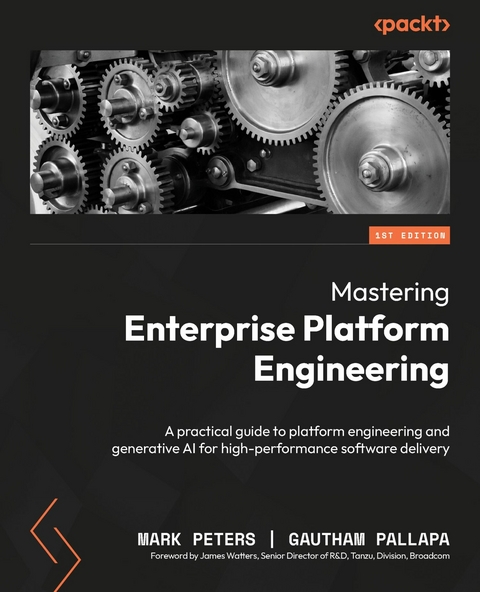
Mastering Enterprise Platform Engineering (eBook)
302 Seiten
Packt Publishing (Verlag)
978-1-83588-049-4 (ISBN)
Modern organizations must deliver software faster, ensure platform stability, and adopt AI, all while reducing operational complexity and cost. But fragmented tooling, scaling challenges, and limited developer enablement hinder progress - driving engineering leaders to seek a cohesive strategy for efficiency, resilience, and innovation.
In this book, Dr. Mark Peters and Dr. Gautham Pallapa join forces to resolve these complexities by showing you how to build scalable platforms, operate them efficiently through automation and AI, and optimize software delivery pipelines for continuous value. The chapters cover core principles, including platform architecture, self-service enablement, and developer experience. You'll explore proven frameworks for cultural transformation, strategic alignment, and continuous improvement, along with 10 bold predictions about the future of platform engineering to help you anticipate trends and lead through change with confidence.
By the end of this book, you'll be able to design and implement resilient, intelligent platforms, accelerate innovation, and drive measurable business impact, positioning you and your organization as leaders in the next era of platform engineering.
Unlock the full potential of enterprise platforms and drive the future of your business by incorporating cutting-edge gen AI techniquesKey FeaturesApply proven frameworks and real-world strategies to design scalable, high-performing platformsIntegrate AI-powered observability, security, compliance into your platform using best practicesWork through hands-on tutorials and case studies to implement platform engineering successfully for measurable business impactPurchase of the print or Kindle book includes a free PDF eBookBook DescriptionModern organizations must deliver software faster, ensure platform stability, and adopt AI, all while reducing operational complexity and cost. But fragmented tooling, scaling challenges, and limited developer enablement hinder progress - driving engineering leaders to seek a cohesive strategy for efficiency, resilience, and innovation. In this book, Dr. Mark Peters and Dr. Gautham Pallapa join forces to resolve these complexities by showing you how to build scalable platforms, operate them efficiently through automation and AI, and optimize software delivery pipelines for continuous value. The chapters cover core principles, including platform architecture, self-service enablement, and developer experience. You ll explore proven frameworks for cultural transformation, strategic alignment, and continuous improvement, along with 10 bold predictions about the future of platform engineering to help you anticipate trends and lead through change with confidence. By the end of this book, you ll be able to design and implement resilient, intelligent platforms, accelerate innovation, and drive measurable business impact, positioning you and your organization as leaders in the next era of platform engineering.What you will learnDiscover how modern platform engineering drives scalability and sustainable business valueDesign and implement internal developer platforms with self-service, golden paths, and AI automationIntegrate AI and machine learning for predictive observability and smart workload optimizationUse leadership and cultural transformation frameworks to build high-performance platform teamsMeasure and optimize platform success through KPIs and FinOps strategiesAccelerate software delivery by unifying existing tools and workflows into cohesive, scalable platformsWho this book is forThis book is for experienced professionals across IT, product, and business functions who are responsible for building, operating, optimizing, or scaling platform capabilities. It is tailored for platform engineers, DevOps engineers, software developers, IT operations teams, transformation leaders, and business executives looking to align platform strategy with organizational goals. A solid understanding of DevOps practices, cloud-native technologies, and software development lifecycles, as well as familiarity with CI/CD, infrastructure automation, and modern application deployment is a must.]]>
Preface
Platform Engineering signifies the next seismic shift in DevOps development by connecting ongoing improvement to long-term automation. It condenses many years of valuable knowledge into a unified framework to evolve how organizations construct, oversee, and expand their digital platforms. In today’s fast-paced business environment, bringing products to market quickly can make or break a company. Creating organic custom platforms often wastes time and misses chances. Platform Engineering offers a straightforward, powerful solution: concentrate on innovation and value while entrusting infrastructure and transformation intricacies to experts. The road to effective Platform Engineering is not a straight line; it is fraught with challenges that demand a deep understanding of technology and strategy.
Many organizations embark on this journey with the best intentions but find themselves trapped in an inefficiency cycle, taking 12–18 months or longer to escape, if ever. The truth is that what you need already exists; the challenge lies in knowing how to harness, integrate, and delegate platform responsibilities.
This book is more than just a compendium of theories; it is a practical guide offering actionable insights, best practices, and real-world tested tools. You’ll learn how to configure scalable, secure, and reliable platforms with precision, ensuring your organization stays ahead of the curve. By the end, you’ll feel fully prepared to lead your organization’s Platform Engineering implementation.
This comprehensive guide covers everything from laying the cultural and architectural foundations to incorporating the latest advancements in AI-driven platforms. Through practical tutorials, hands-on projects, and insightful self-assessment questions, you will grasp Platform Engineering and be empowered to spearhead its adoption within your organization. Key features include the following:
- Designing and building an effective platform.
- Establishing platform infrastructure metrics and integration, including AI solutions.
- Maximizing platform success through accelerated delivery and continuous revenue.
By the time you finish reading, you won’t just be ready for the future—you’ll be prepared to shape it. This book will be your ally on the path to creating a DevOps-compatible, AI-powered platform that is not only a technical marvel but also a strategic asset, positioning your organization at the forefront of digital innovation.
Who this book is for
This book is crafted for professionals across IT, product, and business functions who are at the forefront of enterprise transformation. It speaks directly to business leaders, transformation change agents within IT departments, software developers, and IT operations teams responsible for ensuring the stability, reliability, and overall health of platforms. Whether you’re leading the transformation, developing the platforms, or ensuring operational efficiency, this book is designed to equip you with the knowledge and tools you need to succeed.
This book offers a better path for software developers who are weary of the relentless cycle of building and maintaining their own platforms. The time spent on platform construction (often lasting 40–60 weeks) is time diverted from creating the applications that drive ROI and sharpen your competitive edge. If your goal is to build applications that succeed in the marketplace, the smart move is to leverage a platform engineered by experts, allowing you to focus on what truly matters: innovation and delivery. Similarly, for IT operations teams, Platform Engineering can reduce the burden of platform maintenance, allowing you to focus on strategic tasks that enhance the overall health of the platforms.
This book is an indispensable guide for the C-Suite, managers, and directors of engineering, security, platform, and operations teams, as well as the software developers and platform operators ready to elevate their organizations by adopting a strategic approach to Platform Engineering.
What this book covers
Chapter 1, Introduction to Modern Platform Engineering, offers a foundational explanation for why platforms are essential, some of the basic problems faced by platforms such as speed to market and resource costing, and some of the software solutions that exist. The chapter continues through a comparative analysis of existing tools. Understanding what DevOps is allows one to see the expansion of DevOps through using platforms to concentrate on the important aspects of flow, feedback, and delivery.
Chapter 2, Architectural Foundations and Strategy, helps you understand platform standards starting with the basic cloud migration, the cloud format from AWS to Azure or Google, and the cloud structure, as well as setting up Kubernetes clusters. The basic standards lead one to design and implement custom architectures within those spaces, but architectures also arrive with their own standards.
Chapter 3, Cultural Transformation and Leadership, shows that platforms aren’t just about making technical changes to a production system but about aligning the cultural changes that support implementation. Cultural change requires acknowledging what exists and building a path to organizational changes. As leading-edge innovation, the chapter shapes technical leadership decisions to reach the platform marketplace through effective changes, delivering user value.
Chapter 4, The Platform Engineering Ecosystem, explores the idea that Platform Engineering is not just about installing a single software fix or implementing configuration as code but adjusting the entire delivery ecosystem. Good platforms incorporate a number of different tools to achieve success. Integrating those tools within different aspects of the platform is a key element of effective platforms. Furthermore, those tools should be incorporated into CI/CD outcomes through a DevOps methodology.
Chapter 5, Incorporating Artificial Intelligence into Platform Engineering, talks about how ingesting large amounts of data from different locations can be aided by using generative AI models both in coding and automating operations for software development. The chapter highlights several different off-the-shelf tools that can be integrated to support AI-based outcomes that enhance overall capabilities. Users must recognize their own approach to AI, as well as what other competitors may have done with AI and their lessons learned.
Chapter 6, Engineering Platform Data Management, shows you that platforms don’t just need the initial formation but require managing data throughout multiple applications. One must implement effective strategies, optimize those strategies, and then manage data. Data management tools are described along with methods to handle all data, from user input to streaming solutions.
Chapter 7, Security, Compliance, and Risk Management, explores how DevOps has been recharacterized as DevSecOps, but any operational solution requires security. Platforms emphasize secure-by-default solutions for vulnerability tracking, software bills of materials, and patching solutions before deployment. Security goes beyond the platform itself to managing those who connect to the platform, especially in PaaS and SaaS-type solutions with AI tools.
Chapter 8, Real-World Applications and Case Studies, allows you to review case studies showcasing successful platform transformations and the integration of platforms with business strategies. It explores failed platform transformations to highlight the value of strategic planning and disruption in the enterprise. A DevOps success model is used to capture previous lessons and incorporate them to support current operations. This chapter also examines potential future lessons from those technologies and solutions that are not yet fully implemented.
Chapter 9, Testing, Quality Assurance, and Operations, highlights that platform solutions build beyond the basics to offer standardized pipelines and testing processes. Successfully implementing these processes generates repeatable bodies of evidence, allowing all software to be measured against the same standard. Implementing these standards creates quality across the product and allows for continual success.
Chapter 10, Building High-Performance Platform Teams, shows that central to the platform is having effective platform teams. Using optimal buy versus build strategies allows organizations to minimize dedicated platform individuals while maintaining scalability and reliability. High-performing teams can be designed within a DevOps framework without specialized knowledge based on platform benefits generated from standardized tooling, generative AI solutions, and modernized observability.
Chapter 11, From Vision to Reality: Mastering Enterprise Platform Engineering, emphasizes the importance of visionary leadership, strategic planning, and continuous improvement in driving platform success. It explores articulating platform initiative value to...
| Erscheint lt. Verlag | 27.6.2025 |
|---|---|
| Vorwort | James Watters |
| Sprache | englisch |
| Themenwelt | Informatik ► Office Programme ► Outlook |
| Mathematik / Informatik ► Informatik ► Programmiersprachen / -werkzeuge | |
| Mathematik / Informatik ► Informatik ► Theorie / Studium | |
| ISBN-10 | 1-83588-049-5 / 1835880495 |
| ISBN-13 | 978-1-83588-049-4 / 9781835880494 |
| Informationen gemäß Produktsicherheitsverordnung (GPSR) | |
| Haben Sie eine Frage zum Produkt? |
 EPUB (Ohne DRM)
Digital Rights Management: ohne DRM
Dieses eBook enthält kein DRM oder Kopierschutz. Eine Weitergabe an Dritte ist jedoch rechtlich nicht zulässig, weil Sie beim Kauf nur die Rechte an der persönlichen Nutzung erwerben.
Dateiformat: EPUB (Electronic Publication)
EPUB ist ein offener Standard für eBooks und eignet sich besonders zur Darstellung von Belletristik und Sachbüchern. Der Fließtext wird dynamisch an die Display- und Schriftgröße angepasst. Auch für mobile Lesegeräte ist EPUB daher gut geeignet.
Systemvoraussetzungen:
PC/Mac: Mit einem PC oder Mac können Sie dieses eBook lesen. Sie benötigen dafür die kostenlose Software Adobe Digital Editions.
eReader: Dieses eBook kann mit (fast) allen eBook-Readern gelesen werden. Mit dem amazon-Kindle ist es aber nicht kompatibel.
Smartphone/Tablet: Egal ob Apple oder Android, dieses eBook können Sie lesen. Sie benötigen dafür eine kostenlose App.
Geräteliste und zusätzliche Hinweise
Buying eBooks from abroad
For tax law reasons we can sell eBooks just within Germany and Switzerland. Regrettably we cannot fulfill eBook-orders from other countries.
aus dem Bereich