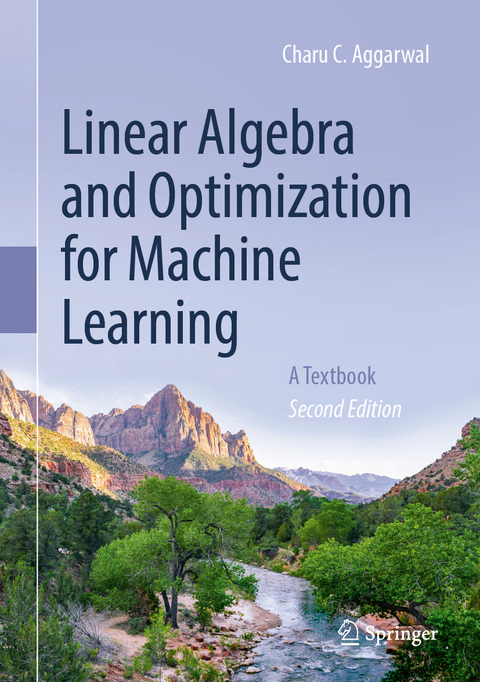
Linear Algebra and Optimization for Machine Learning
Springer International Publishing (Verlag)
978-3-031-98618-5 (ISBN)
This textbook is the second edition of the linear algebra and optimization book that was published in 2020. The exposition in this edition is greatly simplified as compared to the first edition. The second edition is enhanced with a large number of solved examples and exercises. A frequent challenge faced by beginners in machine learning is the extensive background required in linear algebra and optimization. One problem is that the existing linear algebra and optimization courses are not specific to machine learning; therefore, one would typically have to complete more course material than is necessary to pick up machine learning. Furthermore, certain types of ideas and tricks from optimization and linear algebra recur more frequently in machine learning than other application-centric settings. Therefore, there is significant value in developing a view of linear algebra and optimization that is better suited to the specific perspective of machine learning.
It is common for machine learning practitioners to pick up missing bits and pieces of linear algebra and optimization via osmosis while studying the solutions to machine learning applications. However, this type of unsystematic approach is unsatisfying because the primary focus on machine learning gets in the way of learning linear algebra and optimization in a generalizable way across new situations and applications. Therefore, we have inverted the focus in this book, with linear algebra/optimization as the primary topics of interest, and solutions to machine learning problems as the applications of this machinery. In other words, the book goes out of its way to teach linear algebra and optimization with machine learning examples. By using this approach, the book focuses on those aspects of linear algebra and optimization that are more relevant to machine learning, and also teaches the reader how to apply them in the machine learning context. As a side benefit, the reader will pick up knowledge of several fundamental problems in machine learning. At the end of the process, the reader will become familiar with many of the basic linear-algebra- and optimization-centric algorithms in machine learning. Although the book is not intended to provide exhaustive coverage of machine learning, it serves as a technical starter for the key models and optimization methods in machine learning. Even for seasoned practitioners of machine learning, a systematic introduction to fundamental linear algebra and optimization methodologies can be useful in terms of providing a fresh perspective.
The chapters of the book are organized as follows.
1-Linear algebra and its applications: The chapters focus on the basics of linear algebra together with their common
Charu C. Aggarwal is a Distinguished Research Staff Member (DRSM) at the IBM T. J.Watson Research Center in Yorktown Heights, New York. He completed his undergraduate degree in Computer Science from the Indian Institute of Technology at Kanpur in 1993 and his Ph.D. in Operations Research from the Massachusetts Institute of Technology in 1996. He has published more than 400 papers in refereed conferences and journals, and has applied for or been granted more than 80 patents. He is author or editor of 20 books, including textbooks on linear algebra, machine learning, neural networks, and outlier analysis. Because of the commercial value of his patents, he has thrice been designated a Master Inventor at IBM. He has received several awards, including the EDBT Test-of-Time Award (2014), the ACM SIGKDD Innovation Award (2019), the IEEE ICDM Research Contributions Award (2015), and the IIT Kanpur Distinguished Alumnus Award (2023). He is also a recipient of the W. Wallace McDowell Award, the highest award given solely by the IEEE Computer Society across the field of computer science. He has served as an editor-in-chief of ACM Books and the ACM Transactions on Knowledge Discovery from Data. He is a fellow of the SIAM, ACM, and the IEEE, for contributions to knowledge discovery and data mining algorithms.
Preface.- 1 Linear Algebra and Optimization: An Introduction.- 2 Linear Transformations and Linear Systems.- 3 Eigenvectors and Diagonalizable Matrices.- 4 Optimization Basics: A Machine Learning View.- 5 Advanced Optimization Solutions.- 6 Constrained Optimization and Duality.- 7 Singular Value Decomposition.- 8 Matrix Factorization.- 9 The Linear Algebra of Similarity.- 10 The Linear Algebra of Graphs.- 11 Optimization in Computational Graphs.- Index.
| Erscheinungsdatum | 13.06.2025 |
|---|---|
| Zusatzinfo | XXIII, 645 p. 104 illus., 20 illus. in color. |
| Verlagsort | Cham |
| Sprache | englisch |
| Maße | 178 x 254 mm |
| Themenwelt | Informatik ► Theorie / Studium ► Künstliche Intelligenz / Robotik |
| Mathematik / Informatik ► Mathematik ► Algebra | |
| Schlagworte | Deep learning • Dynamic Programming • Gradient descent • linear algebra • linear regression • machine learning • Matrix Algebra • matrix theory • Neural networks • Numerical Algebra • Optimization • Support Vector Machines |
| ISBN-10 | 3-031-98618-0 / 3031986180 |
| ISBN-13 | 978-3-031-98618-5 / 9783031986185 |
| Zustand | Neuware |
| Informationen gemäß Produktsicherheitsverordnung (GPSR) | |
| Haben Sie eine Frage zum Produkt? |
aus dem Bereich