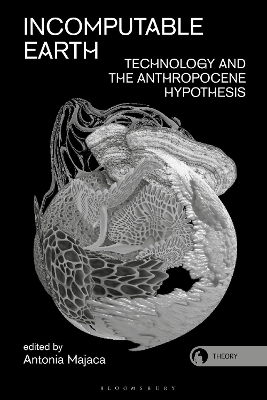
Incomputable Earth
Bloomsbury Academic (Verlag)
978-1-350-26498-4 (ISBN)
- Noch nicht erschienen (ca. April 2027)
- Versandkostenfrei
- Auch auf Rechnung
- Artikel merken
Against the backdrop of new regimes of algorithmic classification and prediction, Incomputable Earth addresses the crucial need to rethink the meaning and inter-relationality of such terms as 'extraction', 'computation', and 'planetarity'. Beyond theory, it examines what cognitive and political capacities we need to grapple with the implications of this parallel intensification of datafication and the Anthropocene.
Through five interconnected sections, international scholars, artists, and theorists reveal how the Anthropocene hypothesis is inextricably linked to colonial histories of computation, emerging alongside the expansion of digital technological systems and new regimes of data positivism.
Examining new forms of subjectivity and resistance, this timely volume tackles urgent topics, from the racialized politics of climate change to feminist ecologies and planetary financialization. In an original, hybrid format reflecting its interdisciplinary nature, Incomputable Earth offers a vital intervention into the past, present, and future of computation and its inescapable impact upon our social, political, and planetary life.
This book emerges from the artistic research project "The Incomputable-Art in the Age of Algorithms," instigated at the IZK - Institute for Contemporary Art, Graz University of Technology, and funded by the Austrian Science Fund FWF, the Austrian Federal Ministry of Arts, Culture, Civil Service and Sport, and the Styrian Provincial Government Department of Economy, Tourism, Science and Research.
This book is available open access through the Bloomsbury Open Access programme and is available on www.bloomsburycollections.com It is funded by The Austrian Science Fund (FWF).
Antonia Majaca is a researcher, curator and principal investigator for the research project ‘Incomputable' (2019-2021) at the IZK - Institute for Contemporary Art, Graz University of Technology, Austria. Marina Vishmidt is a Lecturer in Media, Communications and Cultural Studies and convenor of the MA in Culture Industry at Goldsmiths, University of London, UK. She is the co-author of Reproducing Autonomy: Work, Money, Crisis and Contemporary Art, with Kerstin Stakemeier (2016), and the author of Speculation as a Mode of Production (2018).
List of Illustrations
List of Contributors
Acknowledgments
Series Preface
1. Introduction: The Anthropocene Hypothesis and the Incomputable, Antonia Majaca
Part I: The Political Economy of Anthropocene Technologies
2. Externality and Necessity Between Materialism and Ecology, Marina Vishmidt
3. Between the Planet and the Market, Gary Zhexi Zhang
4. The Automaton of the Anthropocene: On Carbosilicon Machines and Cyberfossil Capital, Matteo Pasquinelli
5. Anatomy of an AI System: The Amazon Echo as an Anatomical Map of Human Labor, Data, and Planetary Resources, Kate Crawford and Vladan Joler
Part II: The Epistemologies of Cosmotechne
6. Black Ecologies: An Opening, an Offering, Imani Jacqueline Brown
7. Pluriversal Horizons: Notes for an Onto-epistemic Reorientation of Technology, Arturo Escobar, Michal Osterweil, and Kriti Sharma
8. Systems Representing Themselves, Juaniko Moreno
9. A Conversation on Art and Cosmotechnics, Yuk Hui and Brian Kuan Wood
10. The Rise of the Coyote: Towards a Socio-Technological Approach to Worldmaking, Sara Garzón
Part III: Artificial Earth
11. The Artificial Earth: A Conceptual Morphology, Conrad Moriarty-Cole and James Phillips
12. The Environment Is Not a System, Tega Brain
13. At the Limits of Computational Technocracy, Victor G. García-Castañeda
14. Prologue to the Sky River, Elise Misao Hunchuck, Marco Ferrari, and Jingru (Cyan) Cheng
15. Designed to Disappear: On the Ambiguity of “Nature” in Dutch Coastal Engineering, Michaela Büsse and Konstantin Mitrokhov
Part IV: Planetary Scientia
16. Poetics of Science / Dialogic Curiosities / Incomputabilities, Fields Harrington and Katherine McKittrick
17. At the End of Autopoiesis: Nonaxiomatic Patterns and Millions of Incomputable Earths, Luciana Parisi
18. Subaquatic Sensoriums and the Incomputable Ocean, Margarida Mendes
19. Pending Xenophora, Mari Bastashevski
Part V: For the End of This World
20. Nature, Estranged from the Idea: Gendered Metaphors and Evolutionary Allegories in the Long Nineteenth Century, Ana Teixeira Pinto
21. The Time Machine Stops, Kevin Walker
22. The Pain of Thinking at Light Speed: Posthuman Play as Response to “I Have No Mouth, and I Must Scream”, Conor McKeown
23. Organic Technologies in the Works of Patricia Domíguez, Daniela Zyman
Bibliography
Index
| Erscheint lt. Verlag | 29.4.2027 |
|---|---|
| Reihe/Serie | Theory in the New Humanities |
| Zusatzinfo | 60 bw illus |
| Verlagsort | London |
| Sprache | englisch |
| Maße | 156 x 234 mm |
| Themenwelt | Informatik ► Theorie / Studium ► Künstliche Intelligenz / Robotik |
| Naturwissenschaften ► Biologie ► Ökologie / Naturschutz | |
| ISBN-10 | 1-350-26498-9 / 1350264989 |
| ISBN-13 | 978-1-350-26498-4 / 9781350264984 |
| Zustand | Neuware |
| Informationen gemäß Produktsicherheitsverordnung (GPSR) | |
| Haben Sie eine Frage zum Produkt? |
aus dem Bereich