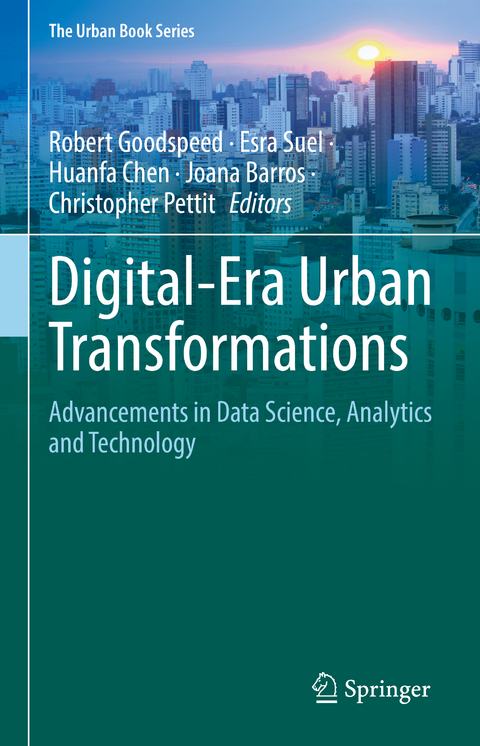
Digital-Era Urban Transformations
Springer International Publishing (Verlag)
978-3-031-98299-6 (ISBN)
- Noch nicht erschienen - erscheint am 05.01.2026
- Versandkostenfrei
- Auch auf Rechnung
- Artikel merken
The diffusion of information technologies to nearly all facets of our society means we are living fully within a new digital era that could previously only be imagined. The digital mediation of transactions, the rise of new global digital infrastructures, even the proliferation of low-cost sensors and satellites, are fundamentally reshaping what can be known about cities and therefore what possibilities are unlocked for new urban analysis and planning tools. Published in conjunction with the 19th Computational Urban Planning and Urban Management (CUPUM) conference, held at the University College London in June 2025, the volume contains 17 chapters exploring new applications of a wide range of contemporary technologies, including artificial intelligence, satellite data, big data analysis, and urban sensing. These are applied to diverse problems including resilience to urban heat, preparing for natural disasters like tsunamis, grappling with urban decline, or reducing GHG emissions, or the creation of novel Planning Support Systems.
Introduction.-Part1Planning Support Systems in Evolution.-A Twenty-Year Review of the What If? Planning Support System.-Bridging the Gap Between Tsunami Risk Awareness and Physical Vulnerabilities: A Data-Driven Approach for Disaster-Resilient Urban Planning.-Virtual Reality as a Collaborative Tool in Road Planning: Insights From a Case Study in Perth, Western Australia.-Rapid Development of a Cloud-Based Chatbot for Housing Policy Enquiries.-Part2Urban Streets and Mobility Systems.-A City s Response to Platformized Mobility: Emerging Interactions of Ride-Hailing Beyond Automobile Travel.-Towards Net Zero: Converting Car Commutes to Bicycling in Australia.-Inferring On-Street Parking Occupancy with Smart Meter Data.-Urban Design Analytics in the Age of Data Science and AI: Discovery, Measurement, Design, and Prediction.-Fingerprinting NYC s Scaffolding Problem with Longitudinal Dashcam Data.-Development of a Method for Identifying the Presence of Front Roads Based on Building Coverage Ratio.-Part3Neighborhoods and Communities.-Gentrification from the Sky: Using Remote Sensing and Machine Learning for Urban Change Detection.-Increasing Urban Greenery through Reconfiguring Street Spaces to Mitigate Urban Heat Island Effects in Metropolitan Adelaide, Australia.-Sensing and Analysing Urban Heat Islands Using Internet of Things: A Real Time Microclimate Network for London.-Daytime to Nighttime Street View Image Generation for 24-hour Safety Perception Mapping.-Spatial Variation Analysis of the Local Population Distribution during Urban Expansion and Contraction Processes.-Do Good Schools Influence Property Prices? Disentangling School and Neighbourhood Effects with Empirical Evidence from Brighton.
| Erscheinungsdatum | 20.07.2025 |
|---|---|
| Reihe/Serie | The Urban Book Series |
| Zusatzinfo | XI, 347 p. 119 illus., 103 illus. in color. |
| Verlagsort | Cham |
| Sprache | englisch |
| Maße | 155 x 235 mm |
| Themenwelt | Informatik ► Theorie / Studium ► Künstliche Intelligenz / Robotik |
| Schlagworte | Artificial Intelligence • Connected environments • data visualisation • GIScience • Planning support science • Urban Analytics • urban data • urban modeling |
| ISBN-10 | 3-031-98299-1 / 3031982991 |
| ISBN-13 | 978-3-031-98299-6 / 9783031982996 |
| Zustand | Neuware |
| Informationen gemäß Produktsicherheitsverordnung (GPSR) | |
| Haben Sie eine Frage zum Produkt? |
aus dem Bereich