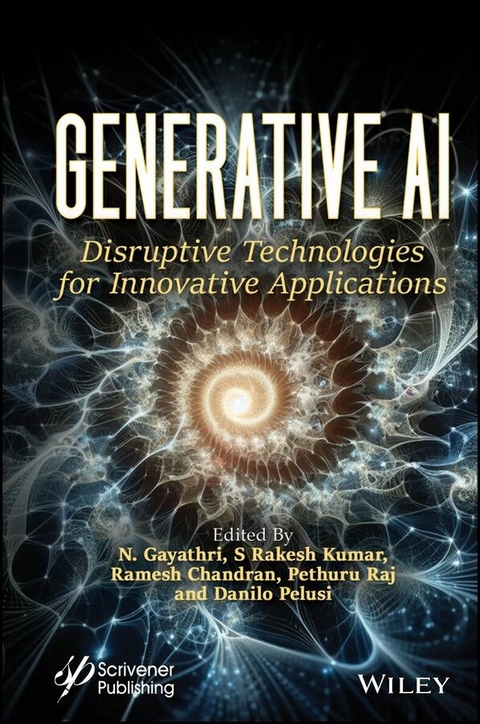
Generative AI (eBook)
406 Seiten
Wiley-Scrivener (Verlag)
978-1-394-30291-8 (ISBN)
This book is essential for anyone eager to understand the groundbreaking advancements in generative AI and its transformative effects across industries, making it a valuable resource for both professional growth and creative inspiration.
Generative AI: Disruptive Technologies for Innovative Applications delves into the exciting and rapidly evolving world of generative artificial intelligence and its profound impact on various industries and domains. This comprehensive volume brings together leading experts and researchers to explore the cutting-edge advancements, applications, and implications of generative AI technologies. This volume provides an in-depth exploration of generative AI, which encompasses a range of techniques such as generative adversarial networks, recurrent neural networks, and transformer models like GPT-3. It examines how these technologies enable machines to generate content, including text, images, and audio, that closely mimics human creativity and intelligence. Readers will gain valuable insights into the fundamentals of generative AI, innovative applications, ethical and social considerations, interdisciplinary insights, and future directions of this invaluable emerging technology. Generative AI: Disruptive Technologies for Innovative Applications is an indispensable resource for researchers, practitioners, and anyone interested in the transformative potential of generative AI in revolutionizing industries, unleashing creativity, and pushing the boundaries of what's possible in artificial intelligence.
Audience
AI researchers, industry professionals, data scientists, machine learning experts, students, policymakers, and entrepreneurs interested in the innovative field of generative AI.
N. Gayathri, PhD, is an assistant professor in the Department of Computer Science and Engineering at the Ghandi Institute of Technology and Management, India. She has published several articles in international journals, edited many books, and serves as a guest editor and reviewer for several international journals. Her research interests include big data analytics, Internet of Things, and mobile networks, and sustainable computing.
S Rakesh Kumar, PhD, is an assistant professor in the Department of Computer Science and Engineering at the Ghandi Institute of Technology and Management, India. He has several publications in international journals, conference proceedings, and edited volumes. His research interests include artificial intelligence and machine learning.
Ramesh Chandran, PhD, is an associate professor in the Department of Computer Science and Engineering at the Vellore Institute of Technology, India, with over 19 years of combined teaching and industry experience. He has published over 20 articles in international journals and has presented papers in national and international conferences. His research interests include cloud computing, data mining, artificial intelligence, data analytics, and blockchain.
Pethuru Raj, PhD, is a chief architect at Reliance Jio Platforms Ltd., Bangalore, India with over 30 years of combined industry and research experience in information technology. He has been granted international research fellowships from organizations including the Japan Society for the Promotion of Science and the Japan Science and Technology Agency. His research interests include Internet of Things, artificial intelligence, model optimization techniques, blockchain, digital twins, and cloud computing.
Danilo Pelusi, PhD, is an associate professor of Computer Science in the Department of Communication Sciences, University of Teramo, Italy. He is an editor for several internationally published books and journals and a member of Machine Intelligence Research Labs. His research interests include coding theory, artificial intelligence, signal processing, pattern recognition, fuzzy logic, neural networks, and genetic algorithms.
This book is essential for anyone eager to understand the groundbreaking advancements in generative AI and its transformative effects across industries, making it a valuable resource for both professional growth and creative inspiration. Generative AI: Disruptive Technologies for Innovative Applications delves into the exciting and rapidly evolving world of generative artificial intelligence and its profound impact on various industries and domains. This comprehensive volume brings together leading experts and researchers to explore the cutting-edge advancements, applications, and implications of generative AI technologies. This volume provides an in-depth exploration of generative AI, which encompasses a range of techniques such as generative adversarial networks, recurrent neural networks, and transformer models like GPT-3. It examines how these technologies enable machines to generate content, including text, images, and audio, that closely mimics human creativity and intelligence. Readers will gain valuable insights into the fundamentals of generative AI, innovative applications, ethical and social considerations, interdisciplinary insights, and future directions of this invaluable emerging technology. Generative AI: Disruptive Technologies for Innovative Applications is an indispensable resource for researchers, practitioners, and anyone interested in the transformative potential of generative AI in revolutionizing industries, unleashing creativity, and pushing the boundaries of what s possible in artificial intelligence. Audience AI researchers, industry professionals, data scientists, machine learning experts, students, policymakers, and entrepreneurs interested in the innovative field of generative AI.
1
Introduction to Generative AI
Ritika Lath1*, Renuka Patwari1, Amit Aylani1 and Deepak Hajoary2
1Vidyalankar Institute of Technology, Mumbai, India
2Bodoland University, Assam, India
Abstract
Generative AI (Gen AI or GAI) is becoming a greater player in the creation and consumption of content with expected ramifications across several industries. In 2025, GAI will account for 10% of all data as compared to less than 1% currently according to Gartner’s 2022 Emerging Technologies and Trends Impact Radar. This machine learning subset can generate new forms of content, including text, audio, images, and video by using advanced neural networks like OpenAI’s GPT models. The introduction of ChatGPT, which was built on the basis of GPT-3.5 showed GAI’s capability in conducting coherent conversations, thus emphasizing its potential in automating the knowledge work delivery process. The applications for GAI are wide-ranging, from drug discovery to manufacturing, thereby challenging traditional notions of creativity as well as authorship. It is anticipated that as companies develop specialized large language models, GAI will eventually become an instrumental tool across different sectors, facilitating innovation and improving efficiency. Nonetheless, there are serious ethical, legal, and social issues that arise because it changes our manner of creating, interacting with, and comprehending various forms of content. In this chapter, we begin by examining Gen AI, starting from its definition, moving on through distinguishing it from traditional Artificial Intelligence (AI) and Machine Learning (ML) by emphasizing its novelty of producing outputs that resemble variety of human generated content. The history of Gen AI is traced, revealing the models that facilitated its progress, including Generative Adversarial Networks (GANs), Variational Autoencoders (VAEs), Transformer models, Recurrent Neural Networks (RNNs) and Long Short-Term Memory Networks (LSTMs), among many others. Besides, this chapter examines how Generative AI works through exploring the complex structure of Large Language Models (LLMs) and how they operate. It highlights the minute differences between LLMs and broader Generative AI frameworks while illustrating LLM’s position within the Gen AI paradigm. The chapter also discusses the consequences and prospects of LLMs, given their transformative abilities in creative industries, scientific research, and other areas. Details concerning how Gen AI can help improve productivity, reduce costs, and the dangers involved, such as invasion of privacy and AI cyber-attacks are elaborated. The performance of Gen AI is then evaluated based upon standards such as quality, diversity, and speed. Besides, applying them in practical life is not easy. The challenges are addressed under the section on Technical Challenges, and the paper concludes by showcasing Gen AI’s real-life application through examples like Unilever and Be My Eyes for societal good.
Keywords: Generative models, gen AI, neural networks, synthetic data, algorithmic creativity, variational autoencoders (VAEs), generative adversarial networks (GANs), diffusion models, transformers
1.1 What is Generative AI
Generative AI is an fascinating area of artificial intelligence that deals with the creation of new data that is inspired by the patterns it has learned from the existing data. If you’re ever wondering how generative AI works, think of it as learning to draw a cat. You might start by studying several photographs of casts, noting features such as body shape, ears, and tails. Eventually, you will start to recognize the basic characteristics of a dog. When you try to recall a dog and draw it, you create a new image using the patterns that you’ve learned. This picture will not be identical to any dog you’ve ever seen, but it will be a completely new interpretation of the concept of a dog. Similarly, generative AI is trained on a vast dataset which can include images, texts, sounds, and more. The AI system studies these instances, then finds the similarities and shapes in the data. By absorbing prior examples, it gains the capacity to generate genuine content with a slight similarity to the training data. For example, a model of generative AI trained on pictures of cats could invent a new kind of cat. The same thing is true for a machine that has been taught to use textual data, for it can create a new paragraph that is almost indistinguishable from a human’s writing style [1].
The most interesting aspect of Gen AI is that it doesn’t merely copy pieces of data it had already seen. Instead, it creates entirely new kinds of content based on the patterns it has learned. This creative ability – generating something new rather than just providing existing data – is what makes GAI so illicitly attractive. For example, a Gen AI model trained on musical scores can produce new music that, though influenced by the training data, is also an original composition [2].
Generative AI has been the most prominent game-changing technology in the last couple of years, leading to a fundamental change in the way content is generated and consumed. According to the Gartner’s Emerging Technologies and Trends Impact Radar for 2022, the GAI will be crucial in many sectors, with the tendency to be dominant in the near future. By 2025, GAI is expected to account for 10% of all data produced, a 1% increment from the current level, which is less than 1%. Moreover, the goal is to achieve a 20% share in the test data output for the consumer applications highlighting that not only data generation but also consumption is increasing its influence in this field. Generative AI, a subset of ML technologies, can produce various types of new content (text, audio, images, and video) from text prompts. This distinct trait has captivated the world, especially via dialogue systems that predominantly revolve around the text. In comparison to conventional chatbots whose capabilities are restricted by fixed rules and limited comprehension of context, generative AI models employ advanced neural networks like OpenAI’s GPT which maintain certain level of contextual awareness [2]. These models are developed using large-scale data collection, which gives them the ability to create new content based on user prompts. The data acquisition phase consists of models getting an AI intelligence that attains a representative knowledge of the world, a capability that even AI experts find difficulty to explain fully due to the inherent uncertainty in the algorithms.
A powerful version of ChatGPT based on the neural network model Open AI’s GPT-3.5 was introduced on November 30, 2022, revealing the true potential of the generative AI’s to the world. It managed to showcase the technology’s ability to engage in a human-like dialogue through the provision of socially correct and contextually relevant answers. Furthermore, the model’s content generation ability has not only changed the conversational space but also revealed the generative AI’s potential to provide solutions in knowledge work, an area that has long been resistant to automation. Being able to create virtually anything that looks like a human text and even images, audio, or video only from basic text prompts, therefore, generative AI tools can be a partner in the creative process of making practical work purposes. Automation industry is going to be revolutionized by this development, as it will open up new avenues for creativity and efficiency in different sectors [3]. With the generative AI technology, the possibilities are endless. According to the Gartner prediction, by 2025, the use of GAI technology in drug discovery and development initiatives will reach 50%, thus science research will be made faster and better. It is reported that in the manufacturing sector by 2027, 30% of manufacturers will use this technology to enhance the efficiency of product development. Such predictions point to a future in which generative AI is a crucial instrument in industries from pharmaceuticals to manufacturing as it will promote innovation and efficiency [4]. The pleasing effect of generative AI is not only about its technical aspects. It means that a new chapter in our relationship with technology and creativity is opening up. The generative AI’s ability to produce never-before-seen content throws new light on traditional understanding of creativity and authorship; therefore, bringing about the question of the role of AI in creative processes. Although the businesses and individuals are searching for the technologies’ possible advantages, there is an increasing recognition of the necessity to comprehend the ethical, legal, and societal implications of generative AI [5].
In the coming years, organizations will develop their own unique models for big language. Companies have always been at the forefront of AI technology, but now AI is becoming more and more tailored to fit specific use cases. This brings us a step closer towards AI systems that have unique characteristics capable of AI functions that are exactly matched with the needs and problems of a company. The more this technology evolves, the more it will become a household name which will give rise to new business models, services, and products [6]. The blooming of AI with a plethora of services and products is not stoppable, it is on its way to every household in the globe. Gen AI is not just a top-notch technology; it is a turner of the tides that improves content generation...
| Erscheint lt. Verlag | 28.5.2025 |
|---|---|
| Sprache | englisch |
| Themenwelt | Informatik ► Office Programme ► Outlook |
| ISBN-10 | 1-394-30291-6 / 1394302916 |
| ISBN-13 | 978-1-394-30291-8 / 9781394302918 |
| Informationen gemäß Produktsicherheitsverordnung (GPSR) | |
| Haben Sie eine Frage zum Produkt? |
 EPUB (Adobe DRM)
Kopierschutz: Adobe-DRM
Adobe-DRM ist ein Kopierschutz, der das eBook vor Mißbrauch schützen soll. Dabei wird das eBook bereits beim Download auf Ihre persönliche Adobe-ID autorisiert. Lesen können Sie das eBook dann nur auf den Geräten, welche ebenfalls auf Ihre Adobe-ID registriert sind.
Details zum Adobe-DRM
Dateiformat: EPUB (Electronic Publication)
EPUB ist ein offener Standard für eBooks und eignet sich besonders zur Darstellung von Belletristik und Sachbüchern. Der Fließtext wird dynamisch an die Display- und Schriftgröße angepasst. Auch für mobile Lesegeräte ist EPUB daher gut geeignet.
Systemvoraussetzungen:
PC/Mac: Mit einem PC oder Mac können Sie dieses eBook lesen. Sie benötigen eine
eReader: Dieses eBook kann mit (fast) allen eBook-Readern gelesen werden. Mit dem amazon-Kindle ist es aber nicht kompatibel.
Smartphone/Tablet: Egal ob Apple oder Android, dieses eBook können Sie lesen. Sie benötigen eine
Geräteliste und zusätzliche Hinweise
Buying eBooks from abroad
For tax law reasons we can sell eBooks just within Germany and Switzerland. Regrettably we cannot fulfill eBook-orders from other countries.
aus dem Bereich