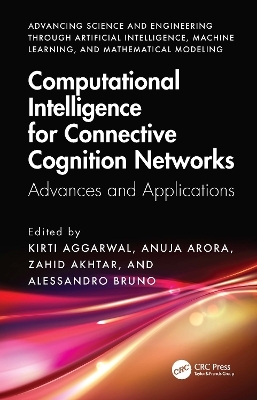
Computational Intelligence for Connective Cognition Networks
CRC Press (Verlag)
978-1-032-94234-6 (ISBN)
This book:
Covers a wide range of topics within network paradigms, including intelligence modeling, sustainability, quantum computing, and network security
Utilizes various machine learning algorithms such as neural networks, support vector machines, and decision trees for data analysis, and prediction tasks
Addresses contemporary issues like fake news detection, social media analysis, and cybersecurity
Employs network analysis techniques to understand the structure and dynamics of complex systems, including social networks, communication networks, and biological networks
Explores the integration of quantum computing principles and algorithms to solve computational intelligence tasks efficiently, especially in quantum-based network paradigms
It is primarily written for senior undergraduates, graduate students, and academic researchers in the fields including electrical engineering, electronics and communications engineering, computer engineering, and information technology.
Kirti Aggarwal is working as a Senior Assistant Professor in the Department of Computer Science & Engineering, Jaypee Institute of Information Technology, Noida, India. She received her Ph.D. degree in Computer Science & Engineering from Jaypee Institute of Technology, Noida in September 2023. She has more than 10 years of academic experience. Her research interests include Social Networking, Nature Inspired Computing, Optimization Algorithms, DBMS, Discrete Mathematics, Computer Networks, Compiler Design, and Java Programming. She has published papers in International Journal and Conferences. Anuja Arora is working as a Professor in the Computer Science & Engineering Department of Jaypee Institute of Information Technology, Noida, India. She has academic and research experience of 19 years and industry experience of 1.5 years. She received her Ph.D. degree in Computer Science from Apaji Institute of Mathematics & Applied Computer Technology, Banasthali University, Banasthali, India in December 2013. She is a Senior IEEE Member, ACM Member, SIAM Member, INSTICC, and Life Member of IAENG. She has published more than 100 research papers in peer-reviewed International journals, Book chapters, and Conferences. Three students have been awarded Ph.D. under her supervision and three are in process. Her Research Interest includes Deep Learning, Artificial Neural Network, Social Network Analysis and Mining, Sustainable Computing, Data Science, Machine Learning, Data Mining, Web Intelligence, Web Application development and Web Technologies, Software Engineering, Software Testing, and Information Retrieval Systems. Dr. Arora participated in many international conferences as an organizer, session chair, and member of national advisory and International Program Committees. She is an editorial board member of numerous IGI, Inderscience, and Bentham international journals. She is the reviewer of many reputed and peer-reviewed IEEE transactions - TKDE, TNSM, IEEE Transaction of Cybernetics, etc. She is also the reviewer of various international Journals. Zahid Akhtar received his Ph.D. in electronic and computer engineering from the University of Cagliari, Italy. He is currently an Assistant Professor at the Department of Network and Computer Security, State University of New York (SUNY) Polytechnic Institute, USA. Prior to that, he was a Research Assistant Professor with the University of Memphis, USA, and a postdoctoral fellow with the INRSEMT, University of Quebec, Canada, the University of Udine, Italy, Bahcesehir University, Turkey, and the University of Cagliari. His research interests include computer vision and machine learning with applications to cybersecurity, biometrics, affect recognition, image and video processing, and audiovisual multimedia quality assessment. Alessandro Bruno earned a Ph.D. degree in computer engineering from DINFO, Palermo University. He is now a Tenure-Track Assistant Professor with the Department of Business, Law, Economics, and Consumer Behaviour at IULM University, in Milan, Italy. Before joining IULM University, Alessandro was an Assistant Professor at Humanities University (Milano, Italy), he worked as a Lecturer in computing with the Department of Computing and Informatics, Bournemouth University in 2021 and 2022. He covered postdoc positions at NCCA (National Centre for Computer Animation) in the UK, INAF IASF (Italian National Institute for Astrophysics), University of Palermo, and IZS (Istituto Zooprofilattico Sperimentale della Sicilia). He was a Research Visitor at Mullard Space Science Laboratory (MSSL), University College London (UCL) in the imaging group led by Professor Jan-Peter Muller. He is the author of more than 50 International articles and serves as Associate Editor for International journals. Alessandro is currently the Principal Investigator of a project funded by the NGI-Search consortium named HeReFaNMi (Health-Related Fake News Mitigation). His research interests include computer vision, artificial intelligence, and image analysis. He has mostly dealt with visual attention and visual saliency, biomedical imaging, crowd behavior analysis, image and video forensics, remote sensing, and human–computer interaction.
1. Enhancing ECG Analysis Through Parametric Quartic Spline Modeling and Machine Learning Classification. 2. Quantum Networking Paradigm. 3. Genetic Algorithm-Based Framework for Optimizing Image Enhancement. 4. Machine Learning Security on Drones or UAV. 5. Image Forgery Detection. 6. The Future of Road Safety Integrating Computational Intelligence with Network Paradigms and AI Innovations. 7. Document Classification Engine to Segregate Multi-lingual PDF Documents. 8. FNDetector: Fake News Detection using Combinations of Various Features. 9. Survey of Visual Deepfake Detection Methods. 10. Empowering Educators: Leveraging Large Language Models for Lecture Preparation Material Development.
| Erscheinungsdatum | 22.10.2025 |
|---|---|
| Reihe/Serie | Advancing Science and Engineering through Artificial Intelligence, Machine Learning, and Mathematical Modeling |
| Zusatzinfo | 36 Tables, black and white; 70 Line drawings, black and white; 10 Halftones, black and white; 80 Illustrations, black and white |
| Verlagsort | London |
| Sprache | englisch |
| Maße | 156 x 234 mm |
| Gewicht | 580 g |
| Themenwelt | Mathematik / Informatik ► Informatik ► Software Entwicklung |
| Informatik ► Theorie / Studium ► Künstliche Intelligenz / Robotik | |
| Technik ► Elektrotechnik / Energietechnik | |
| ISBN-10 | 1-032-94234-7 / 1032942347 |
| ISBN-13 | 978-1-032-94234-6 / 9781032942346 |
| Zustand | Neuware |
| Informationen gemäß Produktsicherheitsverordnung (GPSR) | |
| Haben Sie eine Frage zum Produkt? |
aus dem Bereich