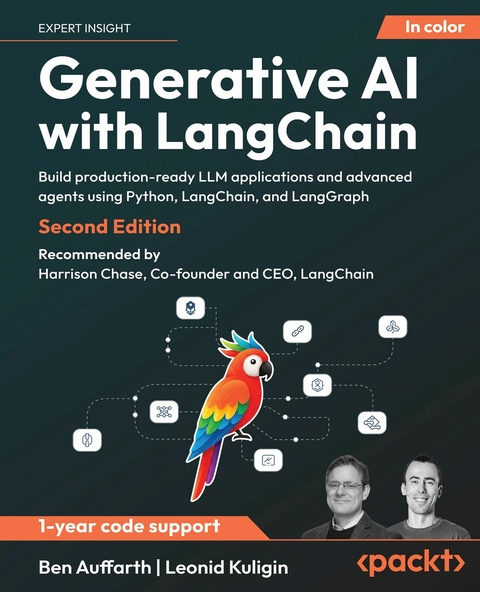
Generative AI with LangChain (eBook)
484 Seiten
Packt Publishing (Verlag)
9781837022007 (ISBN)
This second edition tackles the biggest challenge facing companies in AI today: moving from prototypes to production. Fully updated to reflect the latest developments in the LangChain ecosystem, it captures how modern AI systems are developed, deployed, and scaled in enterprise environments. This edition places a strong focus on multi-agent architectures, robust LangGraph workflows, and advanced retrieval-augmented generation (RAG) pipelines.
You'll explore design patterns for building agentic systems, with practical implementations of multi-agent setups for complex tasks. The book guides you through reasoning techniques such as Tree-of -Thoughts, structured generation, and agent handoffs-complete with error handling examples. Expanded chapters on testing, evaluation, and deployment address the demands of modern LLM applications, showing you how to design secure, compliant AI systems with built-in safeguards and responsible development principles. This edition also expands RAG coverage with guidance on hybrid search, re-ranking, and fact-checking pipelines to enhance output accuracy.
Whether you're extending existing workflows or architecting multi-agent systems from scratch, this book provides the technical depth and practical instruction needed to design LLM applications ready for success in production environments.
Go beyond foundational LangChain documentation with detailed coverage of LangGraph interfaces, design patterns for building AI agents, and scalable architectures used in production-ideal for Python developers building GenAI applicationsKey FeaturesBridge the gap between prototype and production with robust LangGraph agent architecturesApply enterprise-grade practices for testing, observability, and monitoringBuild specialized agents for software development and data analysisPurchase of the print or Kindle book includes a free PDF eBookBook DescriptionThis second edition tackles the biggest challenge facing companies in AI today: moving from prototypes to production. Fully updated to reflect the latest developments in the LangChain ecosystem, it captures how modern AI systems are developed, deployed, and scaled in enterprise environments. This edition places a strong focus on multi-agent architectures, robust LangGraph workflows, and advanced retrieval-augmented generation (RAG) pipelines. You'll explore design patterns for building agentic systems, with practical implementations of multi-agent setups for complex tasks. The book guides you through reasoning techniques such as Tree-of -Thoughts, structured generation, and agent handoffs complete with error handling examples. Expanded chapters on testing, evaluation, and deployment address the demands of modern LLM applications, showing you how to design secure, compliant AI systems with built-in safeguards and responsible development principles. This edition also expands RAG coverage with guidance on hybrid search, re-ranking, and fact-checking pipelines to enhance output accuracy. Whether you're extending existing workflows or architecting multi-agent systems from scratch, this book provides the technical depth and practical instruction needed to design LLM applications ready for success in production environments.What you will learnDesign and implement multi-agent systems using LangGraphImplement testing strategies that identify issues before deploymentDeploy observability and monitoring solutions for production environmentsBuild agentic RAG systems with re-ranking capabilitiesArchitect scalable, production-ready AI agents using LangGraph and MCPWork with the latest LLMs and providers like Google Gemini, Anthropic, Mistral, DeepSeek, and OpenAI's o3-miniDesign secure, compliant AI systems aligned with modern ethical practicesWho this book is forThis book is for developers, researchers, and anyone looking to learn more about LangChain and LangGraph. With a strong emphasis on enterprise deployment patterns, it s especially valuable for teams implementing LLM solutions at scale. While the first edition focused on individual developers, this updated edition expands its reach to support engineering teams and decision-makers working on enterprise-scale LLM strategies. A basic understanding of Python is required, and familiarity with machine learning will help you get the most out of this book.]]>
1
The Rise of Generative AI: From Language Models to Agents
The gap between experimental and production-ready agents is stark. According to LangChain’s State of Agents report, performance quality is the #1 concern among 51% of companies using agents, yet only 39.8% have implemented proper evaluation systems. Our book bridges this gap on two fronts: first, by demonstrating how LangChain and LangSmith provide robust testing and observability solutions; second, by showing how LangGraph’s state management enables complex, reliable multi-agent systems. You’ll find production-tested code patterns that leverage each tool’s strengths for enterprise-scale implementation and extend basic RAG into robust knowledge systems.
LangChain accelerates time-to-market with readily available building blocks, unified vendor APIs, and detailed tutorials. Furthermore, LangChain and LangSmith debugging and tracing functionalities simplify the analysis of complex agent behavior. Finally, LangGraph has excelled in executing its philosophy behind agentic AI – it allows a developer to give a large language model (LLM) partial control flow over the workflow (and to manage the level of how much control an LLM should have), while still making agentic workflows reliable and well-performant.
In this chapter, we’ll explore how LLMs have evolved into the foundation for agentic AI systems and how frameworks like LangChain and LangGraph transform these models into production-ready applications. We’ll also examine the modern LLM landscape, understand the limitations of raw LLMs, and introduce the core concepts of agentic applications that form the basis for the hands-on development we’ll tackle throughout this book.
In a nutshell, the following topics will be covered in this book:
- The modern LLM landscape
- From models to agentic applications
- Introducing LangChain
The modern LLM landscape
Artificial intelligence (AI) has long been a subject of fascination and research, but recent advancements in generative AI have propelled it into mainstream adoption. Unlike traditional AI systems that classify data or make predictions, generative AI can create new content—text, images, code, and more—by leveraging vast amounts of training data.
The generative AI revolution was catalyzed by the 2017 introduction of the transformer architecture, which enabled models to process text with unprecedented understanding of context and relationships. As researchers scaled these models from millions to billions of parameters, they discovered something remarkable: larger models didn’t just perform incrementally better—they exhibited entirely new emergent capabilities like few-shot learning, complex reasoning, and creative generation that weren’t explicitly programmed. Eventually, the release of ChatGPT in 2022 marked a turning point, demonstrating these capabilities to the public and sparking widespread adoption.
The landscape shifted again with the open-source revolution led by models like Llama and Mistral, democratizing access to powerful AI beyond the major tech companies. However, these advanced capabilities came with significant limitations—models couldn’t reliably use tools, reason through complex problems, or maintain context across interactions. This gap between raw model power and practical utility created the need for specialized frameworks like LangChain that transform these models from impressive text generators into functional, production-ready agents capable of solving real-world problems.
Key terminologies
Tools: External utilities or functions that AI models can use to interact with the world. Tools allow agents to perform actions like searching the web, calculating values, or accessing databases to overcome LLMs’ inherent limitations.
Memory: Systems that allow AI applications to store and retrieve information across interactions. Memory enables contextual awareness in conversations and complex workflows by tracking previous inputs, outputs, and important information.
Reinforcement learning from human feedback (RLHF): A training technique where AI models learn from direct human feedback, optimizing their performance to align with human preferences. RLHF helps create models that are more helpful, safe, and aligned with human values.
Agents: AI systems that can perceive their environment, make decisions, and take actions to accomplish goals. In LangChain, agents use LLMs to interpret tasks, choose appropriate tools, and execute multi-step processes with minimal human intervention.
| Year | Development | Key Features |
| 1990s | IBM Alignment Models | Statistical machine translation |
| 2000s | Web-scale datasets | Large-scale statistical models |
| 2009 | Statistical models dominate | Large-scale text ingestion |
| 2012 | Deep learning gains traction | Neural networks outperform statistical models |
| 2016 | Neural Machine Translation (NMT) | Seq2seq deep LSTMs replace statistical methods |
| 2017 | Transformer architecture | Self-attention revolutionizes NLP |
| 2018 | BERT and GPT-1 | Transformer-based language understanding and generation |
| 2019 | GPT-2 | Large-scale text generation, public awareness increases |
| 2020 | GPT-3 | API-based access, state-of-the-art performance |
| 2022 | ChatGPT | Mainstream adoption of LLMs |
| 2023 | Large Multimodal Models (LMMs) | AI models process text, images, and audio |
| 2024 | OpenAI o1 | Stronger reasoning capabilities |
| 2025 | DeepSeek R1 | Open-weight, large-scale AI model |
Table 1.1: A timeline of major developments in language models
The field of LLMs is rapidly evolving, with multiple models competing in terms of performance, capabilities, and accessibility. Each provider brings distinct advantages, from OpenAI’s advanced general-purpose AI to Mistral’s open-weight, high-efficiency models. Understanding the differences between these models helps practitioners make informed decisions when integrating LLMs into their applications.
Model comparison
The following points outline key factors to consider when comparing different LLMs, focusing on their accessibility, size, capabilities, and specialization:
- Open-source vs. closed-source models: Open-source models like Mistral and LLaMA provide transparency and the ability to run locally, while closed-source models like GPT-4 and Claude are accessible through APIs. Open-source LLMs can be downloaded and modified, enabling developers and...
| Erscheint lt. Verlag | 23.5.2025 |
|---|---|
| Sprache | englisch |
| Themenwelt | Informatik ► Theorie / Studium ► Künstliche Intelligenz / Robotik |
| ISBN-13 | 9781837022007 / 9781837022007 |
| Informationen gemäß Produktsicherheitsverordnung (GPSR) | |
| Haben Sie eine Frage zum Produkt? |
 EPUB (Ohne DRM)
Digital Rights Management: ohne DRM
Dieses eBook enthält kein DRM oder Kopierschutz. Eine Weitergabe an Dritte ist jedoch rechtlich nicht zulässig, weil Sie beim Kauf nur die Rechte an der persönlichen Nutzung erwerben.
Dateiformat: EPUB (Electronic Publication)
EPUB ist ein offener Standard für eBooks und eignet sich besonders zur Darstellung von Belletristik und Sachbüchern. Der Fließtext wird dynamisch an die Display- und Schriftgröße angepasst. Auch für mobile Lesegeräte ist EPUB daher gut geeignet.
Systemvoraussetzungen:
PC/Mac: Mit einem PC oder Mac können Sie dieses eBook lesen. Sie benötigen dafür die kostenlose Software Adobe Digital Editions.
eReader: Dieses eBook kann mit (fast) allen eBook-Readern gelesen werden. Mit dem amazon-Kindle ist es aber nicht kompatibel.
Smartphone/Tablet: Egal ob Apple oder Android, dieses eBook können Sie lesen. Sie benötigen dafür eine kostenlose App.
Geräteliste und zusätzliche Hinweise
Buying eBooks from abroad
For tax law reasons we can sell eBooks just within Germany and Switzerland. Regrettably we cannot fulfill eBook-orders from other countries.
aus dem Bereich