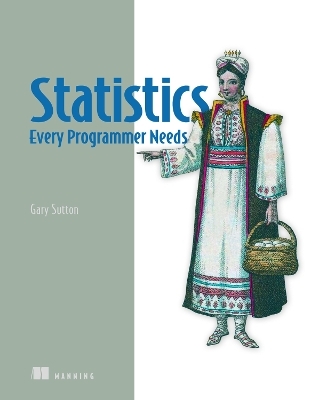
Statistics Every Programmer Needs
Manning Publications (Verlag)
978-1-63343-605-3 (ISBN)
Still trusting gut feel over data? Many professionals make decisions based on instinct rather than evidence because they lack the tools to interpret numbers with confidence. In today’s data-driven world, uncertainty and bias can easily lead to flawed conclusions. What if you could learn how to analyze data systematically and defend every decision with solid, reproducible evidence? By mastering Python-powered statistics, you can move beyond guesswork and make choices grounded in mathematical rigor and real-world insights.
Foundational techniques: Build confidence with means, variance, distributions, and hypothesis tests.
Predictive modeling: Forecast sales, prices, or risk using regression and simulation.
Decision optimization: Choose best-fit strategies under constraints and uncertainty.
Validation workflows: Spot bias, confirm assumptions, and report results with statistical rigor.
Python notebooks: Access reproducible analysis you can adapt to your own projects.
Statistics Every Programmer Needs by analytics leader Gary Sutton delivers a practical guide with copy-and-run Python code.
Each chapter introduces core theory, then jumps straight into the Python data ecosystem—pandas, NumPy, SciPy, and more. Real business scenarios, from quality control to market prediction, show exactly when and why to apply each statistical technique.
After finishing, you will analyze uncertainty systematically, communicate insights persuasively, and back every recommendation with numbers that stand up to scrutiny. Your work becomes structured, reproducible, and credible.
Ideal for analysts, managers, and self-taught developers who need reliable, decision-ready insights fast.
Gary Sutton is a business intelligence leader known for turning raw data into clear, actionable strategy. With decades guiding Fortune-level analytics teams, Gary brings an engaging, example-rich style to every page. He distills advanced statistical expertise into step-by-step Python workflows that let readers act decisively.
1 LAYING THE GROUNDWORK
2 EXPLORING PROBABILITY AND COUNTING
3 EXPLORING PROBABILITY DISTRIBUTIONS AND CONDITIONAL PROBABILITIES
4 FITTING A LINEAR REGRESSION
5 FITTING A LOGISTIC REGRESSION
6 FITTING A DECISION TREE AND A RANDOM FOREST
7 FITTING TIME SERIES MODELS
8 TRANSFORMING DATA INTO DECISIONS WITH LINEAR PROGRAMMING
9 RUNNING MONTE CARLO SIMULATIONS
10 BUILDING AND PLOTTING A DECISION TREE
11 PREDICTING FUTURE STATES WITH MARKOV ANALYSIS
12 EXAMINING AND TESTING NATURALLY OCCURRING NUMBER SEQUENCES
13 MANAGING PROJECTS
14 VISUALIZING QUALITY CONTROL
| Erscheinungsdatum | 20.08.2025 |
|---|---|
| Verlagsort | New York |
| Sprache | englisch |
| Maße | 189 x 235 mm |
| Gewicht | 812 g |
| Themenwelt | Informatik ► Datenbanken ► Data Warehouse / Data Mining |
| Mathematik / Informatik ► Informatik ► Programmiersprachen / -werkzeuge | |
| Mathematik / Informatik ► Mathematik ► Computerprogramme / Computeralgebra | |
| Mathematik / Informatik ► Mathematik ► Statistik | |
| ISBN-10 | 1-63343-605-5 / 1633436055 |
| ISBN-13 | 978-1-63343-605-3 / 9781633436053 |
| Zustand | Neuware |
| Informationen gemäß Produktsicherheitsverordnung (GPSR) | |
| Haben Sie eine Frage zum Produkt? |
aus dem Bereich