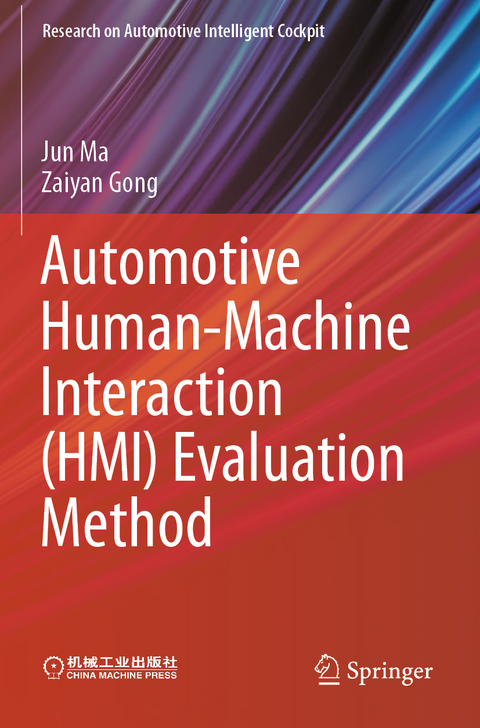
Automotive Human-Machine Interaction (HMI) Evaluation Method
Springer Verlag, Singapore
978-981-99-9953-8 (ISBN)
- Titel nicht im Sortiment
- Artikel merken
The book is divided into three parts. The first part, consisting of Chapters 1–3, introduces the evolution of automotive HMI and proposes a three-dimensional orthogonal evaluation system for automotive HMI that is comprehensive, systematic, and quantifiable. This evaluation system incorporates all evaluation items into a spatial matrix consisting of three dimensions: interaction tasks, interaction modalities, and evaluation indexes. The second part provides a comprehensive presentation and in-depth discussion of the evaluation indexes. The three rational evaluation indexes are utility, safety, and efficiency, which can be tested by the real-car driving simulator. The four emotional evaluation indexes are cognition, intelligence, value, and aesthetics. In orderto standardize the latter two subjective indexes, this book summarizes common differences in value between Chinese and European users and organizes typical aesthetic orientations in automotive UI based on art history research. The third part introduces the application of this HMI evaluation system in the automotive R&D process, including how to integrate the evaluation into a real product development process to achieve efficient product iteration.
This book is suitable for intelligent cockpit and HMI designers, engineers, and researchers. It is also used as a reference for product managers and students in the field of intelligent connected vehicles.
Dr. Jun Ma is Professor and Doctoral Supervisor of School of Automotive Studies, Tongji University, founder of HVR Lab, Double-Hired Professor and Doctoral Supervisor of College of Design & Innovation, Tongji University, and Founder and Director of Innovative Design and Entrepreneurship Faculty. He is Deputy Director of Intelligent Cabin Working Group of China SAE, Board Member of XuanYuan University and Judge of XuanYuan Award, and Founder of China Intelligent Cabin Award (CICA) with J. D. Power. Dr. Ma has about 30 years of research and industrial practice experience in automotive product R&D, human-machine interaction, and innovative design. He focused on the user experience of the automotive industry and improved the academic infrastructure by combining interdisciplinary cooperation and in-depth industrial practice. He proposed the concepts of “Human-Vehicle Relationship”, established the development process of DDP double-diamond process for intelligent vehicles, and created theC-HVR evaluation system. Dr. Jun Ma lived and worked in Germany for 15 years. He was graduated from Technical University Darmstadt in Germany, majoring in electronic engineering and automation. Dr. Zaiyan Gong is Director of HVR Lab, Tongji University, General Manager of Shanghai AMMI Intelligent Technology Co., Ltd., Associate Partner of Hofstede Insights, and board member of DUXU, HCI International. He holds a Ph.D. in Automotive Engineering from Tongji University. His current research activities focus on automotive intelligent cockpit development process across different cultures, including definition, analysis, design, and evaluation. The research covers both rational and emotional fields. For the rational part, he originally created the real-car driving simulation platform, which can test usability with objective quantitative data for any mass-produced cars in a virtual driving scenario. For the emotional part, he introduced the Hofstede 6D culture model into automotive UX definition, to show the distinctive user requirement among various target groups. He has rich experience in the automotive industry for 15 years.
Chapter 1. HMI and automotive HMI.- Chapter 2. Overview of automotive HMI test and evaluation.- Chapter 3. Automotive HMI evaluation system structure.- Chapter 4. Indexes of the automotive HMI evaluation system.- Chapter 5. Utility.- Chapter 6. Safety.- Chapter 7. Efficiency.- Chapter 8. Cognition.- Chapter 9. Intelligence.- Chapter 10. Value.- Chapter 11. Aesthetics.- Chapter 12. Application of the evaluation system in R&D process.
| Erscheinungsdatum | 22.05.2025 |
|---|---|
| Reihe/Serie | Research on Automotive Intelligent Cockpit |
| Zusatzinfo | 100 Illustrations, color; 17 Illustrations, black and white; XIV, 211 p. 117 illus., 100 illus. in color. |
| Verlagsort | Singapore |
| Sprache | englisch |
| Maße | 155 x 235 mm |
| Themenwelt | Kunst / Musik / Theater ► Design / Innenarchitektur / Mode |
| Informatik ► Software Entwicklung ► User Interfaces (HCI) | |
| Technik ► Fahrzeugbau / Schiffbau | |
| Technik ► Maschinenbau | |
| Schlagworte | Automotive HMI • Driving Simulation • Eye Tracking • Human-Machine Interaction • intelligent vehicle • Interaction Design • Interculture based design • In-vehicle infotainment system • Usability Evaluation • user interface |
| ISBN-10 | 981-99-9953-7 / 9819999537 |
| ISBN-13 | 978-981-99-9953-8 / 9789819999538 |
| Zustand | Neuware |
| Informationen gemäß Produktsicherheitsverordnung (GPSR) | |
| Haben Sie eine Frage zum Produkt? |
aus dem Bereich