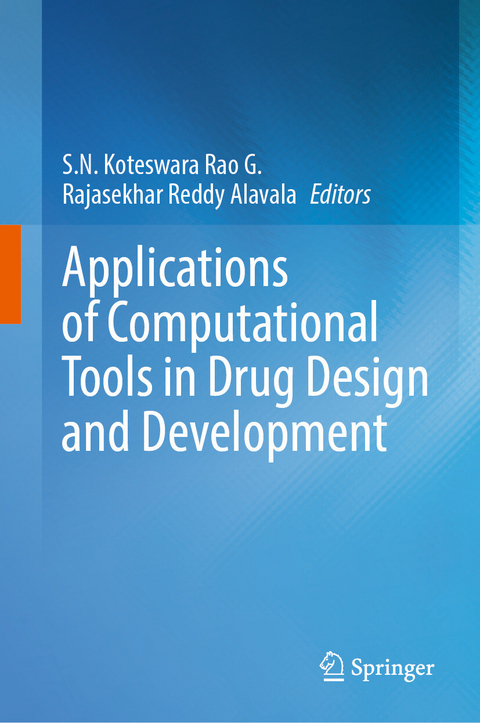
Applications of Computational Tools in Drug Design and Development (eBook)
1022 Seiten
Springer Nature Singapore (Verlag)
978-981-96-4154-3 (ISBN)
This book provides a comprehensive overview of the role of computers and computational tools at different stages of drug discovery and development. Designed to meet the needs of a beginner to advanced learner, the book provides the information on the tools, how they work, with the latest reports on applications in drug design, drug delivery and building network pharmacology models.
Part I explores the pharmacological aspects, covering computational simulation of drug delivery at the molecular level, modeling for formulation design, and the revolutionary use of computational fluid dynamics in pharmaceutical processes. Specific applications such as pharmaceutical die filling processes, inhalation aerosol-based targeted drug delivery, and the development of inhalation compounds using in silico modeling tools are discussed. The use of computational tools in cheminformatics and their application in preformulation perspectives for drug delivery are also included.
Part II expands the scope to include solubility prediction, absorption prediction, protein binding prediction, bio-permeability prediction, toxicity prediction, and metabolism prediction. It covers the identification of potential sites of metabolism in lead molecules and computer-assisted simulation studies to understand drug-polymer interactions. Recent advances in drug likeness screening using software and online tools are also reviewed.
Part III focuses on specific therapeutic areas. The chapters examine the mechanistic understanding of anti-Alzheimer's agents, the design of novel antidiabetic agents, and the exploration of drug design for atherosclerosis. It also covers modern computational intelligence-based drug repurposing for cancer therapeutics, computational analyses of the mechanism of action of antiepileptic agents, and rational approaches for designing antihypertensive agents. The final chapters explore drug discovery and computational strategies in the context of multi-drug-resistant tuberculosis and the network pharmacology approach to uncover the pharmacological mechanisms of natural products.
The book will be a useful reference for researchers, students and professionals in the field of life sciences, chemistry, pharmaceutics and bioinformatics.
This book provides a comprehensive overview of the role of computers and computational tools at different stages of drug discovery and development. Designed to meet the needs of a beginner to advanced learner, the book provides the information on the tools, how they work, with the latest reports on applications in drug design, drug delivery and building network pharmacology models. Part I explores the pharmacological aspects, covering computational simulation of drug delivery at the molecular level, modeling for formulation design, and the revolutionary use of computational fluid dynamics in pharmaceutical processes. Specific applications such as pharmaceutical die filling processes, inhalation aerosol-based targeted drug delivery, and the development of inhalation compounds using in silico modeling tools are discussed. The use of computational tools in cheminformatics and their application in preformulation perspectives for drug delivery are also included. Part II expands the scope to include solubility prediction, absorption prediction, protein binding prediction, bio-permeability prediction, toxicity prediction, and metabolism prediction. It covers the identification of potential sites of metabolism in lead molecules and computer-assisted simulation studies to understand drug-polymer interactions. Recent advances in drug likeness screening using software and online tools are also reviewed. Part III focuses on specific therapeutic areas. The chapters examine the mechanistic understanding of anti-Alzheimer's agents, the design of novel antidiabetic agents, and the exploration of drug design for atherosclerosis. It also covers modern computational intelligence-based drug repurposing for cancer therapeutics, computational analyses of the mechanism of action of antiepileptic agents, and rational approaches for designing antihypertensive agents. The final chapters explore drug discovery and computational strategies in the context of multi-drug-resistant tuberculosis and the network pharmacology approach to uncover the pharmacological mechanisms of natural products. The book will be a useful reference for researchers, students and professionals in the field of life sciences, chemistry, pharmaceutics and bioinformatics.
| Erscheint lt. Verlag | 20.5.2025 |
|---|---|
| Zusatzinfo | XVIII, 1022 p. 271 illus., 140 illus. in color. |
| Sprache | englisch |
| Themenwelt | Mathematik / Informatik ► Informatik ► Theorie / Studium |
| Medizin / Pharmazie ► Medizinische Fachgebiete ► Pharmakologie / Pharmakotherapie | |
| Medizin / Pharmazie ► Pharmazie | |
| Medizin / Pharmazie ► Studium ► 1. Studienabschnitt (Vorklinik) | |
| Naturwissenschaften ► Biologie ► Biochemie | |
| Naturwissenschaften ► Chemie ► Physikalische Chemie | |
| Schlagworte | Bioinformatics • cheminformatics • Druglikeness screening • Drug-polymer interactions • Drug repurposing • homology modeling • in silico screening • Lead identification • Molecular Docking • Molecular dynamic simulations • QSAR • Toxicity Prediction |
| ISBN-10 | 981-96-4154-3 / 9819641543 |
| ISBN-13 | 978-981-96-4154-3 / 9789819641543 |
| Informationen gemäß Produktsicherheitsverordnung (GPSR) | |
| Haben Sie eine Frage zum Produkt? |
 PDF (Wasserzeichen)
DRM: Digitales Wasserzeichen
Dieses eBook enthält ein digitales Wasserzeichen und ist damit für Sie personalisiert. Bei einer missbräuchlichen Weitergabe des eBooks an Dritte ist eine Rückverfolgung an die Quelle möglich.
Dateiformat: PDF (Portable Document Format)
Mit einem festen Seitenlayout eignet sich die PDF besonders für Fachbücher mit Spalten, Tabellen und Abbildungen. Eine PDF kann auf fast allen Geräten angezeigt werden, ist aber für kleine Displays (Smartphone, eReader) nur eingeschränkt geeignet.
Systemvoraussetzungen:
PC/Mac: Mit einem PC oder Mac können Sie dieses eBook lesen. Sie benötigen dafür einen PDF-Viewer - z.B. den Adobe Reader oder Adobe Digital Editions.
eReader: Dieses eBook kann mit (fast) allen eBook-Readern gelesen werden. Mit dem amazon-Kindle ist es aber nicht kompatibel.
Smartphone/Tablet: Egal ob Apple oder Android, dieses eBook können Sie lesen. Sie benötigen dafür einen PDF-Viewer - z.B. die kostenlose Adobe Digital Editions-App.
Buying eBooks from abroad
For tax law reasons we can sell eBooks just within Germany and Switzerland. Regrettably we cannot fulfill eBook-orders from other countries.
aus dem Bereich