


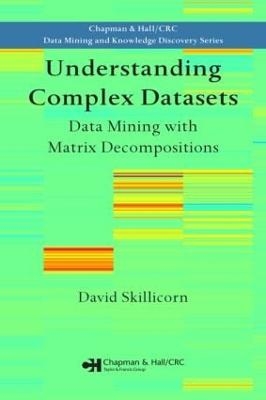
Understanding Complex Datasets
Data Mining with Matrix Decompositions
Seiten
2007
Chapman & Hall/CRC (Verlag)
978-1-58488-832-1 (ISBN)
Chapman & Hall/CRC (Verlag)
978-1-58488-832-1 (ISBN)
Focusing on data mining mechanics and applications, this book explores some of the most common matrix decompositions, including singular value, semidiscrete, independent component analysis, non-negative matrix factorization, and tensors. It also discusses several important theoretical and algorithmic problems of matrix decompositions.
Making obscure knowledge about matrix decompositions widely available, Understanding Complex Datasets: Data Mining with Matrix Decompositions discusses the most common matrix decompositions and shows how they can be used to analyze large datasets in a broad range of application areas. Without having to understand every mathematical detail, the book helps you determine which matrix is appropriate for your dataset and what the results mean.
Explaining the effectiveness of matrices as data analysis tools, the book illustrates the ability of matrix decompositions to provide more powerful analyses and to produce cleaner data than more mainstream techniques. The author explores the deep connections between matrix decompositions and structures within graphs, relating the PageRank algorithm of Google's search engine to singular value decomposition. He also covers dimensionality reduction, collaborative filtering, clustering, and spectral analysis. With numerous figures and examples, the book shows how matrix decompositions can be used to find documents on the Internet, look for deeply buried mineral deposits without drilling, explore the structure of proteins, detect suspicious emails or cell phone calls, and more.
Concentrating on data mining mechanics and applications, this resource helps you model large, complex datasets and investigate connections between standard data mining techniques and matrix decompositions.
Making obscure knowledge about matrix decompositions widely available, Understanding Complex Datasets: Data Mining with Matrix Decompositions discusses the most common matrix decompositions and shows how they can be used to analyze large datasets in a broad range of application areas. Without having to understand every mathematical detail, the book helps you determine which matrix is appropriate for your dataset and what the results mean.
Explaining the effectiveness of matrices as data analysis tools, the book illustrates the ability of matrix decompositions to provide more powerful analyses and to produce cleaner data than more mainstream techniques. The author explores the deep connections between matrix decompositions and structures within graphs, relating the PageRank algorithm of Google's search engine to singular value decomposition. He also covers dimensionality reduction, collaborative filtering, clustering, and spectral analysis. With numerous figures and examples, the book shows how matrix decompositions can be used to find documents on the Internet, look for deeply buried mineral deposits without drilling, explore the structure of proteins, detect suspicious emails or cell phone calls, and more.
Concentrating on data mining mechanics and applications, this resource helps you model large, complex datasets and investigate connections between standard data mining techniques and matrix decompositions.
Queen's University, Kingston, Ontario, Canada
Data Mining. Matrix Decompositions. Singular Value Decomposition (SVD). Graph Analysis. SemiDiscrete Decomposition (SDD). Using SVD and SDD Together. Independent Component Analysis (ICA). Non-Negative Matrix Factorization (NNMF). Tensors. Conclusion. Appendix. Bibliography. Index.
| Erscheint lt. Verlag | 1.7.2007 |
|---|---|
| Reihe/Serie | Chapman & Hall/CRC Data Mining and Knowledge Discovery Series |
| Zusatzinfo | 84 Illustrations, black and white |
| Sprache | englisch |
| Maße | 156 x 234 mm |
| Gewicht | 650 g |
| Themenwelt | Informatik ► Datenbanken ► Data Warehouse / Data Mining |
| Mathematik / Informatik ► Informatik ► Theorie / Studium | |
| ISBN-10 | 1-58488-832-6 / 1584888326 |
| ISBN-13 | 978-1-58488-832-1 / 9781584888321 |
| Zustand | Neuware |
| Informationen gemäß Produktsicherheitsverordnung (GPSR) | |
| Haben Sie eine Frage zum Produkt? |
Mehr entdecken
aus dem Bereich

aus dem Bereich
Ein verständlicher Einstieg mit Python
Buch | Softcover (2024)
O'Reilly (Verlag)
CHF 41,85
mit neuen IT-Technologien Energieeffizienz erreichen, die Umwelt …
Buch | Hardcover (2025)
Springer Fachmedien Wiesbaden (Verlag)
CHF 55,90


