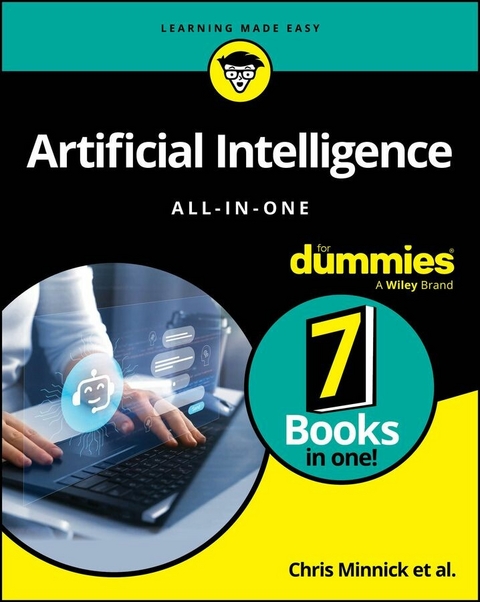
Artificial Intelligence All-in-One For Dummies (eBook)
1023 Seiten
For Dummies (Verlag)
978-1-394-34173-3 (ISBN)
A comprehensive roadmap to using AI in your career and in your life
Artificial intelligence is everywhere. Major software organizations like Microsoft, Google, and Apple have built AI directly into products and invited the world to become part of the AI revolution. And it's impossible to use these tools to their fullest potential without understanding the basics of what AI is and what it can do.
Artificial Intelligence All-in-One For Dummies compiles insight from the expert authors of AI books in the For Dummies series to provide an easy-to-follow walkthrough for anyone interested in learning how to use AI. You'll learn how to put artificial intelligence to work for you and your company in a wide variety of situations, from creating office assistants to managing projects and marketing your products.
Inside the book:
- How to prompt AI platforms like ChatGPT and Copilot while avoiding 'hallucinations' and other bugs
- Strategies for adding artificial intelligence tools to your company's existing workflows to improve efficiency and generate new opportunities
- Techniques to improve your programming capabilities with AI or create new AI-powered tools
Perfect for professionals curious about the potential and pitfalls associated with generative artificial intelligence, Artificial Intelligence All-in-One For Dummies shows you exactly how AI works and how you can apply it in your own professional and personal life.
This collection gathers the work of top authors of AI topics in the For Dummies series including Chris Minnick, author of Coding with AI For Dummies; John Paul Mueller, Luca Massaron and Stephanie Diamond, co-authors of Artificial Intelligence For Dummies, 3rd Edition; Pam Baker, author of ChatGPT For Dummies; Shiv Singh, author of Marketing with AI For Dummies; Daniel Stanton, author of Project Management with AI For Dummies; Paul Mladjenovic, author of AI Investing For Dummies; Sheryl Lindsell-Roberts, author of Business Writing with AI For Dummies; and Jeffrey Allan, co-author of Writing AI Prompts For Dummies.
A comprehensive roadmap to using AI in your career and in your life Artificial intelligence is everywhere. Major software organizations like Microsoft, Google, and Apple have built AI directly into products and invited the world to become part of the AI revolution. And it's impossible to use these tools to their fullest potential without understanding the basics of what AI is and what it can do. Artificial Intelligence All-in-One For Dummies compiles insight from the expert authors of AI books in the For Dummies series to provide an easy-to-follow walkthrough for anyone interested in learning how to use AI. You'll learn how to put artificial intelligence to work for you and your company in a wide variety of situations, from creating office assistants to managing projects and marketing your products. Inside the book: How to prompt AI platforms like ChatGPT and Copilot while avoiding hallucinations and other bugs Strategies for adding artificial intelligence tools to your company's existing workflows to improve efficiency and generate new opportunities Techniques to improve your programming capabilities with AI or create new AI-powered tools Perfect for professionals curious about the potential and pitfalls associated with generative artificial intelligence, Artificial Intelligence All-in-One For Dummies shows you exactly how AI works and how you can apply it in your own professional and personal life.
Chapter 1
Delving into What AI Means
IN THIS CHAPTER
Defining AI and its history
Using AI for practical tasks
Seeing through AI hype
Connecting AI with computer technology
Common apps, such as Google Assistant, Alexa, and Siri, have many people using artificial intelligence (AI) daily without even thinking about it. Productivity and creative apps such as ChatGPT, Synesthesia, and Gemini help us focus on the content rather than on how to get there. The media floods our entire social environment with so much information and disinformation that many people see AI as a kind of magic (which it most certainly isn’t). So, the best way to start this book is to define what AI is, what it isn’t, and how it connects to computers today.
Defining the Term AI
Before you can use a term in any meaningful way, you must have a definition for it. After all, if nobody agrees on a meaning, the term has none; it’s just a collection of characters. Defining the idiom (a term whose meaning isn’t clear from the meanings of its constituent elements) is especially important with technical terms that have received more than a little press coverage at various times and in various ways.
Saying that AI is an artificial intelligence doesn’t tell you anything meaningful, which is why people have so many discussions and disagreements over this term. Yes, you can argue that what occurs is artificial, not having come from a natural source. However, the intelligence part is, at best, ambiguous. Even if you don’t necessarily agree with the definition of AI as it appears in the sections that follow, this book uses AI according to that definition, and knowing it will help you follow the text more easily.
Discerning intelligence
People define intelligence in many different ways. However, you can say that intelligence involves certain mental activities composed of the following activities:
- Learning: Having the ability to obtain and process new information
- Reasoning: Being able to manipulate information in various ways
- Understanding: Considering the result of information manipulation
- Grasping truths: Determining the validity of the manipulated information
- Seeing relationships: Divining how validated data interacts with other data
- Considering meanings: Applying truths to particular situations in a manner consistent with their relationship
- Separating fact from belief: Determining whether the data is adequately supported by provable sources that can be demonstrated to be consistently valid
The activities list could easily grow quite long, but even this list is relatively prone to interpretation by anyone who accepts it as viable. As the list implies, however, intelligence often follows a process that a computer system can mimic as part of a simulation:
- Set a goal (the information to process and the desired output) based on needs or wants.
- Assess the value of any known information in support of the goal.
- Gather additional information that could support the goal. The emphasis here is on information that could support the goal rather than on information you know will support the goal.
- Manipulate the data such that it achieves a form consistent with existing information.
- Define the relationships and truth values between existing and new information.
- Determine whether the goal is achieved.
- Modify the goal in light of the new data and its effect on the probability of success.
- Repeat Steps 2 through 7 as needed until the goal is achieved (found true) or the possibilities for achieving it are exhausted (found false).
Even though you can create algorithms and provide access to data in support of this process within a computer, a computer’s capability to achieve intelligence is severely limited. For example, a computer is incapable of understanding anything because it relies on machine processes to manipulate data using pure math in a strictly mechanical fashion. Likewise, computers can’t easily separate truth from mistruth (as described in Chapter 2 of this book). In fact, no computer can fully implement any of the mental activities in the earlier list that describes intelligence.
As part of deciding what intelligence actually involves, categorizing intelligence is also helpful. Humans don’t use just one type of intelligence; rather, they rely on multiple intelligences to perform tasks. Howard Gardner, a Harvard psychologist, has defined a number of these types of intelligence (for details, see the article “The Theory of Multiple Intelligences” from Project Zero at Harvard University, https://pz.harvard.edu/resources/the-theory-of-multiple-intelligences). Knowing them helps you relate them to the kinds of tasks a computer can simulate as intelligence. (See Table 1-1 for a modified version of these intelligences with additional description.)
TABLE 1-1 The Kinds of Human Intelligence and How AIs Simulate Them
| Type | Simulation Potential | Human Tools | Description |
|---|
| Bodily kinesthetic | Moderate to high | Specialized equipment and real-life objects | Body movements, such as those used by a surgeon or a dancer, require precision and body awareness. Robots commonly use this kind of intelligence to perform repetitive tasks, often with higher precision than humans, but sometimes with less grace. It’s essential to differentiate between human augmentation, such as a surgical device that provides a surgeon with enhanced physical ability, and true independent movement. The former is simply a demonstration of mathematical ability in that it depends on the surgeon for input. |
| Creative | None | Artistic output, new patterns of thought, inventions, new kinds of musical composition | Creativity is the act of developing a new pattern of thought that results in unique output in the form of art, music, or writing. A truly new kind of product is the result of creativity. An AI can simulate existing patterns of thought and even combine them to create what appears to be a unique presentation but is in reality just a mathematically based version of an existing pattern. To create, an AI would need to possess self-awareness, which would require intrapersonal intelligence. |
| Interpersonal | Low to moderate | Telephone, audioconferencing, videoconferencing, writing, computer conferencing, email | Interacting with others occurs at several levels. The goal of this form of intelligence is to obtain, exchange, give, or manipulate information based on the experiences of others. Computers can answer basic questions because of keyword input, not because they understand the question. The intelligence occurs while obtaining information, locating suitable keywords, and then giving information based on those keywords. Cross-referencing terms in a lookup table and then acting on the instructions provided by the table demonstrates logical intelligence, not interpersonal intelligence. |
| Intrapersonal | None | Books, creative materials, diaries, privacy, time | Looking inward to understand one’s own interests and then setting goals based on those interests is now a human-only kind of intelligence. As machines, computers have no desires, interests, wants, or creative abilities. An AI processes numeric input using a set of algorithms and provides an output; it isn’t aware of anything it does, nor does it understand anything it does. |
| Linguistic (often divided into oral, aural, and written) | Low | Games, multimedia, books, voice recorders, spoken words | Working with words is an essential tool for communication because spoken and written information exchange is far faster than any other form. This form of intelligence includes understanding oral, aural, and written input, managing the input to develop an answer, and providing an understandable answer as output. Discerning just how capable computers are in this form of intelligence is difficult in light of AIs such as ChatGPT because it’s all too easy to create tests in which the AI produces nonsense answers. |
| Logical mathematical | High (potentially higher than humans) | Logic games, investigations, mysteries, brainteasers | Calculating results, performing comparisons, exploring patterns, and considering relationships are all areas in which computers now excel. When you see a computer defeat a human on a game show, this is the only form of intelligence you’re seeing, out of eight kinds of intelligence. Yes, you may see small bits of other kinds of intelligence, but this is the focus. Basing an assessment of human-versus-computer intelligence on just one area isn’t a good idea. |
| Naturalist | None | Identification, exploration, discovery, new tool creation | Humans rely on the ability to identify, classify, and... |
| Erscheint lt. Verlag | 15.5.2025 |
|---|---|
| Sprache | englisch |
| Themenwelt | Mathematik / Informatik ► Informatik ► Theorie / Studium |
| Schlagworte | AI for beginners • AI guide • AI handbook • Ai tutorial • artificial intelligence for beginners • Artificial Intelligence Guide • artificial intelligence handbook • artificial intelligence tutorial • generative AI • generative artificial intelligence |
| ISBN-10 | 1-394-34173-3 / 1394341733 |
| ISBN-13 | 978-1-394-34173-3 / 9781394341733 |
| Informationen gemäß Produktsicherheitsverordnung (GPSR) | |
| Haben Sie eine Frage zum Produkt? |
 EPUB (Adobe DRM)
Kopierschutz: Adobe-DRM
Adobe-DRM ist ein Kopierschutz, der das eBook vor Mißbrauch schützen soll. Dabei wird das eBook bereits beim Download auf Ihre persönliche Adobe-ID autorisiert. Lesen können Sie das eBook dann nur auf den Geräten, welche ebenfalls auf Ihre Adobe-ID registriert sind.
Details zum Adobe-DRM
Dateiformat: EPUB (Electronic Publication)
EPUB ist ein offener Standard für eBooks und eignet sich besonders zur Darstellung von Belletristik und Sachbüchern. Der Fließtext wird dynamisch an die Display- und Schriftgröße angepasst. Auch für mobile Lesegeräte ist EPUB daher gut geeignet.
Systemvoraussetzungen:
PC/Mac: Mit einem PC oder Mac können Sie dieses eBook lesen. Sie benötigen eine
eReader: Dieses eBook kann mit (fast) allen eBook-Readern gelesen werden. Mit dem amazon-Kindle ist es aber nicht kompatibel.
Smartphone/Tablet: Egal ob Apple oder Android, dieses eBook können Sie lesen. Sie benötigen eine
Geräteliste und zusätzliche Hinweise
Buying eBooks from abroad
For tax law reasons we can sell eBooks just within Germany and Switzerland. Regrettably we cannot fulfill eBook-orders from other countries.
aus dem Bereich