Smart Sensing with Digital Twins
CRC Press (Verlag)
978-1-041-13229-5 (ISBN)
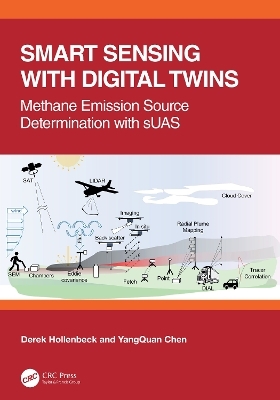
Based on the concept of smart sensing, which combines mobile sensor data with physics-based models to provide actionable and timely insights, this book presents novel methods for monitoring and quantifying methane emissions, a potent greenhouse gas, using digital twins in single and multiple sUAS-based approaches. The first part of the book examines the methane sensing problem for detecting, locating, and quantifying emission sources, with case studies highlighting key observations and lessons learned from field experiments. The second part proposes what, why, and how digital twins should be used in environmental monitoring applications, covering both basic detection principles and advanced source localization and quantification techniques. This section shows how digital twins can enhance sUAS-based source detection and smart sensing methods.
With practical tools and field-tested examples, this book serves as both an introductory guide and advanced reference to environmental monitoring and is particularly valuable to researchers, students, engineers, and environmental professionals in engineering, environmental studies, and technology.
Derek Hollenbeck earned his Ph.D. in Mechanical Engineering in 2023 at the University of California, Merced. His research interests are in digital twins, fluid mechanics, controls, fractional calculus, and cyber physical systems using small unmanned aerial systems with applications in methane leak detection and quantification. YangQuan Chen is a professor at the University of California Merced, US. His research interests include mechatronics for sustainability, digital twins, small multi-UAV, applied fractional calculus. His recent publication with CRC Press includes Fractional Calculus for Skeptics I: The Fractal Paradigm.
Section I: From Detection to Quantification: sUAS-based Methane
Sensing Techniques 1. The Methane Sensing Problem 2. Emission Source Detection 3. Emission Source Localization 4. Emission Source Quantification 5. Case Studies: LDAQ with sUAS Section II: Embedding Smartness to the Emission Source Determination Problem Solutions 6. Digital Twin Framework 7. Case Studies: Digital Twins 8. Smart Sensing, Sensor Placement, and the Observability Gramian 9. Case Studies: Smart Sensing 10. Conclusions and Best Practices
| Erscheinungsdatum | 18.10.2025 |
|---|---|
| Reihe/Serie | Fractional Order Thinking in Exploring the Frontiers of STEM |
| Zusatzinfo | 17 Tables, black and white; 71 Line drawings, black and white; 13 Halftones, black and white; 84 Illustrations, black and white |
| Verlagsort | London |
| Sprache | englisch |
| Maße | 178 x 254 mm |
| Gewicht | 570 g |
| Themenwelt | Mathematik / Informatik ► Informatik ► Theorie / Studium |
| Naturwissenschaften ► Biologie ► Ökologie / Naturschutz | |
| Technik ► Bauwesen | |
| Technik ► Elektrotechnik / Energietechnik | |
| Technik ► Umwelttechnik / Biotechnologie | |
| ISBN-10 | 1-041-13229-8 / 1041132298 |
| ISBN-13 | 978-1-041-13229-5 / 9781041132295 |
| Zustand | Neuware |
| Informationen gemäß Produktsicherheitsverordnung (GPSR) | |
| Haben Sie eine Frage zum Produkt? |
aus dem Bereich