AWS for System Administrators (eBook)
434 Seiten
Packt Publishing (Verlag)
978-1-83546-955-2 (ISBN)
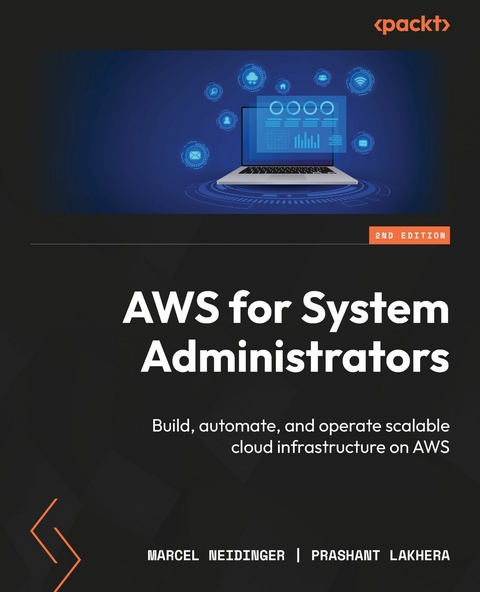
System administrators adopting AWS often struggle with automation, scalability, and multi-account management. Originally authored by Prashant Lakhera and now thoroughly updated by Senior Solutions Architect Marcel Neidinger, this second edition is your scenario-driven, hands-on guide to efficiently deploying and managing cloud infrastructure using Infrastructure as Code (IaC).
This updated edition features new topics like chaos engineering with AWS Fault Injection Simulator, multi-account CI/CD deployments, reusable IaC patterns, and cloud compliance using AWS Config and service control policies-all to help you build modern cloud architectures.
You'll set up AWS CLI, Terraform, and CDK to automate deployments, as well as explore cloud networking with VPCs, EC2, and Transit Gateway, followed by auto-scaling and load balancing strategies. The chapters highlight AWS Secrets Manager for securely storing and accessing your secrets, along with CloudWatch for monitoring and observability in the cloud. You'll implement centralized logging and develop backup and disaster recovery strategies. The book guides you through the processes and best practices for setting up a multi-account environment, with real-world scenarios for optimizing costs and ensuring high availability.
By the end of this book, you'll have the skills to efficiently deploy, manage, and optimize AWS infrastructure at scale.
Master AWS infrastructure management by leveraging automation to build scalable, efficient, and resilient cloud solutions with this practical guideKey FeaturesLearn to set up, scale, and automate AWS infrastructure using best practicesAutomate AWS deployment and maintenance using Terraform, AWS CLI, Boto3, and the AWS Cloud Development Kit (CDK)Work through real-world scenarios to optimize scalability, performance, and cost efficiencyPurchase of the print or Kindle book includes a free PDF eBookBook DescriptionSystem administrators adopting AWS often struggle with automation, scalability, and multi-account management. Originally authored by Prashant Lakhera and now thoroughly updated by Senior Solutions Architect Marcel Neidinger, this second edition is your scenario-driven, hands-on guide to efficiently deploying and managing cloud infrastructure using Infrastructure as Code (IaC). This updated edition features new topics like chaos engineering with AWS Fault Injection Simulator, multi-account CI/CD deployments, reusable IaC patterns, and cloud compliance using AWS Config and service control policies all to help you build modern cloud architectures. You ll set up AWS CLI, Terraform, and CDK to automate deployments, as well as explore cloud networking with VPCs, EC2, and Transit Gateway, followed by auto-scaling and load balancing strategies. The chapters highlight AWS Secrets Manager for securely storing and accessing your secrets, along with CloudWatch for monitoring and observability in the cloud. You ll implement centralized logging and develop backup and disaster recovery strategies. The book guides you through the processes and best practices for setting up a multi-account environment, with real-world scenarios for optimizing costs and ensuring high availability. By the end of this book, you ll have the skills to efficiently deploy, manage, and optimize AWS infrastructure at scale.What you will learnDesign and deploy networks in the cloud with VPCs and deploy instances with EC2Implement auto-scaling and load balancing to optimize application performanceDeploy relational databases with Amazon RDSSecure credentials using AWS Secrets ManagerMonitor AWS resources using CloudWatch and SNSTest infrastructure resiliency using AWS Fault Injection SimulatorAutomate backups and implement disaster recovery strategiesSet up and manage multiple AWS accounts using AWS OrganizationsWho this book is forThis book is designed for system administrators, DevOps engineers, and IT professionals who want to effectively manage and automate AWS environments. A basic understanding of cloud computing, the Linux operating system, and networking concepts is recommended.]]>
Preface
Welcome to the fascinating world of systems operations – or SysOps – in AWS. AWS for System Administrators, Second Edition is your introduction to deploying, automating, and operating workloads in AWS. Over its 17 chapters, this book introduces you to the tools and techniques required to operate workloads in the cloud.
After finishing this book, you’ll have explored the world of scalable compute, learned how to automate the deployment of relational databases, set up a multi-account organization, and much more.
Throughout the book, you’ll see hands-on examples of automating the deployment of these infrastructure components through the use of Infrastructure-as-Code tools such as Terraform or CloudFormation. You’ll get architectural guidance and explanations for the central concepts of operating workloads within AWS.
Who this book is for
This book is designed for technology professionals with some basic cloud experience who aim to understand how to automate and operate software systems and their underlying infrastructure on AWS.
Whether you are a systems administrator, DevOps engineer, or solutions architect looking into getting the most out of AWS, this book will enable you to better understand the challenges and the solutions involved when running applications on AWS.
A basic understanding of cloud concepts and services within AWS as well as some familiarity with IT tools such as Git and Terraform and a programming language such as Python is recommended. But if you don’t have these prerequisites, the book offers explanations to bring you up to speed on these concepts.
Use this book to get started on your journey to becoming a systems operator on AWS!
What this book covers
Chapter 1, Setting Up the AWS Environment, introduces you to the basics of setting up an account on AWS as well as the Infrastructure-as-Code (IaC) tools we’ll use throughout this book: Terraform, CloudFormation, and AWS Cloud Development Kit (CDK).
Chapter 2, Protecting Your AWS Account Using IAM, explains the concepts of the Identity and Access Management (IAM) service that is used throughout AWS for authentication and authorization.
Chapter 3, Creating a Data Center in the Cloud Using a VPC, covers the basic networking concepts of the virtual private cloud (VPC) – your data center in AWS.
Chapter 4, Scalable Compute Capacity in the Cloud via EC2, looks at concepts of Elastic Compute Cloud (EC2) – the AWS service to provision virtual machines within AWS.
Chapter 5, Increasing Application Fault-Tolerance and Efficiency with Elastic Load Balancing, explains how we can use Elastic Load Balancing (ELB) to route traffic between multiple instances to increase fault-tolerance and efficiency.
Chapter 6, Increasing Application Performance Using AWS Auto Scaling, covers how we can use Auto Scaling Groups in AWS to automatically scale our compute up or down.
Chapter 7, Scaling a Relational Database in the Cloud Using Amazon Relational Database Service (RDS), explains how to deploy an open source Postgres database using the Amazon Relational Database Service (RDS) and explores the concept of managed services.
Chapter 8, Managing Secrets and Encryption Keys with AWS Secrets Manager and KMS, teaches you how to handle secrets such as passwords or access tokens as well as the basic concepts of encryption in the cloud.
Chapter 9, Centralized Logging and Monitoring with Amazon CloudWatch, explains how you can use CloudWatch and SNS for centralized logging, metrics, and alerting on AWS.
Chapter 10, Centralizing Cloud Backup Solutions, explains AWS Backup and how you can use this service to implement backup plans.
Chapter 11, Disaster Recovery Options with AWS, explores the different options available to architect resilient applications on AWS. The chapter also explains the key concepts of Recovery Time Objective (RTO) and Recovery Point Objective (RPO).
Chapter 12, Testing the Resilience of Your Infrastructure and Architecture with AWS Fault Injection Service, introduces you to chaos engineering and AWS Fault Injection Service (FIS) – a service that lets you inject failures into your AWS-deployed applications to test their ability to withstand such failures when they happen in production.
Chapter 13, Deploying Infrastructure Using CI/CD Pipelines, covers the topic of automated infrastructure rollout based on IaC code that is stored in the version control system git.
Chapter 14, Building Reusable Infrastructure-as-Code Components, covers patterns and best practices when building reusable components for your teams to scale IaC usage.
Chapter 15, Ensuring Compliance Using AWS Config and SCPs, introduces two different methods, a proactive and reactive way, to block or detect the creation of infrastructure that is non-compliant with your set of rules and requirements.
Chapter 16, Operating in a Multi-Account Environment, introduces AWS Organizations as a way to set up the multiple AWS accounts usually required when operating a real-world application in the cloud.
Chapter 17, End-to-End Deployment of an Application, uses the tools, techniques, and concepts learned throughout the book to cover the end-to-end deployment of an application. From account setup to deployment pipeline and fault testing, this chapter shows how all the concepts introduced throughout this book fit together.
To get the most out of this book
To make full use of this book, you should have a working knowledge of cloud computing concepts, AWS services, and a basic understanding of computer networking concepts such as subnets, IP addresses, and CIDR ranges.
Throughout this book, we’ll use IaC tools such as CloudFormation, Terraform, and CDK to automate the creation of our infrastructure and its maintenance. A working knowledge of at least one of these tools as well as a working knowledge of the Python programming language is beneficial.
You’ll also need an AWS account to which you can test the hands-on learning parts of this book. Be advised that the examples in this book will incur a charge for the provisioned infrastructure.
An internet connection is required to interact with AWS and to download and install the required tools (see the following table).
| Software/hardware covered in the book | OS requirement |
| AWS CLI | Windows, Linux, or macOS |
| Git | Windows, Linux, or macOS |
| Visual Studio Code (or similar code editor) | Windows, Linux, or macOS |
| Docker / Docker Desktop | Windows, Linux, or macOS |
| Python | Windows, Linux, or macOS |
| Node.js | Windows, Linux, or macOS (optional) |
| Web browser | Windows, Linux, or macOS |
| Terraform | Windows, Linux, or macOS |
The required software is listed in the Technical requirements section of the applicable chapter.
Download the example code files
You can...
| Erscheint lt. Verlag | 29.5.2025 |
|---|---|
| Sprache | englisch |
| Themenwelt | Mathematik / Informatik ► Informatik |
| ISBN-10 | 1-83546-955-8 / 1835469558 |
| ISBN-13 | 978-1-83546-955-2 / 9781835469552 |
| Informationen gemäß Produktsicherheitsverordnung (GPSR) | |
| Haben Sie eine Frage zum Produkt? |
 EPUB (Ohne DRM)
Digital Rights Management: ohne DRM
Dieses eBook enthält kein DRM oder Kopierschutz. Eine Weitergabe an Dritte ist jedoch rechtlich nicht zulässig, weil Sie beim Kauf nur die Rechte an der persönlichen Nutzung erwerben.
Dateiformat: EPUB (Electronic Publication)
EPUB ist ein offener Standard für eBooks und eignet sich besonders zur Darstellung von Belletristik und Sachbüchern. Der Fließtext wird dynamisch an die Display- und Schriftgröße angepasst. Auch für mobile Lesegeräte ist EPUB daher gut geeignet.
Systemvoraussetzungen:
PC/Mac: Mit einem PC oder Mac können Sie dieses eBook lesen. Sie benötigen dafür die kostenlose Software Adobe Digital Editions.
eReader: Dieses eBook kann mit (fast) allen eBook-Readern gelesen werden. Mit dem amazon-Kindle ist es aber nicht kompatibel.
Smartphone/Tablet: Egal ob Apple oder Android, dieses eBook können Sie lesen. Sie benötigen dafür eine kostenlose App.
Geräteliste und zusätzliche Hinweise
Buying eBooks from abroad
For tax law reasons we can sell eBooks just within Germany and Switzerland. Regrettably we cannot fulfill eBook-orders from other countries.
aus dem Bereich