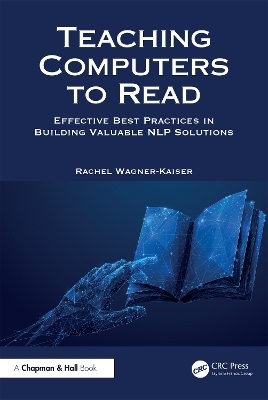
Teaching Computers to Read
Chapman & Hall/CRC (Verlag)
978-1-032-48435-8 (ISBN)
Building Natural Language Processing (NLP) solutions that deliver ongoing business value is not straightforward. This book provides clarity and guidance on how to design, develop, deploy, and maintain NLP solutions that address real-world business problems.
In this book, we discuss the main challenges and pitfalls encountered when building NLP solutions. We also outline how technical choices interact with (and are impacted by) data, tools, the business goals, and integration between human experts and the artificial intelligence (AI) solution. The best practices we cover here do not depend on cutting-edge modeling algorithms or the architectural flavor of the month. We provide practical advice for NLP solutions that are adaptable to the solution’s specific technical building blocks.
Through providing best practices across the lifecycle of NLP development, this handbook will help organizations – particularly technical teams – use critical thinking to understand how, when, and why to build NLP solutions, what the common challenges are, and how to address or avoid those challenges. These best practices help organizations deliver consistent value to their stakeholders and deliver on the promise of AI and NLP.
A code companion for the book is available here: https://github.com/TeachingComputersToRead/TC2R-CodeCompanion
Rachel Wagner-Kaiser has 15 years of experience in data and AI, entering the data science field after completing her Ph.D. in astronomy. She specializes in building natural language processing solutions for real-world problems constrained by limited or messy data. Rachel leads technical teams to design, build, deploy, and maintain NLP solutions, and her expertise has helped companies organize and decode their unstructured data to solve a variety of business problems and drive value through automation.
1. Debunking Common Myths in Natural Language Processing, 2. The Trajectory of Natural Language Processing: Classic, Modern, and Generative, 3. Large Language Models and Generative Artificial Intelligence, 4. Pre-processing and Exploratory Data Analysis for NLP, 5. Framing the Task and Data Labeling, 6. Data Curation for NLP Corpora, 7. Machine Learning Approaches for Natural Language Problems, 8. Working Across Languages in NLP, 9. Evaluating Performance of NLP Solutions, 10. Maintaining Value: Deploying and Monitoring NLP Solutions, 11. NLPOps: The Mechanics of NLP Production at Scale, 12. Ethics in Data Science and NLP, 13. Key Factors for Successful NLP Solutions
| Erscheinungsdatum | 17.10.2025 |
|---|---|
| Zusatzinfo | 5 Tables, black and white; 62 Line drawings, black and white; 5 Halftones, black and white; 67 Illustrations, black and white |
| Sprache | englisch |
| Maße | 156 x 234 mm |
| Gewicht | 440 g |
| Themenwelt | Informatik ► Datenbanken ► Data Warehouse / Data Mining |
| Informatik ► Theorie / Studium ► Künstliche Intelligenz / Robotik | |
| ISBN-10 | 1-032-48435-7 / 1032484357 |
| ISBN-13 | 978-1-032-48435-8 / 9781032484358 |
| Zustand | Neuware |
| Informationen gemäß Produktsicherheitsverordnung (GPSR) | |
| Haben Sie eine Frage zum Produkt? |
aus dem Bereich