


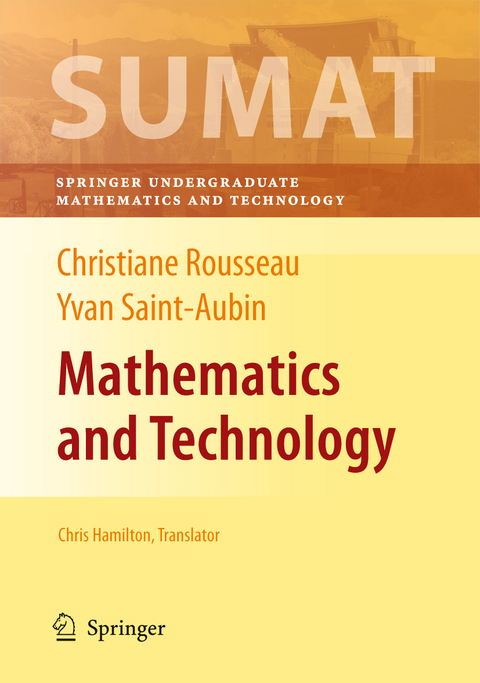
Mathematics and Technology
Seiten
2008
Springer-Verlag New York Inc.
978-0-387-69215-9 (ISBN)
Springer-Verlag New York Inc.
978-0-387-69215-9 (ISBN)
Most university courses, pressed for time and rigidly structured, o?er little opportunity to present and study actual applications and real-world examples. Since no appropriate text or manual for the course we envisioned existed, we were led to write our own course notes, from which we taught.
Of what use is mathematics? Hasn’t everything in mathematics already been disc- ered? Thesearenaturalquestionsoftenaskedbyundergraduates. Theanswersprovided by their professors are often quite brief. Most university courses, pressed for time and rigidly structured, o?er little opportunity to present and study actual applications and real-world examples. Evenmorehigh-schoolstudentsaskthesamequestionswithmoreinsistence. Tea- ers in these schools generally work under even tighter constraints than university prof- sors. If they are able to competently respond to these questions it is probably because they received good answers from their teachers and professors. And if they do not have the answers, then whose fault is it? The genesis of this text It is impossible to introduce this text without ?rst discussing the course in which it originated. The course “Mathematics and Technology” was created at the Universit´ e de Montr´ eal and taught for the ?rst time in the winter semester of 2001. It was created after observing that most courses in the department neglect to present real applications. Sinceitscreationthecoursehasbeenopentobothundergraduatemathematicsstudents and future high-school teachers. Since no appropriate text or manual for the course we envisioned existed, we were led to write our own course notes, from which we taught. We got so caught up in writing these notes that they quickly grew to the size of a textbook, containing much more material than could possibly be taught in one semester. Despite the two of us being career mathematicians, we must admit that we both knew little or nothing about most of the applications presented in the following chapters.
Of what use is mathematics? Hasn’t everything in mathematics already been disc- ered? Thesearenaturalquestionsoftenaskedbyundergraduates. Theanswersprovided by their professors are often quite brief. Most university courses, pressed for time and rigidly structured, o?er little opportunity to present and study actual applications and real-world examples. Evenmorehigh-schoolstudentsaskthesamequestionswithmoreinsistence. Tea- ers in these schools generally work under even tighter constraints than university prof- sors. If they are able to competently respond to these questions it is probably because they received good answers from their teachers and professors. And if they do not have the answers, then whose fault is it? The genesis of this text It is impossible to introduce this text without ?rst discussing the course in which it originated. The course “Mathematics and Technology” was created at the Universit´ e de Montr´ eal and taught for the ?rst time in the winter semester of 2001. It was created after observing that most courses in the department neglect to present real applications. Sinceitscreationthecoursehasbeenopentobothundergraduatemathematicsstudents and future high-school teachers. Since no appropriate text or manual for the course we envisioned existed, we were led to write our own course notes, from which we taught. We got so caught up in writing these notes that they quickly grew to the size of a textbook, containing much more material than could possibly be taught in one semester. Despite the two of us being career mathematicians, we must admit that we both knew little or nothing about most of the applications presented in the following chapters.
Positioning on Earth and in Space.- Friezes and Mosaics.- Robotic Motion.- Skeletons and Gamma Ray Radiosurgery.- Savings and Loans.- Error Correcting Codes.- Public Key Cryptography.- Random Number Generators.- Google and the Page Rank Algorithm.- Why 44100 Samples per Second.- Image Compression Iterated Function Systems.- Image Compression The JPEG Standard.- The DNA Computer.- Calculus of Variations.- Science Flashes.
| Reihe/Serie | Springer Undergraduate Texts in Mathematics and Technology |
|---|---|
| Co-Autor | Hélène Antaya, Isabelle Ascah-Coallier |
| Übersetzer | Chris Hamilton |
| Zusatzinfo | XV, 580 p. |
| Verlagsort | New York, NY |
| Sprache | englisch |
| Maße | 178 x 235 mm |
| Themenwelt | Mathematik / Informatik ► Mathematik ► Angewandte Mathematik |
| Mathematik / Informatik ► Mathematik ► Wahrscheinlichkeit / Kombinatorik | |
| ISBN-10 | 0-387-69215-0 / 0387692150 |
| ISBN-13 | 978-0-387-69215-9 / 9780387692159 |
| Zustand | Neuware |
| Informationen gemäß Produktsicherheitsverordnung (GPSR) | |
| Haben Sie eine Frage zum Produkt? |
Mehr entdecken
aus dem Bereich
aus dem Bereich
Buch | Softcover (2025)
Springer Vieweg (Verlag)
CHF 62,95
Buch | Softcover (2025)
Springer Fachmedien Wiesbaden (Verlag)
CHF 69,95
Buch | Softcover (2024)
Springer Vieweg (Verlag)
CHF 53,15


