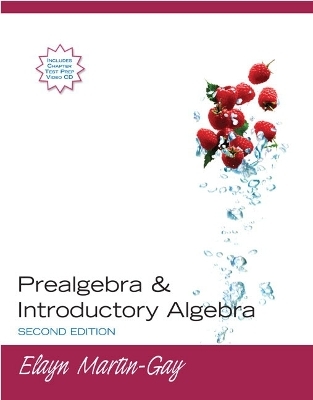
Prealgebra & Introductory Algebra
Pearson
978-0-13-157705-3 (ISBN)
- Titel erscheint in neuer Auflage
- Artikel merken
Prealgebra and Introductory Algebra 2e is appropriate for a 2-sem sequence of Prealgebra (Basic Math with very early introduction to algebra) and Introductory Algebra (aka Elementary Algebra). This text was written to help students effectively make the transition from arithmetic to algebra and provide a strong foundation for success in their next, intermediate algebra course. To reach this goal, Martin-Gay introduces algebraic concepts early and repeats them as she treats traditional arithmetic topics, and then further develops their exposure to elementary-level algebra topics.
The material from this text is also available split out into two separate textbooks, Prealgebra 5e and Introductory Algebra 3e, if you prefer to use split textbooks, rather than one combined textbook for your 2-sem sequence.
Elayn Martin-Gay, University of New Orleans An award-winning instructor and best-selling author, Elayn Martin-Gay has taught mathematics at the University of New Orleans for more than 25 years. Her numerous teaching awards include the local University Alumni Association’s Award for Excellence in Teaching, and Outstanding Developmental Educator at University of New Orleans, presented by the Louisiana Association of Developmental Educators. In addition to this 2nd Edition of Prealgebra and Introductory Algebra, Elayn also authors Prealgebra 5e and the recently published ©2007 Worktext Series: Basic College Mathematics 3e, Introductory Algebra 3e, Intermediate Algebra 3e, and Algebra A Combined Approach 3e and two new first editions worktexts, Basic College Mathematics with Early Integers, and Developmental Mathematics. Elayn Martin-Gay also authors a best-selling ©2005 Hardback Series: Beginning Algebra 4e, Intermediate Algebra 4e, Intermediate Algebra: A Graphing Approach 3e, and Beginning and Intermediate Algebra 3e. Prior to writing textbooks, Elayn developed an acclaimed series of lecture videos to support developmental mathematics students in their quest for success. These highly successful videos originally served as the foundation material for her texts. Today, the videos are specific to each book in the Martin-Gay series. Elayn also originated the Chapter Test Prep Video CD to help students as they prepare for a test - their most “teachable moment!” Elayn’s experience has made her aware of how busy instructors are and what a difference quality support makes. For this reason, she created the Instructor-to-Instructor video series. These videos provide instructors with suggestions for presenting specific math topics and concepts in basic mathematics, prealgebra, beginning algebra, and intermediate algebra. Seasoned instructors can use them as a source for alternate approaches in the classroom. New or adjunct faculty may find the CDs useful for review. Her textbooks and acclaimed video program support Elayn's passion of helping every student to succeed.
Chapter 1 — Whole Numbers and Introduction to Algebra 1.1 Tips for Success in Mathematics
1.2 Place Value and Names for Numbers
1.3 Adding and Subtracting Whole Numbers and Perimeter
1.4 Rounding and Estimating
1.5 Multiplying Whole Numbers and Area
1.6 Dividing Whole Numbers
Integrated Review — Operations on Whole Numbers
1.7 Exponents and Order of Operations
1.8 Introduction to Variables, Algebraic Expressions and Equations
Chapter 2 — Integers and Introduction to Solving Equations
2.1 Introduction to Integers
2.2 Adding Integers
2.3 Subtracting Integers
2.4 Multiplying and Dividing Integers
Integrated Review - Integers
2.5 Order of Operations
2.6 Solving Equations: The Addition and Multiplication Properties
Chapter 3 — Solving Equations and Problem Solving
3.1 Simplifying Algebraic Expressions
3.2 Solving Equations: Review of the Addition and Multiplication Properties
Integrated Review — Expressions and Equations
3.3 Solving Linear equations in One Variable
3.4 Linear Equations in One Variable and Problem Solving
Chapter 4 — Fractions
4.1 Introduction to Fractions and Equivalent Fractions
4.2 Factors and Lowest Terms
4.3 Multiplying and Dividing Fractions
4.4 Adding and Subtracting Like Fractions and Least Common Denominator
4.5 Adding and Subtracting Fractions with Unlike Denominators
Integrated Review — Summary on Fractions and Operations on Fractions
4.6 Complex Fractions and Review of Order of Operations
4.7 Operations on Mixed Numbers
4.8 Solving Equations Containing Fractions
Chapter 5 — Decimals
5.1 Introduction to Decimals
5.2 Adding and Subtracting Decimals
5.3 Multiplying Decimals and Circumference of a Circle
5.4 Dividing Decimals
Integrated Review — Operations on Decimals
5.5 Fractions, Decimals, and Order of Operations
5.6 Equations Containing Decimals
5.7 Decimal Applications: Mean, Median, and Mode
Chapter 6 — Percent
6.1 Ratio and Proportion
6.2 Percents, Decimals, and Fractions
6.3 Solving Percent Problems with Equations
6.4 Solving Percent Problems with Proportions
Integrated Review — Ratio, Proportion, and Percent
6.5 Applications of Percent
6.6 Percent and Problem Solving: Sales Tax, Commission, and Discount
6.7 Percent and Problem Solving: Interest
Chapter 7 — Graphs and Triangle Applications
7.1 Reading Pictographs, Bar Graphs, Histograms and Line Graphs
7.2 Reading Circle Graphs
Integrated Review — Reading Graphs
7.3 Square Roots and the Pythagorean Theorem
7.4 Congruent and Similar Triangles
7.5 Counting and Introduction to Probability
Chapter 8 — Geometry and Measurement
8.1 Lines and Angles
8.2 Perimeter
8.3 Area and Volume, and Surface Area
Integrated Review — Geometry Concepts
8.4 Linear Measurement
8.5 Weight and Mass
8.6 Capacity
8.7 Temperature and Conversions Between the U.S. and Metric Systems
Chapter 9 Equations, Inequalities, and Problem Solving
9.1 Symbols and Sets of Numbers
9.2 Properties of Real Numbers
9.3 Further Solving Linear Equations
Integrated Review — Real Numbers and Solving Linear Equations
9.4 Further Problem Solving
9.5 Formulas and Problem Solving
9.6 Linear Inequalities and Problem Solving
Chapter 10 Exponents and Polynomials
10.1 Exponents
10.2 Negative Exponents and Scientific Notation
10.3 Introduction to Polynomials
10.4 Adding and Subtracting Polynomials
10.5 Multiplying Polynomials
10.6 Special Products
Integrated Review — Exponents and Operations on Polynomials
10.7 Dividing Polynomials
Chapter 11 Factoring Polynomials
11.1 The greatest Common Factor
11.2 Factoring Trinomials of the Form x2 + bx + c
11.3 Factoring Trinomials of the Form ax2 + bx + c
11.4 Factoring Trinomials by Grouping
11.5 Factoring By Special Products
Integrated Review — Choosing a Factoring Strategy
11.6 Solving Quadratic Equations by Factoring
11.7 Quadratic Equations and Problem Solving
Chapter 12 Rational Expressions
12.1 Simplifying Rational Expressions
12.2 Multiplying and Dividing Rational Expressions
12.3 Adding and Subtracting Rational Expressions with the Same Denominator and Least Common Denominator
12.4 Adding and Subtracting Rational Expressions with Different Denominators
12.5 Solving Equations Containing Rational Expressions
Integrated Review — Summary on Rational Expressions
12.6 Rational Equations and Problem Solving
12.7 Simplifying Complex Fractions
Chapter 13 Graphing Equations and Inequalities
13.1 The Rectangular Coordinate System
13.2 Graphing Linear Equations
13.3 Intercepts
13.4 Slope and Rate of Change
13.5 Equations of Lines
Integrated Review — Summary on Linear Equations
13.6 Introduction to Functions
13.7 Graphing Linear Inequalities in two Variables
13.8 Direct and Inverse Variation
Chapter 14 Systems of Equations
14.1 Solving systems of Linear Equations by Graphing
14.2 Solving Systems of Linear Equations by Substitution
14.3 Solving Systems of Linear Equations by Addition
Integrated Review — Systems of Linear Equations
14.4 Systems of Linear Equations and Problem Solving
Chapter 15 Roots and Radicals
15.1 Introduction to Radicals
15.2 Simplifying Radicals
15.3 Adding and Subtracting Radicals
15.4 Multiplying and Dividing Radicals
Integrated Review — Simplifying Radicals
15.5 Solving Equations Containing Radicals
15.6 Radical Equations and Problem Solving
Chapter 16 Quadratic Equations
16.1 Solving Quadratic Equations by the Square Root Property
16.2 Solving Quadratic Equations by Completing the Square
16.3 Solving Quadratic Equations by the Quadratic Formula
Integrated Review — Summary of Solving Quadratic Equations
16.4 Graphing Quadratic Equations in Two Variables
Appendices
Appendix A: Tables (1. Geometric Figures 2. Percents, Decimals, and Fraction Equivalents 3. Finding Common Percents of a Number 4. Squares and Square Roots)
Appendix B: The Bigger Picture
Appendix C: Factoring Sums and Differences of Cubes
Appendix D: Systems of Linear Inequalities
| Erscheint lt. Verlag | 23.2.2007 |
|---|---|
| Sprache | englisch |
| Maße | 216 x 276 mm |
| Gewicht | 2420 g |
| Themenwelt | Mathematik / Informatik ► Mathematik ► Algebra |
| ISBN-10 | 0-13-157705-0 / 0131577050 |
| ISBN-13 | 978-0-13-157705-3 / 9780131577053 |
| Zustand | Neuware |
| Informationen gemäß Produktsicherheitsverordnung (GPSR) | |
| Haben Sie eine Frage zum Produkt? |
aus dem Bereich