


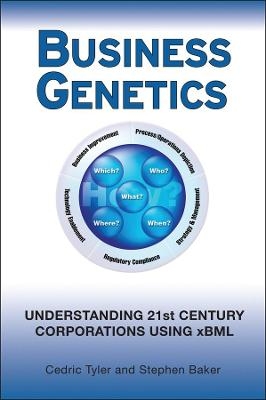
Business Genetics
John Wiley & Sons Inc (Verlag)
978-0-470-06654-6 (ISBN)
A revolutionary way to describe business, xBML (extended Business Modelling Language) is an intuitive graphical language that unlocks the DNA of a corporation using a system of diagrams based on five Ws (Who; What; Which; Where; When). xBML gives companies an complete and accurate map of their enterprise, that can then be re-used repeatedly to describe, plan and create improvement. It’s time to throw out the flow charts. xBML breaks down the silos of an enterprise and provides the means for clear, concise communication between all members of the organization. Tyler and Baker provide a complete guide to xBML, and to why unlocking an organization’s Business Genetics will lead to quantifiable business improvement.
Cedric G. Tyler is President of BusinessGenetics®, principle inventor of the xBML™ methodology, and a leading expert in the fields of Business Modeling, Business Process and Information Technology. He began his career with IBM in the UK and subsequently cofounded INFOMET and Infolab, two international companies specializing in the business-to-information technology interface which were acquired by IBM in the 1990’s. He has advised many leading organizations in the private and public sectors and served as an adjunct professor at the Daniels College of Business at Denver University. Steve Baker is CEO of BusinessGenetics® and has over twenty-five years of experience in the IT, Healthcare, and Real Estate industries. He has held management positions in Fortune organizations including Digital Equipment Corporation (DEC) and Science Applications International Corporation (SAIC). For the past decade he has focused on improving the communication within and among businesses as well as improving their operational efficiencies. He sits on the boards of several private and nonprofit corporations, and has been an Adjunct Professor at the Daniels School of Business.
Acknowledgements ix
Preface xi
1 What’s the issue and why should I care? 1
2 Why are tools to understand business so inadequate? 5
2.1 How did we get here? 8
2.2 Business definition à la 20th century 13
2.3 But we have had some (limited) success 21
3 OK (enough already), so What must be done? 25
3.1 Purpose-based thinking 33
3.2 How we answer the W5 questions 35
4 What do genetic business models (xBML) look like? 39
W1: the What dimension 49
W2: the Who dimension 54
W3: the Where dimension 57
W4: the Which dimension 61
W5: the When model 66
W5I (integrated): the How model 69
5 How do we (quickly) create xBML models (aka Business Co-FormulationTM) 81
6 The ‘So what’ (where’s my darn ROI?) 97
6.1 Some quantifiable types of business gain 102
6.2 Some more very real but less quantifiable types of business gain 116
7 How do I implement this? 131
7.1 Enterprise deployment? 131
7.2 But how do I implement or manage my xBML projects? 136
8 What about BPM (Business Process Management)? 141
9 What the heck is the difference between BPEL, BPMN, UML, IDEF and xBML? 149
9.1 BPEL 150
9.2 BPMN 154
9.3 UML 159
9.4 IDEF 166
9.5 xBML 167
10 Based on (anticipated) popular demand, more on auto-business requirements generation 173
11 COTS (commercial off-the-shelf) software selection 181
12 An added big, big takeaway 185
13 A quick last summary 191
Appendices 195
Appendix A: xBML example – Fill ‘a vacant job position’ 195
Appendix B: Potential knowledge sources 201
Appendix C: Some government laws governing commerce 202
Appendix D: Sample enterprise deployment what model 209
Appendix E: BRD 211
Appendix F: Can xBML be automated? 216
Glossary 221
Bibliography 235
Index 237
| Erscheint lt. Verlag | 1.6.2007 |
|---|---|
| Verlagsort | New York |
| Sprache | englisch |
| Maße | 162 x 237 mm |
| Gewicht | 510 g |
| Einbandart | gebunden |
| Themenwelt | Mathematik / Informatik ► Mathematik ► Finanz- / Wirtschaftsmathematik |
| Wirtschaft ► Betriebswirtschaft / Management | |
| ISBN-10 | 0-470-06654-7 / 0470066547 |
| ISBN-13 | 978-0-470-06654-6 / 9780470066546 |
| Zustand | Neuware |
| Informationen gemäß Produktsicherheitsverordnung (GPSR) | |
| Haben Sie eine Frage zum Produkt? |
aus dem Bereich


