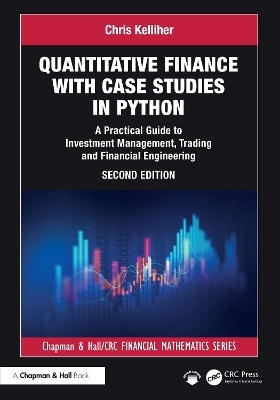
Quantitative Finance with Case Studies in Python
Chapman & Hall/CRC (Verlag)
978-1-032-86800-4 (ISBN)
This new edition includes brand new material on data science and AI concepts, including large language models, as well as updated content to reflect the transition from Libor to SOFR to bring the text right up to date. It also includes expanded material on inflation and mortgage-backed securitie, more trade ideas embedded in each chapter and also via a dedicated chapter analyzing a set of derivatives trades. There are additional examples throughout based on recent market dynamics, including the post-Covid inflation shock and its impact on risk parity strategies.
Overall, the new edition is designed to be even more of a practical tool than the first edition, and more firmly rooted in real-world data, applications, and examples.
Features
Useful as both a teaching resource and as a practical tool for professional investors
Ideal textbook for first year graduate students in quantitative finance programs, such as those in master’s programs in Mathematical Finance, Quant Finance or Financial Engineering
Includes a perspective on the future of quant finance techniques, and in particular covers concepts of Machine Learning and Artificial Intelligence
Free-to-access repository with Python codes available at www.routledge.com/ 9781032014432 and on https://github.com/lingyixu/Quant-Finance-With-Python-Code.[CK1]
Chris Kelliher is a multi-asset portfolio manager and senior quantitative researcher with over 20 years of investment experience at asset management firms and hedge funds. In addition, Mr. Kelliher is an adjunct professor in the Master's in Mathematical Finance and Financial Technology program at Boston University’s Questrom School of Business where he has also held the role of Executive Director. In these roles, he has taught graduate-level courses on computational methods in finance, fixed income, credit risk and programming for quant finance. He is also the author of "Quantitative Finance with Python: A Practical Guide to Investment Management, Trading and Financial Engineering" and was named among the top 20 US Finance Professors in 2024 by Rebellion Research. Mr. Kelliher earned a BA in economics from Gordon College, where he graduated Cum Laude with departmental honours and an MS in mathematical finance from New York University’s Courant Institute.
Foreword Contributors Acknowledgments Section I Foundations of Quant Modeling Chapter 1 Setting the Stage: Quant Landscape Chapter 2 Setting the Stage: Landscape of Financial Instruments Chapter 3 Theoretical Underpinnings of Quant Modeling: Modeling the Risk Neutral Measure Chapter 4 Theoretical Underpinnings of Quant Modeling: Modeling the Physical Measure Section II Fundamentals of Coding and Data Analysis Chapter 5 Python Programming Environment Chapter 6 Programming Concepts in Python Chapter 7 Working with Financial Datasets Chapter 8 Data Science Techniques in Finance Chapter 9 Model Validation Section III Options Modeling Chapter 10 Stochastic Models Chapter 11 Options Pricing Techniques for European Options Chapter 12 Options Pricing Techniques for Exotic Options Chapter 13 Greeks and Options Trading Chapter 14 Extraction of Risk Neutral Densities Section IV Quant Modeling in Different Markets Chapter 15 Interest Rate Markets Chapter 16 Credit Markets Chapter 17 Foreign Exchange Markets Chapter 18 Equity & Commodity Market Section V Portfolio Construction & Risk Management Chapter 19 Portfolio Construction & Optimization Techniques Chapter 20 Modeling Expected Returns and Covariance Matrices Chapter 21 Risk Management Chapter 22 Quantitative Trading Models Chapter 23 Artificial Intelligence: Incorporating Machine Learning Techniques Chapter 24 Artificial Intelligence: Incorporating Deep Learning, Large Language Models and Working with Unstructured Data Bibliography Index
| Erscheinungsdatum | 17.12.2025 |
|---|---|
| Reihe/Serie | Chapman and Hall/CRC Financial Mathematics Series |
| Sprache | englisch |
| Maße | 178 x 254 mm |
| Gewicht | 1580 g |
| Themenwelt | Mathematik / Informatik ► Informatik ► Programmiersprachen / -werkzeuge |
| Mathematik / Informatik ► Informatik ► Theorie / Studium | |
| Mathematik / Informatik ► Mathematik ► Angewandte Mathematik | |
| ISBN-10 | 1-032-86800-7 / 1032868007 |
| ISBN-13 | 978-1-032-86800-4 / 9781032868004 |
| Zustand | Neuware |
| Informationen gemäß Produktsicherheitsverordnung (GPSR) | |
| Haben Sie eine Frage zum Produkt? |
aus dem Bereich