


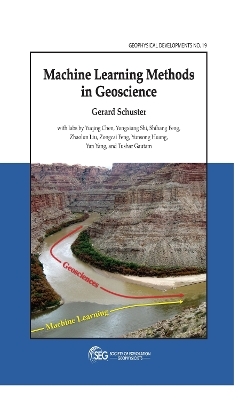
Machine Learning Methods in Geoscience
Seiten
2024
Society of Exploration Geophysicists (Verlag)
978-1-56080-403-1 (ISBN)
Society of Exploration Geophysicists (Verlag)
978-1-56080-403-1 (ISBN)
Discover how machine learning transforms geoscience challenges by employing neural networks, fuzzy clustering, Bayesian inversion, and PCA. The text demystifies methods used on seismic, geochemical, and earthquake data, pairing mathematical fundamentals with hands-on MATLAB exercises that highlight real-world applications.
This book presents the theory of machine learning (ML) algorithms and their applications to geoscience problems. Geoscience problems include traveltime picking of seismograms by a fuzzy cluster method; migration and inversion of seismic data by neural network (NN) methods; geochemical analysis and dating of rock samples by Gaussian discriminant analysis; convolutional neural network (CNN) picking of faults, cracks, and bird types in images; Bayesian inversion of seismic data; clustering of earthquake data and semblance plots; principal component analysis of seismic data and geochemical records; filtering of seismic sections; seismic interpolation by an NN; transformer analysis of seismic data; and recurrent NN deconvolution of a seismic trace. More than half of the described algorithms fall under the class of neural network methods. Their description is at a level that can be understood by anyone with a modest background in linear algebra, calculus, and probability. An elementary working knowledge of MATLAB is useful and almost every chapter is accompanied by lab exercises to reinforce the ML principles.
This book presents the theory of machine learning (ML) algorithms and their applications to geoscience problems. Geoscience problems include traveltime picking of seismograms by a fuzzy cluster method; migration and inversion of seismic data by neural network (NN) methods; geochemical analysis and dating of rock samples by Gaussian discriminant analysis; convolutional neural network (CNN) picking of faults, cracks, and bird types in images; Bayesian inversion of seismic data; clustering of earthquake data and semblance plots; principal component analysis of seismic data and geochemical records; filtering of seismic sections; seismic interpolation by an NN; transformer analysis of seismic data; and recurrent NN deconvolution of a seismic trace. More than half of the described algorithms fall under the class of neural network methods. Their description is at a level that can be understood by anyone with a modest background in linear algebra, calculus, and probability. An elementary working knowledge of MATLAB is useful and almost every chapter is accompanied by lab exercises to reinforce the ML principles.
| Erscheinungsdatum | 28.05.2025 |
|---|---|
| Verlagsort | Tulsa |
| Sprache | englisch |
| Maße | 216 x 279 mm |
| Themenwelt | Informatik ► Theorie / Studium ► Künstliche Intelligenz / Robotik |
| Naturwissenschaften ► Geowissenschaften ► Geografie / Kartografie | |
| Naturwissenschaften ► Geowissenschaften ► Geophysik | |
| ISBN-10 | 1-56080-403-3 / 1560804033 |
| ISBN-13 | 978-1-56080-403-1 / 9781560804031 |
| Zustand | Neuware |
| Informationen gemäß Produktsicherheitsverordnung (GPSR) | |
| Haben Sie eine Frage zum Produkt? |
Mehr entdecken
aus dem Bereich



aus dem Bereich
Eine praxisorientierte Einführung
Buch | Softcover (2025)
Springer Vieweg (Verlag)
CHF 53,15
Buch | Softcover (2025)
Reclam, Philipp (Verlag)
CHF 11,20
Eine kurze Geschichte der Informationsnetzwerke von der Steinzeit bis …
Buch | Hardcover (2024)
Penguin (Verlag)
CHF 39,95


