


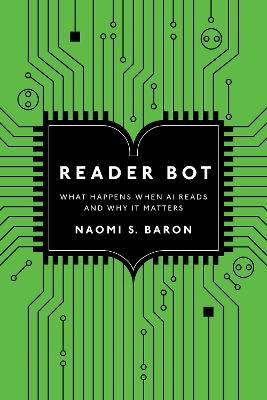
Reader Bot
What Happens When AI Reads and Why It Matters
Seiten
2026
|
New edition
Stanford University Press (Verlag)
978-1-5036-4394-9 (ISBN)
Stanford University Press (Verlag)
978-1-5036-4394-9 (ISBN)
- Noch nicht erschienen (ca. Januar 2026)
- Portofrei ab CHF 40
- Auch auf Rechnung
- Artikel merken
What happens to human reading when AI bots can do it for us?
Explosive developments in artificial intelligence have awed everyday users with the technology's ability to draw, do computer coding, and especially to write. Those AI-generated essays and poems, legal briefs and responses to requests for information are all visible evidence of large language models at work. What we don't see is the critical prior step: before it can write, AI needs to read.
While AI's written outcomes are remarkably similar to what a diligent student, lawyer, or researcher might produce, AI doesn't read the way that humans do. Now that AI is proving an adept reader, what happens to our own reading skills and motivations—especially at a time when both voluntary and school reading are increasingly on the decline? We have learned that when we let chatbots write for us, there are pros and cons to handing over our virtual pens. It's critical that we also think through the consequences of relinquishing reading—a deeply human activity—to bots.
What do we stand to gain and lose when we let AI read for us? Tracing the intersecting trajectories of AI and reading, Reader Bot tackles this vital question, revealing why we must be thoughtful about how we welcome AI-as-reader into our lives.
Explosive developments in artificial intelligence have awed everyday users with the technology's ability to draw, do computer coding, and especially to write. Those AI-generated essays and poems, legal briefs and responses to requests for information are all visible evidence of large language models at work. What we don't see is the critical prior step: before it can write, AI needs to read.
While AI's written outcomes are remarkably similar to what a diligent student, lawyer, or researcher might produce, AI doesn't read the way that humans do. Now that AI is proving an adept reader, what happens to our own reading skills and motivations—especially at a time when both voluntary and school reading are increasingly on the decline? We have learned that when we let chatbots write for us, there are pros and cons to handing over our virtual pens. It's critical that we also think through the consequences of relinquishing reading—a deeply human activity—to bots.
What do we stand to gain and lose when we let AI read for us? Tracing the intersecting trajectories of AI and reading, Reader Bot tackles this vital question, revealing why we must be thoughtful about how we welcome AI-as-reader into our lives.
Naomi S. Baron is Professor Emerita of Linguistics at American University. Her most recent books include How We Read Now: Strategic Choices for Print, Screen, and Audio (2021) and Who Wrote This? How AI and the Lure of Efficiency Threaten Human Writing (Stanford, 2023).
| Erscheint lt. Verlag | 20.1.2026 |
|---|---|
| Verlagsort | Palo Alto |
| Sprache | englisch |
| Maße | 152 x 229 mm |
| Themenwelt | Geisteswissenschaften ► Sprach- / Literaturwissenschaft ► Anglistik / Amerikanistik |
| Geisteswissenschaften ► Sprach- / Literaturwissenschaft ► Literaturwissenschaft | |
| Geisteswissenschaften ► Sprach- / Literaturwissenschaft ► Sprachwissenschaft | |
| Informatik ► Theorie / Studium ► Künstliche Intelligenz / Robotik | |
| ISBN-10 | 1-5036-4394-8 / 1503643948 |
| ISBN-13 | 978-1-5036-4394-9 / 9781503643949 |
| Zustand | Neuware |
| Informationen gemäß Produktsicherheitsverordnung (GPSR) | |
| Haben Sie eine Frage zum Produkt? |
Mehr entdecken
aus dem Bereich


aus dem Bereich
Eine praxisorientierte Einführung
Buch | Softcover (2025)
Springer Vieweg (Verlag)
CHF 53,15
Künstliche Intelligenz, Macht und das größte Dilemma des 21. …
Buch | Softcover (2025)
C.H.Beck (Verlag)
CHF 25,20
Buch | Softcover (2025)
Reclam, Philipp (Verlag)
CHF 11,20


