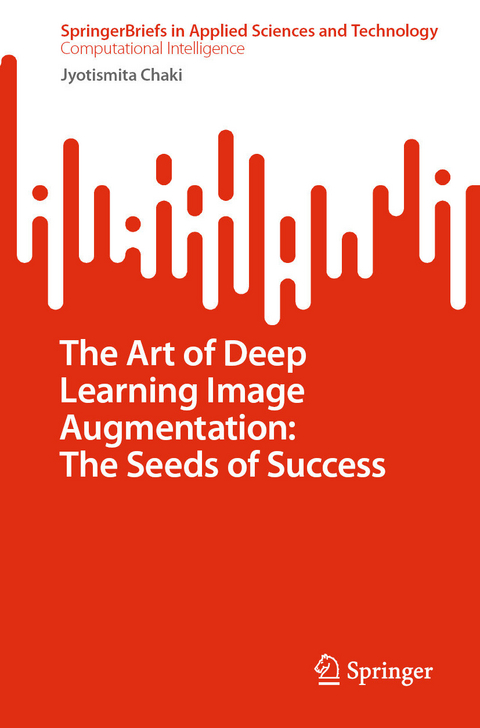
The Art of Deep Learning Image Augmentation: The Seeds of Success (eBook)
142 Seiten
Springer Nature Singapore (Verlag)
978-981-96-5081-1 (ISBN)
This book addresses the critical challenge of limited training data in deep learning for computer vision by exploring and evaluating various image augmentation techniques, with a particular emphasis on deep learning-based methods. Chapter 1 establishes the core problem of data scarcity, outlining its negative impacts on model performance, and introduces traditional image augmentation techniques like geometric transformations, color space manipulations, and other methods such as noise injection. It highlights the limitations of these traditional approaches, including limited variation, lack of control, and inability to introduce new information, before introducing the advantages of deep learning-based augmentation, such as superior control, task adaptability, enhanced realism, and automation. Chapter 2 delves into GAN-based image augmentation, discussing how GANs generate realistic synthetic images for various applications like super-resolution and image-to-image translation, while also addressing the challenges associated with GAN training and potential future directions. Chapter 3 explores autoencoder-based image augmentation, covering techniques like VAEs, DAEs, and AAEs, and highlighting architectural considerations and challenges such as overfitting. Chapter 4 showcases the diverse applications of deep learning-based image augmentation and how it enhances various computer vision tasks by improving generalization, robustness, and accuracy. Chapter 5 discusses strategies for evaluating and optimizing deep learning image augmentation, including traditional metrics, image quality metrics, and hyperparameter tuning techniques. Finally, Chapter 6 explores cutting-edge advancements, covering AutoAugment, interpretable augmentation, attention-based augmentation, counterfactual augmentation, and human-in-the-loop augmentation, emphasizing the role of human expertise in creating high-quality augmented data.
This book addresses the critical challenge of limited training data in deep learning for computer vision by exploring and evaluating various image augmentation techniques, with a particular emphasis on deep learning-based methods. Chapter 1 establishes the core problem of data scarcity, outlining its negative impacts on model performance, and introduces traditional image augmentation techniques like geometric transformations, color space manipulations, and other methods such as noise injection. It highlights the limitations of these traditional approaches, including limited variation, lack of control, and inability to introduce new information, before introducing the advantages of deep learning-based augmentation, such as superior control, task adaptability, enhanced realism, and automation. Chapter 2 delves into GAN-based image augmentation, discussing how GANs generate realistic synthetic images for various applications like super-resolution and image-to-image translation, while also addressing the challenges associated with GAN training and potential future directions. Chapter 3 explores autoencoder-based image augmentation, covering techniques like VAEs, DAEs, and AAEs, and highlighting architectural considerations and challenges such as overfitting. Chapter 4 showcases the diverse applications of deep learning-based image augmentation and how it enhances various computer vision tasks by improving generalization, robustness, and accuracy. Chapter 5 discusses strategies for evaluating and optimizing deep learning image augmentation, including traditional metrics, image quality metrics, and hyperparameter tuning techniques. Finally, Chapter 6 explores cutting-edge advancements, covering AutoAugment, interpretable augmentation, attention-based augmentation, counterfactual augmentation, and human-in-the-loop augmentation, emphasizing the role of human expertise in creating high-quality augmented data.
| Erscheint lt. Verlag | 2.5.2025 |
|---|---|
| Reihe/Serie | SpringerBriefs in Applied Sciences and Technology | SpringerBriefs in Computational Intelligence |
| Zusatzinfo | IX, 142 p. 36 illus., 29 illus. in color. |
| Sprache | englisch |
| Themenwelt | Informatik ► Grafik / Design ► Digitale Bildverarbeitung |
| Informatik ► Theorie / Studium ► Künstliche Intelligenz / Robotik | |
| Technik ► Bauwesen | |
| Technik ► Elektrotechnik / Energietechnik | |
| Schlagworte | Autoaugment • Autoencoders • Deep learning • Generative Adversarial Network • Image Augmentation |
| ISBN-10 | 981-96-5081-X / 981965081X |
| ISBN-13 | 978-981-96-5081-1 / 9789819650811 |
| Informationen gemäß Produktsicherheitsverordnung (GPSR) | |
| Haben Sie eine Frage zum Produkt? |
 PDF (Wasserzeichen)
DRM: Digitales Wasserzeichen
Dieses eBook enthält ein digitales Wasserzeichen und ist damit für Sie personalisiert. Bei einer missbräuchlichen Weitergabe des eBooks an Dritte ist eine Rückverfolgung an die Quelle möglich.
Dateiformat: PDF (Portable Document Format)
Mit einem festen Seitenlayout eignet sich die PDF besonders für Fachbücher mit Spalten, Tabellen und Abbildungen. Eine PDF kann auf fast allen Geräten angezeigt werden, ist aber für kleine Displays (Smartphone, eReader) nur eingeschränkt geeignet.
Systemvoraussetzungen:
PC/Mac: Mit einem PC oder Mac können Sie dieses eBook lesen. Sie benötigen dafür einen PDF-Viewer - z.B. den Adobe Reader oder Adobe Digital Editions.
eReader: Dieses eBook kann mit (fast) allen eBook-Readern gelesen werden. Mit dem amazon-Kindle ist es aber nicht kompatibel.
Smartphone/Tablet: Egal ob Apple oder Android, dieses eBook können Sie lesen. Sie benötigen dafür einen PDF-Viewer - z.B. die kostenlose Adobe Digital Editions-App.
Buying eBooks from abroad
For tax law reasons we can sell eBooks just within Germany and Switzerland. Regrettably we cannot fulfill eBook-orders from other countries.
aus dem Bereich