


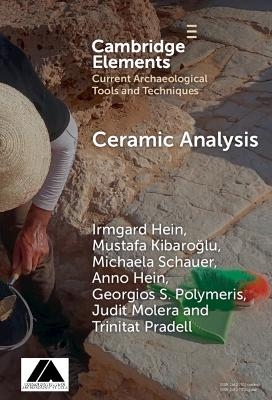
Ceramic Analysis
Laboratory Methods
Seiten
2025
Cambridge University Press (Verlag)
978-1-009-53075-0 (ISBN)
Cambridge University Press (Verlag)
978-1-009-53075-0 (ISBN)
This Element, authored by specialists, overviews analytical techniques for examining archaeological ceramics. Pottery, one of the earliest human materials, varies in production, material, form, decoration and function, presenting challenges for archaeologists. It explores methods for determining composition, manufacturing processes, age and more.
This Element, authored by a team of specialist researchers, provides an overview of the various analytical techniques employed in the laboratory for the examination of archaeological ceramic materials. Pottery represents one of the earliest technical materials used by humans and is arguably the most frequently encountered object in archaeological sites. The original plastic raw material, which is solidified by firing, exhibits a wide range of variations in terms of production methods, material, form, decoration and function. This frequently presents significant challenges for archaeologists. In modern laboratories, a variety of archaeometric measurement methods are available for addressing a wide range of archaeological questions. Examples of these include determining the composition of archaeological materials, elucidating the processes involved in manufacturing and decoration, estimating the age of archaeological material, and much more. The six sections present available methods for analysing pottery, along with an exploration of their potential application.
This Element, authored by a team of specialist researchers, provides an overview of the various analytical techniques employed in the laboratory for the examination of archaeological ceramic materials. Pottery represents one of the earliest technical materials used by humans and is arguably the most frequently encountered object in archaeological sites. The original plastic raw material, which is solidified by firing, exhibits a wide range of variations in terms of production methods, material, form, decoration and function. This frequently presents significant challenges for archaeologists. In modern laboratories, a variety of archaeometric measurement methods are available for addressing a wide range of archaeological questions. Examples of these include determining the composition of archaeological materials, elucidating the processes involved in manufacturing and decoration, estimating the age of archaeological material, and much more. The six sections present available methods for analysing pottery, along with an exploration of their potential application.
1. Introduction Irmgard Hein and Michaela Schauer; 2. Visualization Methods, Microstructural, Mineralogical and Chemical Analysis Mustafa Kibaroğlu and Michaela Schauer; 3. Material Testing of Pottery Anno Hein; 4. Thermoluminescence as a Tool for Age Assessment and Palaeothermometry Studies of Baked Clayey Artefacts Georgios S. Polymeris; 5. Specific Types of Ceramics: Analysis of Glazed Surfaces Judit Molera and Trinitat Pradell; 6. Statistical Approaches to the Evaluation of Analytical Data in Ceramic Studies Anno Hein; References.
| Erscheinungsdatum | 30.09.2025 |
|---|---|
| Reihe/Serie | Elements in Current Archaeological Tools and Techniques |
| Zusatzinfo | Worked examples or Exercises |
| Verlagsort | Cambridge |
| Sprache | englisch |
| Gewicht | 274 g |
| Themenwelt | Geisteswissenschaften ► Archäologie |
| Informatik ► Datenbanken ► Data Warehouse / Data Mining | |
| Naturwissenschaften ► Chemie ► Analytische Chemie | |
| ISBN-10 | 1-009-53075-5 / 1009530755 |
| ISBN-13 | 978-1-009-53075-0 / 9781009530750 |
| Zustand | Neuware |
| Informationen gemäß Produktsicherheitsverordnung (GPSR) | |
| Haben Sie eine Frage zum Produkt? |
Mehr entdecken
aus dem Bereich

aus dem Bereich
Ein verständlicher Einstieg mit Python
Buch | Softcover (2024)
O'Reilly (Verlag)
CHF 41,85
mit neuen IT-Technologien Energieeffizienz erreichen, die Umwelt …
Buch | Hardcover (2025)
Springer Fachmedien Wiesbaden (Verlag)
CHF 55,90


