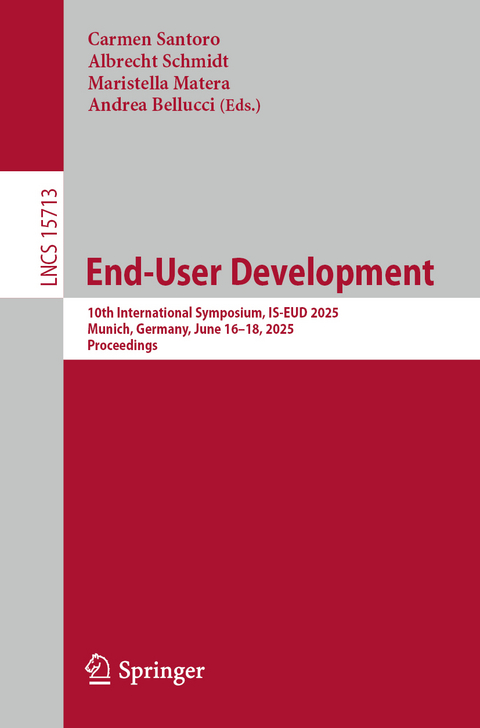
End-User Development
Springer International Publishing (Verlag)
9783031954511 (ISBN)
This book constitutes the refereed proceedings of the 10th International Symposium on End-User Development, IS-EUD 2025, held in Munich, Germany, during June 16 18, 2025.
The 13 full papers and 8 short papers included in this book were carefully reviewed and selected from 25 submissions. These papers have been organized under the following topical sections: Automation, Sustainability, and Smart Environments; Democratizing AI and Programming; AI for End-User Empowerment: Personalization andWellbeing; and EUD Principles, Methodologies, and Participatory Cultures.
.- Automation, Sustainability, and Smart Environments.
.- An EUD Approach to Creating Feasible and Energy-saving Automations for Smart Homes.
.- End-User Customization of Trigger-Action Rules through Fine-Tuned LLMs.
.- Explaining Problems in Daily Automations with ExplainTAP.
.- Conversational Rule Creation in XR: User s Strategies in VR and AR Automation.
.- From User Needs to Smart Ecosystems through LLMs: the Smartifier Case Study.
.- Assembly Workers as PLC Programmers: What End Users Need to Understand about Low-Code Development Platforms.
.- Democratizing AI and Programming.
.- Fostering Novice Collaboration in ML-Based System Design Through Visual Languages and Touch Interfaces.
.- Visual and Textual Language Synchronization for End-User Programming Environments.
.- OMNI: an EUD tool for Ontological Multisensory Navigation Interface.
.- Explanation-Driven Interventions for Artificial Intelligence Model Customization: Empowering End-Users to Tailor Black-Box AI in Rhinocytology.
.- Evaluating Visual Prompting Modalities for Generative AI-Assisted UI Design.
.- AI for End-User Empowerment: Personalization andWellbeing.
.- Beyond Usability: IntroducingWellbeing-Driven End-User Development Design.
.- AI-Assisted Cognitive Support for Caregivers: A RAG and EUD Framework for Geriatric Care.
.- From Digital Self-Control Apps to iOS Shortcuts: Enabling Privacy-Centric Wellbeing Research Without Code.
.- Empowering End Users to Design for Their Digital Self-Control.
.- Leveraging EUD and Generative AI for Ethical Phishing Campaigns.
.- Classifying User Motivation in Interactions.
.- EUD Principles, Methodologies, and Participatory Cultures.
.- Mindsets, Cultures, and Technologies in Support of End-User Development.
.- Assessing Computational Thinking Skills through Artefacts: the Case of ModeLLer.
.- Scenario-Based Design Tools: End-User Reflections to Requirements.
.- Defining Classes and Semantic Relationships from User Scenarios through a Heuristic Approach.
| Erscheinungsdatum | 13.06.2025 |
|---|---|
| Reihe/Serie | Lecture Notes in Computer Science |
| Zusatzinfo | XXI, 346 p. 68 illus., 60 illus. in color. |
| Verlagsort | Cham |
| Sprache | englisch |
| Maße | 155 x 235 mm |
| Themenwelt | Mathematik / Informatik ► Informatik ► Software Entwicklung |
| Schlagworte | Automation • Block-based Languages • Creativity • customization • Digital Literacy • Digital Wellbeing • end-user development • end-user programming • explainability • generative AI • Human-AI interaction • Large Language Models • Low-Code Development • Natural Language Interaction • No-Code Tools • Trigger-Action Programming • visual programming |
| ISBN-13 | 9783031954511 / 9783031954511 |
| Zustand | Neuware |
| Informationen gemäß Produktsicherheitsverordnung (GPSR) | |
| Haben Sie eine Frage zum Produkt? |
aus dem Bereich